
Now Reading: K Studio extends Dexamenes Seaside Hotel above historic wine tanks in Greece
- 01
K Studio extends Dexamenes Seaside Hotel above historic wine tanks in Greece

K Studio extends Dexamenes Seaside Hotel above historic wine tanks in Greece

Dexamenes Seaside Hotel occupies a rare position on the western coast of the Peloponnese, where a group of concrete wine tanks from the early twentieth century has been transformed into a discreet hospitality project by Athens based practice K Studio. Located in Kourouta, Greece, the hotel is rooted in the industrial history of the region and in the economic cycle once shaped by the cultivation, export and later decline of currants.

The site dates back to the period commonly associated with the Greek currant trade. After the collapse of the market in the early twentieth century, surplus currants were redirected toward alternative uses, including wine production. Dexamenes was built directly by the sea so that wine could be stored in large tanks and transferred onto ships bound for international markets. For decades, the concrete structures remained largely untouched, weathered by salt, wind and time.
Rather than concealing this industrial past, K Studio treated it as the project’s architectural foundation. The design preserves the weight and austerity of the existing buildings while introducing a measured language of concrete, steel, timber and glass. New elements are deliberately light in appearance, allowing the old tanks, stone outbuildings and industrial remnants to retain their presence within the hotel.


The main accommodation is housed within two long concrete blocks, each divided into rows of former wine storage tanks. Measuring approximately five by six metres, the tanks were adapted into compact guest rooms with ensuite bathrooms and shaded private patios. Their original proportions inform the internal organisation, creating rooms that are simple, precise and intimate.

Inside each room, K Studio inserted a narrow black steel framework that gathers the bed, storage, bathroom and lighting into a clear spatial system. The raw patina of the concrete walls remains visible, while textured glass allows natural light to pass between the sleeping area and the bathroom. Polished terrazzo introduces a softer material note, echoing the texture of beach pebbles and the exposed aggregates revealed where the old concrete walls were cut to form new openings.

The seafront rooms make direct use of the site’s orientation. Beds are positioned toward large sliding windows that open to views of the Ionian Sea, while canopied patios frame the sunset. A raised timber promenade connects these rooms with the rest of the hotel and the beach, incorporating reclaimed parts of the original irrigation system into its railings.


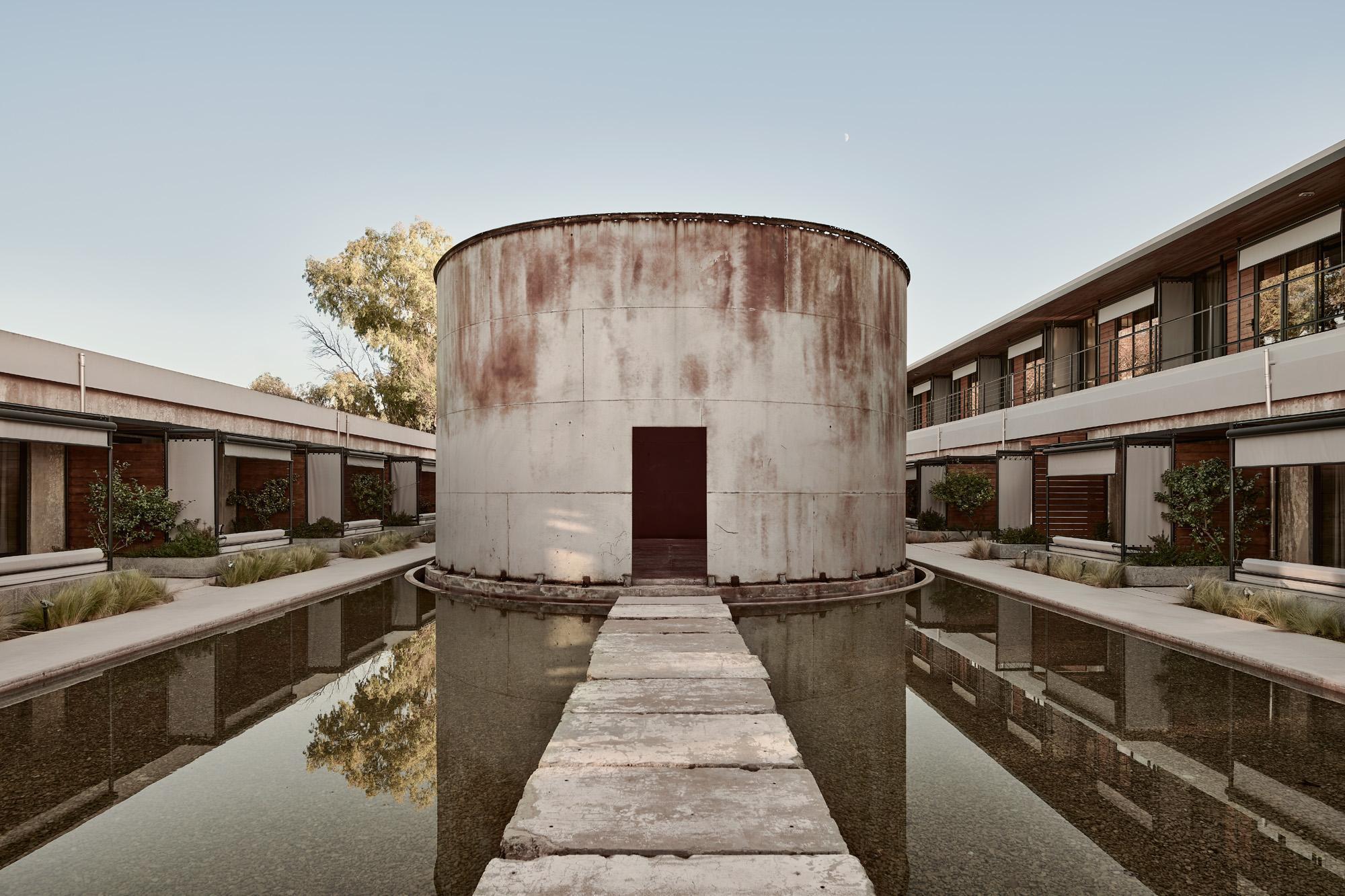
Between the two concrete blocks, a former industrial yard has been reimagined as a quiet courtyard garden. A shallow pool runs through the centre, cooling the space and reflecting light onto the surrounding rooms. Preserved steel drums, now part of the hotel’s visual identity, stand within the water as sculptural reminders of the site’s former function.

Concrete slabs removed from the tanks during construction have been reused as stepping stones. Guests can move across the water and enter the drums, where changing light and sound reveal the spatial character of their concave metal surfaces. Along the edges of the courtyard, local grape and currant varieties are gradually taking root, extending the agricultural memory of the site into the hotel’s present life.

The arrival sequence is equally restrained. From the adjacent road, visitors enter through a discreet pavilion attached to the original concrete volumes. With its open glass partitions and warm plywood canopy, the reception area softens the transition between the exposed coastal landscape and the robust industrial shell. The experience moves from shade to light, from road to courtyard, and from ruin to occupation.

Two original stone outbuildings have been converted into spaces for dining, events and cultural programming. Reclaimed bricks found within the structures were reused across the floors and terraces, while the pitched roofs were rebuilt with locally made ceramic tiles designed to blend with the original fabric.


The taverna includes an open kitchen and communal table, supporting wine tastings, cooking workshops and meals prepared with local ingredients. Opposite it, a larger cultural building hosts exhibitions, performances, lectures and workshops. In this way, Dexamenes operates not only as a seaside hotel but also as a platform for artistic and culinary exchange, linking hospitality to the wider cultural life of the region.

The most recent phase of the project introduces eight new rooms above the original concrete tanks. The idea emerged during the early stages of construction, when the roof of the tanks offered an unexpected experience of openness. From this elevated position, the horizon appeared uninterrupted, with sea and sky meeting in a clear line beyond the industrial mass below.
K Studio translated this sensation into a lightweight rooftop structure. Slender metal tubes and warm timber planks form a delicate framework that hovers above the heavy concrete base. The new level follows the geometry of the existing building without overpowering it, while a thin canopy gives the impression of floating above the tanks.

A narrow water channel frames the view toward the horizon, visually linking the sea with the architecture. Sunlight reflected from the water animates the timber pergola, giving the new rooms a nautical, raft like quality. Each room opens toward the sea from a generous veranda, while access from the rear courtyard connects the elevated level back to the daily life of the hotel below.

The rooftop addition does not attempt to complete Dexamenes in a definitive way. Instead, it extends the project’s central idea: that reuse can remain open, gradual and alive. The hotel has continued to evolve through modest interventions, cultural programmes, culinary events and now a new layer of accommodation that gives guests a different perspective on the silos, vines, courtyard and sea.
At Dexamenes, architecture is not treated as a clean break from the past. It is a process of careful occupation, where industrial remains are not polished into nostalgia but allowed to keep their roughness, scale and silence. The result is a hotel shaped by memory, climate and material restraint, where each new gesture adds to the life of the site without erasing what came before.

K Studio is an Athens based design practice founded by brothers Dimitris and Konstantinos Karampatakis. Working across hospitality, residential and public projects, the studio develops architecture grounded in context, atmosphere and long term use. Its work often explores how contemporary design can emerge from local culture, existing structures and the specific character of place.
Project credit
Project name: Dexamenes Seaside Hotel
Project extension: Dexamenes Seaside Hotel Extension
Location: Kourouta, Greece
Architecture: K Studio / @k_studio_gr
Photo: BREBA, Claus Brechenmacher and Reiner Baumann
Area: 2,760 m²
Original project year: 2018
Extension year: 2026