Now Reading: The Matrix of Living: Ken Isaacs and Beach Matrix
- 01
The Matrix of Living: Ken Isaacs and Beach Matrix

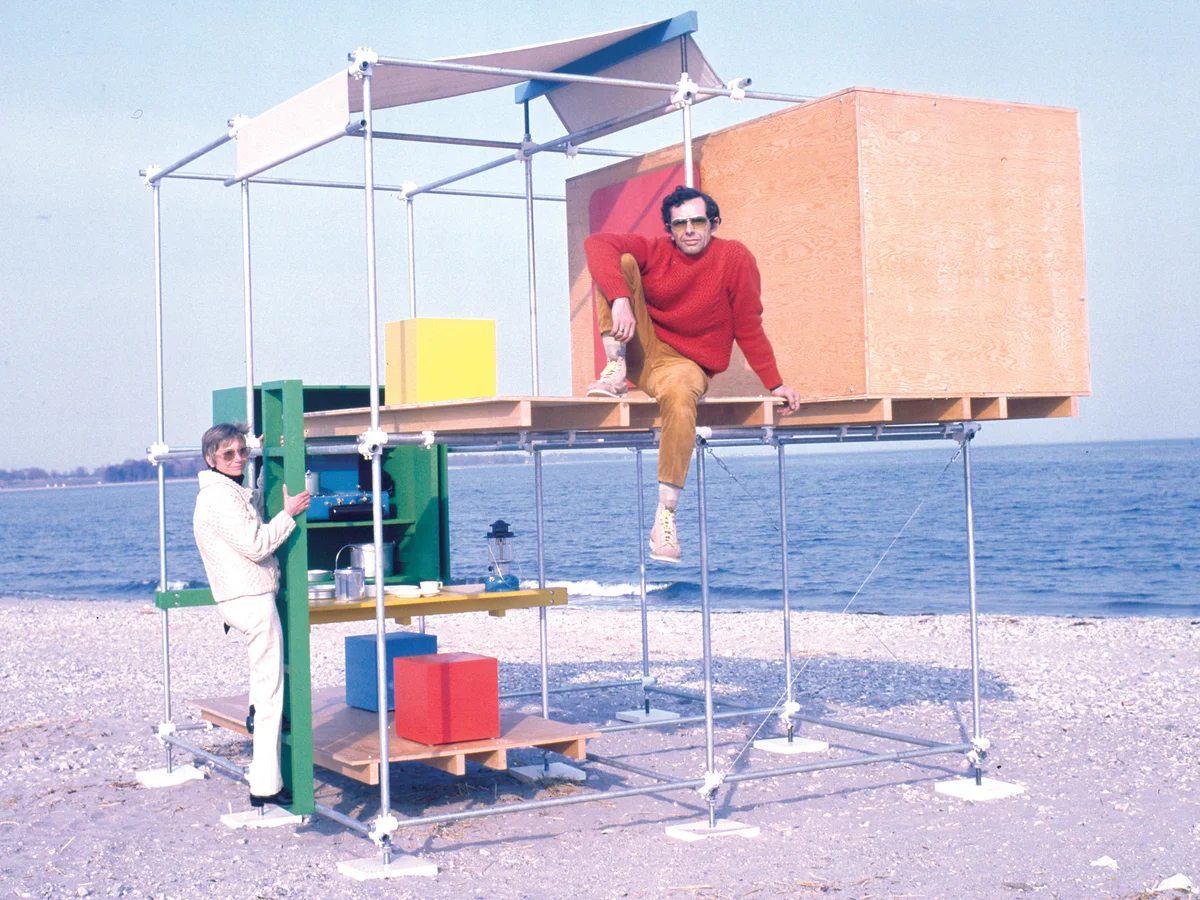

In 1967, on a beach in Westport, Connecticut, Ken Isaacs built a small structure that seemed to hover between furniture, shelter and experiment. Beach Matrix was not a house in the conventional sense. Nor was it simply a piece of furniture enlarged to architectural scale. Made from a light tubular frame, platforms, panels and a canopy, it offered a compact environment for sitting, reading, sleeping and looking out to sea. Its presence was temporary, almost provisional, but its ambition was larger than its size suggested.
The image of Beach Matrix remains striking because it refuses the familiar idea of domestic enclosure. Instead of a sealed room set against nature, Isaacs proposed an open framework placed within it. The structure lifted daily life above the sand without trying to possess the landscape. It made room for the body while keeping air, light and horizon in view. In this modest beach construction, many of Isaacs’s lifelong concerns came together: economy of means, spatial efficiency, self-build culture, ecological awareness and a belief that design should change how people live rather than merely provide them with new objects to own.
Ken Isaacs was born in Peoria, Illinois, in 1927. His childhood coincided with the Great Depression and the beginning of the Second World War. His father held several jobs, including a period as a tenant farmer, and Isaacs later connected that experience to a broader lesson in self-reliance, observation and living close to the land. Before entering the field of design, he worked in contexts shaped by machinery, fabrication and practical making. These early experiences mattered. His work would never belong entirely to the world of polished industrial design or architectural spectacle. It came from the workshop, the farm, the apartment and the improvised structure.
A decisive intellectual encounter took place near the end of the Second World War, when Isaacs was serving in the United States Navy. Behind a Nissen hut, he found a copy of Ruth Benedict’s Patterns of Culture. The book’s argument that values and norms are culturally produced rather than universal became a revelation for him. If ways of living are made by culture, they can also be remade. This insight gave Isaacs a critical distance from the American domestic ideal that would dominate the postwar decades: the suburban house, the accumulation of furniture, the status of ownership and the promise that comfort could be purchased through consumption.
His first Living Structure designs began to take shape while he was studying at Bradley University. In 1949, newly married and living in a small apartment with his wife Jo, Isaacs built a gridded cubic frame that combined platforms, storage, a suspended table and sleeping areas. The structure was not a theoretical exercise. The couple lived with it, altered it and adapted it to their needs. This is important to understanding Isaacs. His designs were rarely conceived as finished icons. They were working systems, open to use, adjustment and revision.

In 1952, Isaacs received a Saint Dunstan’s Fellowship to attend Cranbrook Academy of Art in Bloomfield Hills, Michigan. There, under the guidance of architect and industrial designer Ted Luderowski, he developed what became the Matrix Research Project. The Matrix was both a physical system and a way of thinking. Based on a three-dimensional grid, it allowed furniture, storage, lighting, sleeping, working and circulation to be organized as parts of a single environment. Rather than solve design problems one object at a time, Isaacs tried to address the whole condition of living.
His 1954 Cranbrook Living Structure, an improved version of the earlier apartment experiment, attracted considerable attention. It was a cubic, multi-level environment made from simple components, designed to be assembled quickly with basic tools. The press treated it as a curiosity, but its importance lay elsewhere. Isaacs was not merely proposing a new kind of furniture. He was challenging the separation between furniture and architecture, between product and environment, between professional designer and user.
For Isaacs, the Matrix was never a style. It was a method for reducing dependency on conventional domestic systems. A room full of separate objects produced clutter, maintenance and passive consumption. A Living Structure, by contrast, integrated activities into one adaptable framework. It compressed space without making life smaller. It invited the user to take part in the making of the environment. This was why Isaacs called some of his work a “culture-breaker”. The term was not decorative rhetoric. It described an attempt to interrupt the rituals of middle-class domestic life in postwar America.
The Superchair, conceived in the 1950s and formalized for production in 1967, brought this idea to the scale of the body. Within a compact cubic frame, Isaacs placed seating, storage, an adjustable book stand, a movable table surface, lighting, a place for a small television and a seat that could unfold into a bed. It was chair, room and equipment at once. The point was not novelty, although the object looked unmistakably new. The point was use. Everything necessary for reading, resting, eating or watching could be brought within reach, reducing the room’s dependence on scattered furniture.
Beach Matrix extended this logic outdoors. It took the integrated living unit and exposed it to weather, sand and horizon. Its platforms and framed volumes suggested a place for temporary inhabitation rather than permanent settlement. The structure did not imitate a beach house. It stripped the idea of shelter down to a scaffold of essential acts: climbing, sitting, lying down, looking, cooking, storing, reading. In doing so, it turned architecture into a light negotiation with site.
Isaacs’s Microhouses developed the same argument at a larger scale. In 1962, with support from a Graham Foundation fellowship, he built three Microhouses on land in Groveland, Illinois. These were matrix-based pods assembled from prefabricated parts, conceived as compact dwellings that could be built, dismantled and adapted. They were not tiny versions of suburban houses. They were critiques of the house as a status object. By eliminating conventional furniture and integrating living equipment into the structure itself, Isaacs believed that a small shelter could become precise, efficient and ecologically more responsible.

His work was not limited to dwelling. At the Institute of Design at the Illinois Institute of Technology, Isaacs developed the project later known as the Knowledge Box. Built in 1962, it was a 12-foot cube of wood, Masonite and steel, equipped with 24 slide projectors and sound. The participant entered an immersive field of projected images, data and audio. The experience was deliberately non-linear. Isaacs wanted learning to happen through comparison, juxtaposition and active synthesis, rather than through the passive reception of a lecture. In this sense, the Knowledge Box was also a Matrix: not a house for the body, but an environment for perception.
Image 7: Knowledge Box
(Archival reconstruction photos from exhibitions are recommended here — high-res versions available in Walker Art Center documentation.)
In 1974, Isaacs published How to Build Your Own Living Structures. The book was part manual, part diary, part manifesto. It included drawings, material lists and instructions, but its deeper purpose was to transfer agency from designer to user. Isaacs was less interested in mass-producing objects than in distributing methods. He believed that making something could change the person who made it. This belief placed him close to the open-design and countercultural currents of the 1960s and 1970s, but his work was never simply utopian. It was too practical for that. Its radicalism came from its plainness.

For decades, Isaacs remained somewhat outside the central narrative of modern design. His work was too domestic to be treated as heroic architecture, too architectural to be absorbed into furniture history, and too anti-consumerist to become a commercial design movement. Yet this marginal position is also what makes his work compelling today. Recent exhibitions and Susan Snodgrass’s study Inside the Matrix: The Radical Designs of Ken Isaacs have helped restore the precision and relevance of his practice.
Isaacs’s questions now feel less eccentric than necessary. How much space does a person need to live well? How many objects are required before comfort becomes burden? Can a home be understood as an adaptable system rather than a container for possessions? Can design return agency to the user rather than deepen dependence on the market?

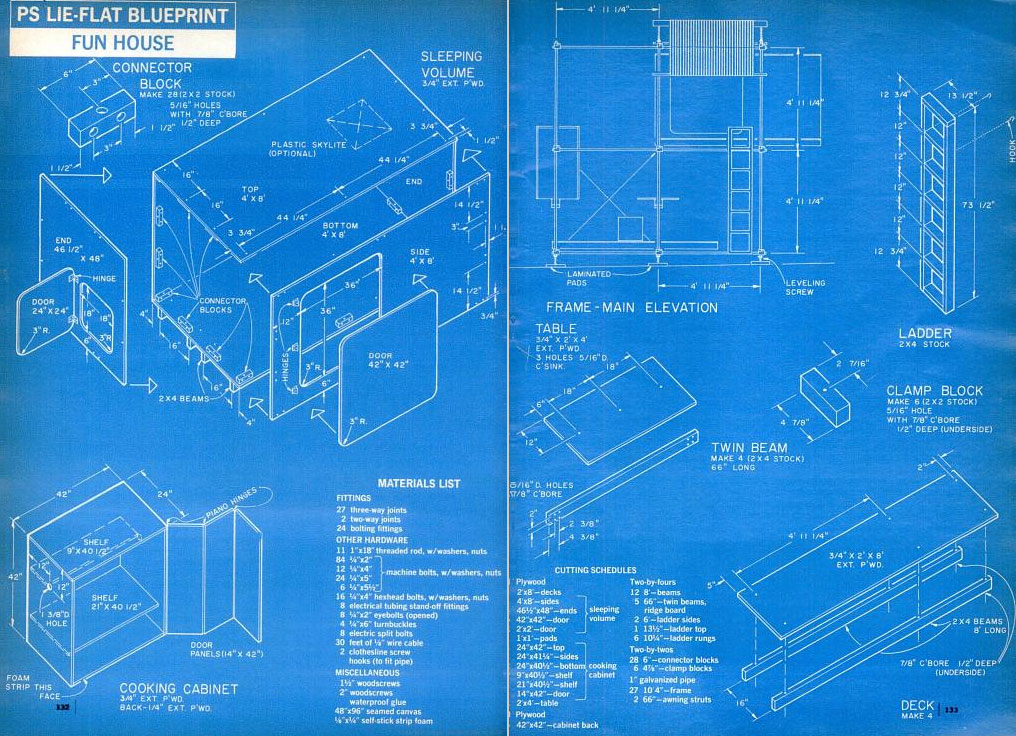
Beach Matrix answers these questions not with theory, but with an image: a light frame on a beach, open to air and weather, holding just enough structure for life to take place. It has no monumentality. It does not promise luxury. Its power lies in its refusal of excess. Isaacs did not leave behind a style to imitate. He left behind a method for thinking about space, materials, use and freedom. The Matrix was not only a grid. It was an ethic of living with less, making more carefully and allowing design to become a means of self-determination.
Photo Cover
Ken Isaacs with Beach Matrix, Westport, Connecticut, 1967. The light tubular structure elevated above the sand integrates living functions while opening to the sea and sky. Credit: Archival color photograph, courtesy of the Estate of Ken Isaacs / historical architecture documentation.