Now Reading: Manon Benoit gives form to what remains
- 01
Manon Benoit gives form to what remains

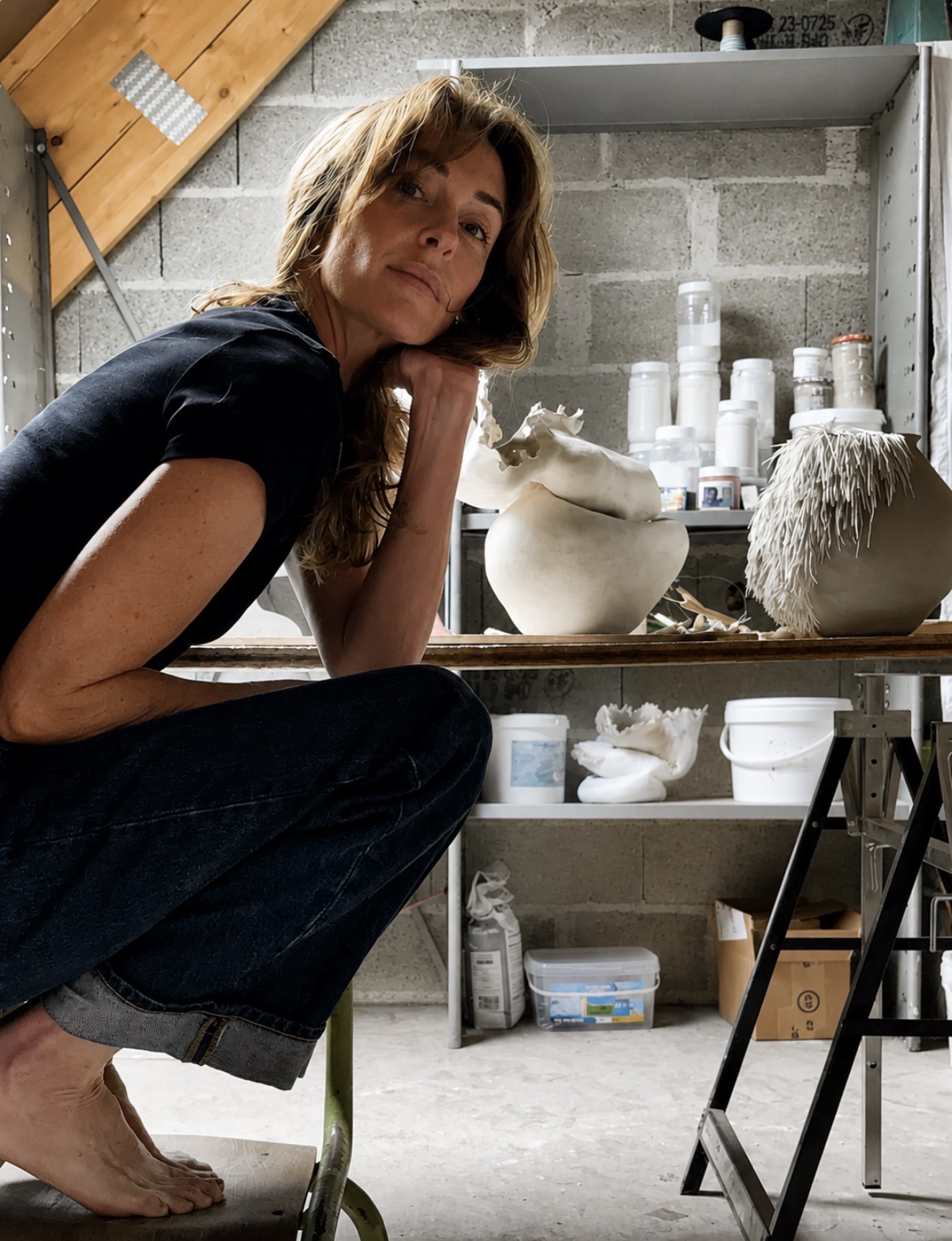

In the work of Manon Benoit, clay is never a passive material. Working under the name louve., the French ceramic artist develops a practice in stoneware that moves between sculpture and use, between the body and the object, between what is held by matter and what remains of a gesture. Her pieces are shaped by touch, tension and memory. They suggest skins, fragments, traces and presences rather than fixed images, allowing the viewer to encounter ceramic not only as form, but as something inhabited by time.
Her collection PØLAIRE extends this language into the fragile imaginary of northern landscapes. Through fissured surfaces, downy textures and organic volumes, Manon does not seek to represent polar territories literally. Instead, she gives shape to a state of vulnerability and persistence, where ice, skin, animal presence and geological memory seem to coexist. In this conversation, she reflects on ceramics as a language of transformation and care, on the quiet resilience of threatened ecosystems, and on the way matter can preserve what the world is slowly losing.

Your artist statement evokes the notions of memory, trace and transformation through the phrases “Matter retains. The gesture remains.” and “Sculpting what remains.” How do these ideas nourish your work?
These two phrases quite accurately sum up my relationship with ceramics.
I have always been fascinated by clay’s ability to preserve a trace. When working with earth, nothing is completely erased. The pressure of a finger, an imprint, a crack, even a hesitation can remain inscribed in the material. Even after firing, something remains. When I sculpt, I am not necessarily trying to achieve a perfect form. Rather, I try to reveal a presence. I work slowly, by hand, accepting the irregularities, marks and accidents that appear throughout the creative process. Very often, they are what give the piece its truth and its power. My pieces, my sculptures, often take the form of fragments. They may evoke a skin, a fissure, an organic presence or even a landscape in transformation. I like them to sit between several possible readings, without truly belonging completely to one or the other.
At heart, I seek to give form to what subsists: a trace, a memory, an emotion. Something that continues to exist despite time, wounds and transformations.

What drew you to polar landscapes, and how did this fascination give rise to the PØLAIRE collection?
I did not discover polar territories through travel, although I sincerely hope to do so one day. I would really like to go there, and also take my children, so that they can know a landscape that is in the process of disappearing. But I discovered these territories more through contemplation, reading, documentaries and a long-standing fascination with the landscapes of the North.
For a long time, I have felt much more drawn to cold light, grey seas, silences and vast expanses than to tropical landscapes. There is in these territories an almost motionless beauty, at once powerful and vulnerable, that touches me deeply.
My connection with the marine world is also very old. My mother once told me that when she was pregnant with me, she would place headphones on her belly and play me the soundtrack of The Big Blue. I do not know what memories that may have transmitted, or whether it truly played a part, but I have always felt a particular closeness to the sea, its depths, its silences and its mysteries.

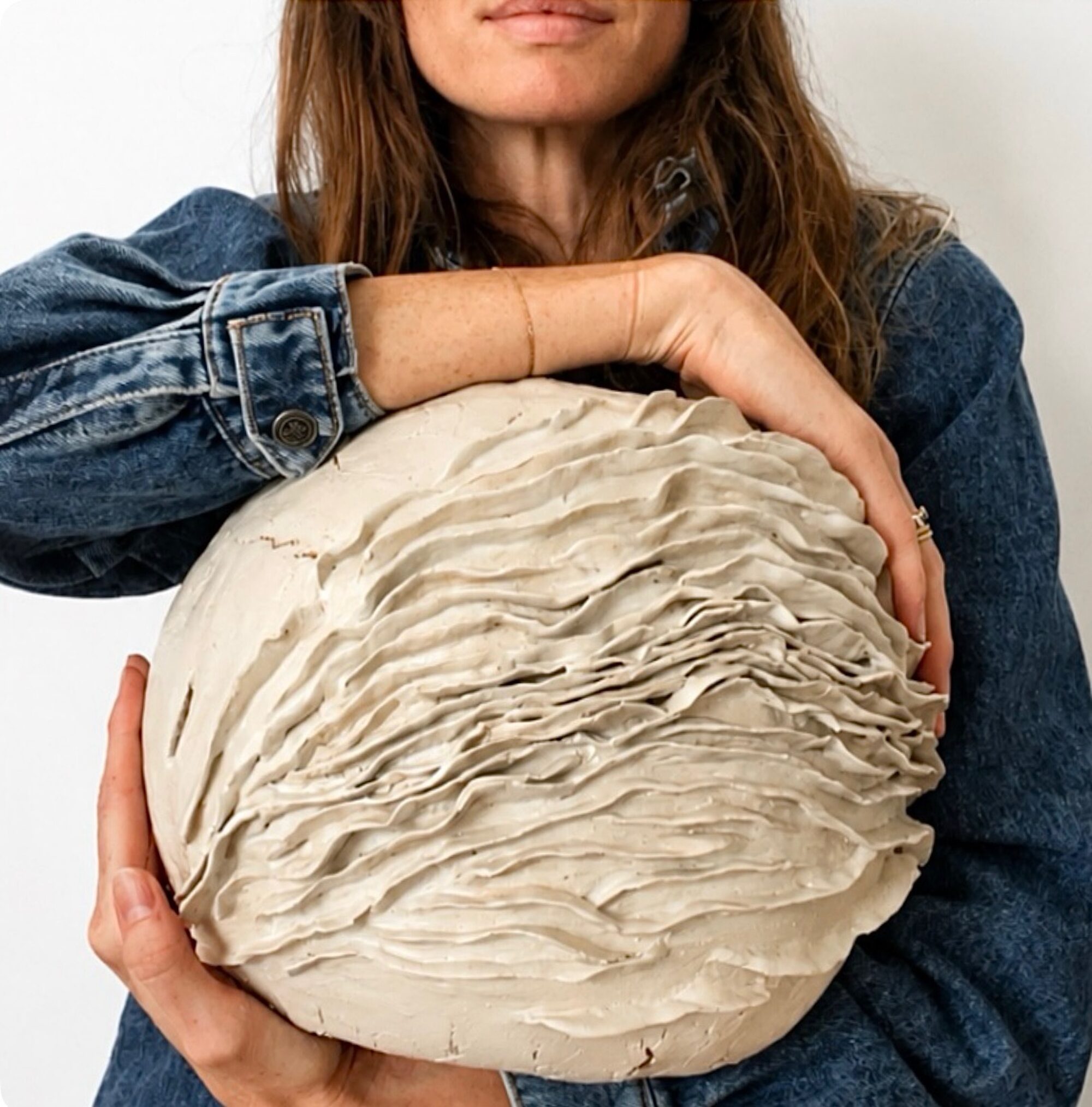
PØLAIRE was born from all of this: from an imaginary world of the North, of silence, skin, ice, fur and fragments. I do not seek to represent an animal, a glacier or an identifiable landscape. What interests me more is the sensation that the piece may provoke. Through textures, fissures, downy surfaces and organic forms, I try to evoke a presence. A memory. A fragile, immense and precious world.
In PØLAIRE, the human body seems to enter into dialogue with the landscape. What does this encounter between the biological and the geological reveal?
I do not really see a boundary between the body and the landscape. For me, we are part of the same living world, and ultimately we carry the same stories of transformation, fragility and adaptation. When I work on a piece, certain forms naturally evoke skin, a scar, fur or even a fold of the body. Others recall eroded rock, a fissure or a fragment of ice. I do not try to choose between these references. On the contrary, I want the gaze to hesitate, and I like it when the gaze hesitates.
Polar landscapes led me to reflect on this proximity. They seem immense, almost inviolable, while being profoundly vulnerable. I find something similar in human bodies. We appear solid, and yet we are constantly traversed by time, by change, by wounds and by memories. My sculptures then become sensitive territories where the biological and the geological meet. A fissure may be that of a fractured land as much as that of an intimate memory. A soft surface may evoke both protection and vulnerability.
Through PØLAIRE, I try to remind us that we are not external to nature. Body and territory respond to one another. They become mirrors of each other.


Ceramics, and more specifically stoneware, is a material that naturally records the memory of gesture and time. How does this idea translate into your practice?
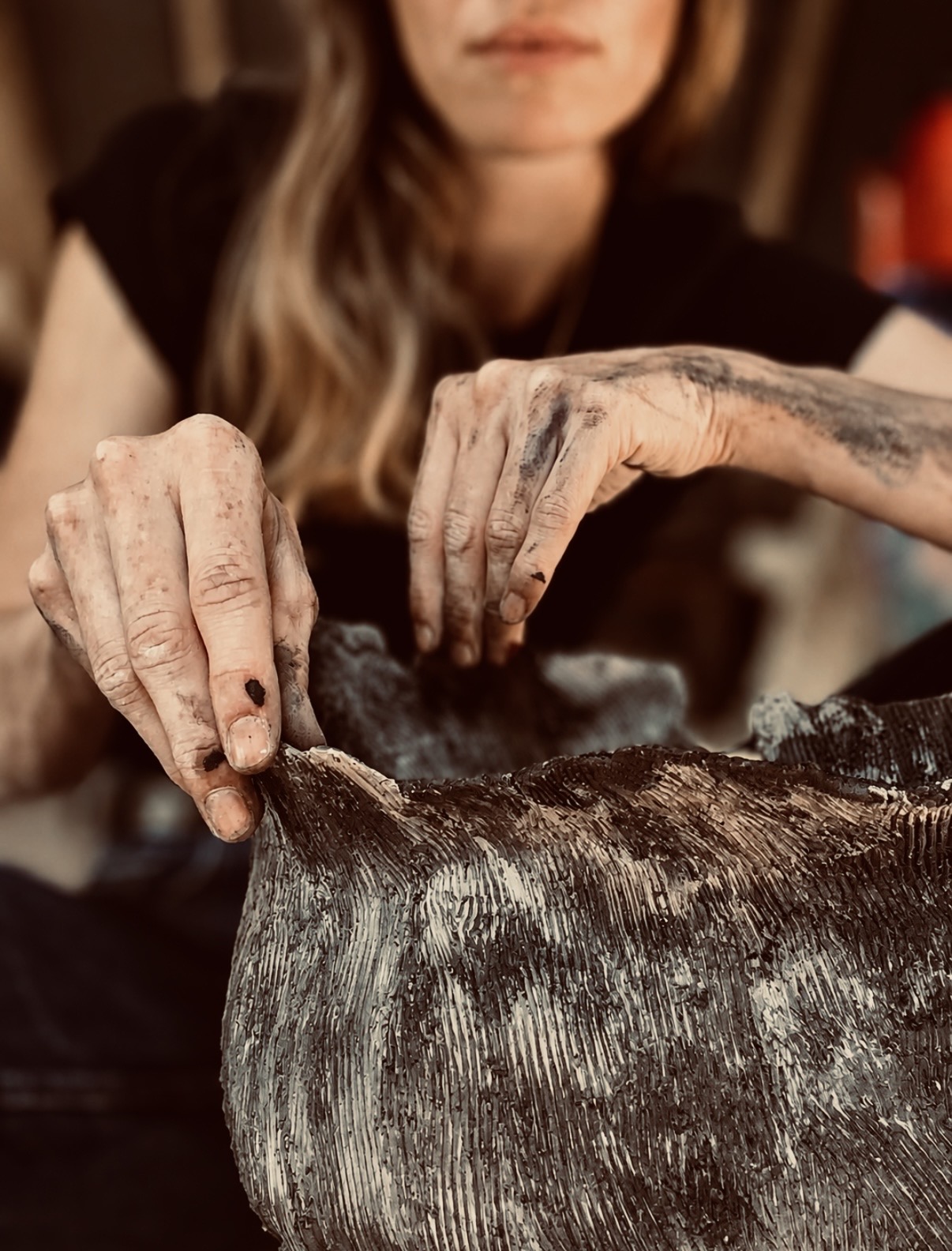
In my practice, this memory is translated very concretely through modelling. I work mainly by hand because I need direct contact with the earth. My hands are my first tools. They build the form, but they also allow tensions, pressures, shrinkage and reworking to appear.
Stoneware interests me particularly for its density. It is a material that can seem raw, almost mineral, yet it retains a great sensitivity of surface. It allows me to create textures, fissures, strata and skins, where each mark contributes to the story of the piece.
I do not try to completely erase the stages of making. On the contrary, I like it when one can feel that the material has been moved, added, constrained, sometimes repaired. The textures I use are not merely decorative. They carry a memory. Firing then plays an essential role. It transforms earth into stone, but it also reveals what happened before: internal tensions, shrinkage, accidents and areas of fragility. It freezes a state while leaving visible the stages that preceded it.
This paradox touches me deeply. The earth becomes solid, almost permanent, yet it continues to tell its story.
Your works often explore tensions: softness and collapse, intimacy and isolation, permanence and disappearance. How do these dualities manifest in your work, and what challenges or satisfactions do they present when you work with the unpredictable nature of clay and firing?
These tensions are very present in the way I look at the world, and they naturally find their way into my work. I am drawn to what appears solid yet remains fragile, to what seems soft while carrying a form of resistance. In my sculptures, a downy surface can sit alongside a deep fissure. A protective form can also suggest vulnerability. Sometimes, a piece may evoke both a refuge and a disappearance.
Polar landscapes have strengthened this reflection. They convey an impression of power and permanence, while also being fragile territories, traversed by profound transformations. I find in them something very human: the coexistence of strength and vulnerability. This duality also manifests in my relationship with clay. Ceramics is a constant dialogue between control and letting go. I can guide a form and build an intention, but the material always retains a degree of autonomy. It shrinks, deforms, resists and sometimes reveals unexpected effects during drying or firing.
For a long time, this unpredictability unsettled me. Today, I consider it an essential part of the process. Accidents often tell something I could not have anticipated. They bring truth to the piece.
This is perhaps one of the great lessons ceramics teaches me: to accept that not everything can be controlled. As in nature, as in our lives, transformation is part of the process, and that is what I like.
As a ceramic artist, you consider your art not only as a technique, but also as a language of transformation and care. Which aspects of traditional ceramic practices do you privilege or divert in PØLAIRE?
I am deeply attached to certain aspects of traditional ceramics: slow time, handwork, attention to the material, and the humility imposed by the process. Earth obliges us to slow down. It asks us to observe, to wait, sometimes to begin again. I have restarted many pieces, and I like this relationship with time, so far removed from immediacy. It is an integral part of my work.
I also feel close to the Japanese philosophy of wabi-sabi, which recognises the beauty of imperfection, alteration and the passage of time. A fissure, an asymmetry or a mark of making are not, for me, flaws to be hidden, but elements that can give depth to a work. In PØLAIRE, I take up this attention to gesture, material and time. But I deliberately move away from the idea of an object that is perfectly controlled, decorative or fixed. The pieces sometimes seem to be in transformation, as if they were continuing to evolve.
The eroded surfaces, organic textures and fragmentary forms evoke presences more than stabilised objects. They are kinds of fragments, skins, territories and memories. Ceramics then becomes more than a technique. It becomes a language. A supple earth passes through fire and becomes stone. It retains the memory of what it was while becoming something else.
This metamorphosis touches me deeply because it echoes our own condition. We are all shaped by time, by experiences and by the transformations we go through.

The works in PØLAIRE appear as silent monuments dedicated to fragile ecosystems, rather than as direct calls to action. How do you reconcile aesthetic poetry and emotional atmosphere with the responsibility of raising public awareness about climate change?
I do not consider myself an activist artist in the traditional sense. My work does not seek to convince through figures or through a frontal discourse. What interests me more is art’s capacity to create emotion, attention and attachment.
I am deeply convinced that we more easily protect what we love. Before wanting to act, we often need to feel. Poetry, contemplation and wonder can sometimes connect us more intimately to a subject than a direct message. That is why the works in PØLAIRE do not show catastrophe. They do not illustrate the melting of ice or the disappearance of species. Rather, they seek to evoke a presence, a memory, even a sensation. I like to leave room for interpretation and for the personal experience of the person looking at my pieces.


The territories of the North move me deeply. Their beauty, their silence and their fragility have long nourished my imagination. As a mother, I also feel a great concern when I think about the world we will pass on to future generations. This concern exists in my work, but it is expressed through sensitivity rather than injunction. I believe that the artist’s responsibility is not necessarily to provide answers. It may also consist in creating a space for reflection, emotion and connection with the living world.
For me, sensitivity is not the opposite of commitment. It is often its starting point.
Your sculptures evoke the notion of “what subsists” after erosion and transformation. In the context of threatened polar ecosystems, how does your work reflect a personal love for these environments? What role do hope or quiet resilience play in the face of themes of disappearance?
PØLAIRE was born above all from attachment. I do not work on polar territories because they are disappearing. I work on them because they move me profoundly.
I am deeply drawn to their particular light, their silence, their almost untouched expanses and the forms of life that have found their place there. I see in them a sober beauty, at once powerful and fragile. When I evoke the disappearance or transformation of these ecosystems, it is not only through concern. It is also a way of paying homage to what still exists. My sculptures are gestures of attachment, attempts to preserve a trace of what moves me.
The notion of “what subsists” is at the heart of my work. It does not speak only of loss. It also speaks of what remains despite changes: a memory, a presence, a capacity to adapt. I do not believe in a naïve hope that would ignore the upheavals we are going through. On the other hand, I do believe in a form of quiet resilience in the living world. Even in the most weakened landscapes, something continues to exist, to transform, to resist differently.
My sculptures seek to make this silent persistence visible. They speak as much of vulnerability as of resistance, because I do not see these two notions as opposites. For me, they coexist.

Beyond PØLAIRE, how has your practice evolved in the face of broader environmental concerns? Do you consider ceramics a particularly powerful medium for expressing human responsibility towards the planet?
These concerns mainly influence my way of looking and producing.
I work slowly, in unique pieces or in very small series, with particular attention paid to the material and to the time each work requires. I do not seek to produce a lot. Rather, I try to create pieces that carry a presence, that last, and that resist the idea of rapid consumption.
Ceramics is a paradoxical medium. It comes from earth, water and fire, but it also requires energy, firings and resources. This obliges me to remain conscious of my gestures, my choices, of what I make and why I make it. I think ceramics possesses a particular strength when addressing our relationship with the living world because it brings us back face to face with the elements. It reminds us that every transformation takes time, that every gesture leaves a trace, and that nothing is entirely separate.
In a world where everything is accelerating, this medium imposes waiting, attention and patience. It brings us back to a form of humility. I do not believe that art can solve environmental crises. However, I believe it can transform the way we look. It can perhaps make us more attentive, more sensitive and more conscious of what connects us to the world.
For me, the artist’s responsibility may lie there: in creating forms capable of awakening attachment. Because we naturally take greater care of what we love.


If viewers were to retain one key idea or feeling after observing your sculptures, what would that idea be regarding craftsmanship, nature and our shared future?
I would like them to leave with a feeling of attachment.
An attachment to matter, to the living world and to everything that connects us.
We live in a world that often values speed, efficiency and performance. Ceramics teaches me the opposite. It requires time, attention, patience and a form of humility. The material imposes its own rhythm and reminds us that certain things cannot be accelerated. I would also like the people who look at my pieces not to feel disconnected from nature, and to realise that we all participate in the same story. Landscapes, animals, bodies and materials are part of that story. We share the same fragilities, the same transformations and, sometimes, the same scars.
My works do not seek to provide answers. Rather, they offer a pause. A moment to observe, to feel and perhaps to reconnect with a form of wonder. If one idea were to remain after the encounter with my work, it might be this: what is fragile is not necessarily weak. Very often, it is precisely what most deserves our attention and care.
At heart, I would like my sculptures to remind us that taking care of the living world is not only a responsibility. It is also a way of inhabiting the world with more attention, respect and poetry.


Article Credit
Text by Rafael Cunha
Time: 06.2026
Photo: Courtesy of the artist.