Now Reading: Wadhal subverts London suburban housing with Wade House
- 01
Wadhal subverts London suburban housing with Wade House



Set on a former garage site in Ruislip, West London, Wade House is a compact two-bedroom home designed by emerging practice Wadhal. Occupying just 70 square metres, the project replaces a pair of dilapidated garages and demonstrates how contemporary architecture can emerge within the strict planning constraints of London’s suburbs.


The local council required any new building on the site to closely replicate the form and appearance of the neighbouring 1930s semi-detached house. Rather than resisting these restrictions, Wadhal embraced them, matching the adjacent home’s massing while reinterpreting its material language through refined detailing, crafted surfaces and a distinctly contemporary character.
Commissioned by a client who inherited the site from their late father, a local builder whose name inspired the project, the house combines practical efficiency with a series of carefully considered architectural gestures. Red brickwork arranged in a repeating four-point pattern, white rendered upper walls, alternating clay roof tiles and a bespoke stained-glass entrance create an identity that feels familiar yet unmistakably new.


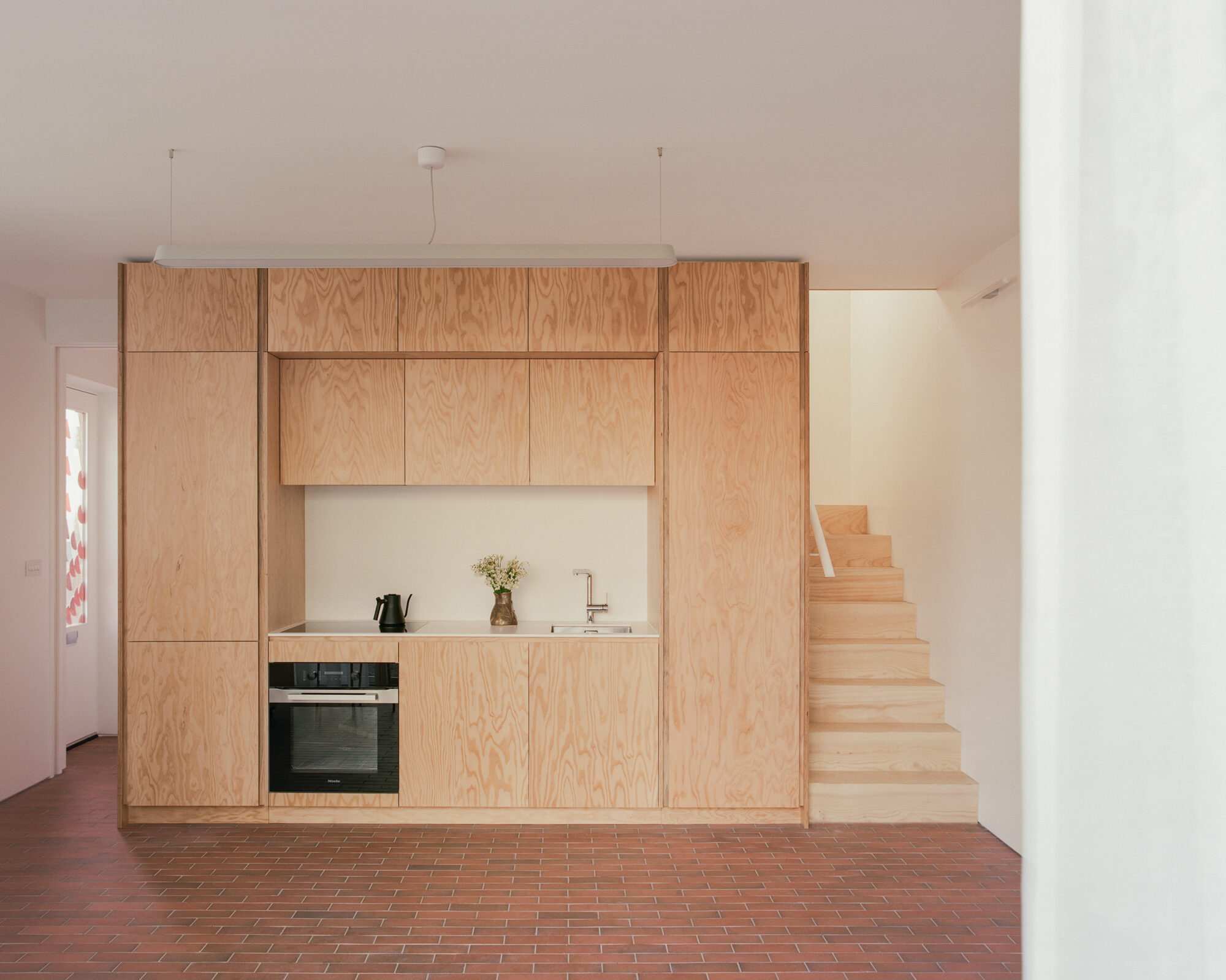
Inside, the architects transformed the compact footprint through a highly efficient spatial arrangement that eliminates conventional corridors. A bespoke staircase wraps around the kitchen joinery, allowing circulation to flow naturally through the house while preserving valuable floor area. The result is a sequence of spaces that feels considerably larger than its modest dimensions suggest.

The first floor takes advantage of the full roof volume. Rather than concealing the timber structure behind ceilings, Wadhal exposed the Douglas fir framework to create vaulted bedrooms reaching almost four metres in height. This approach increases spatial generosity throughout the house while bringing warmth and texture to the interior.
Custom interventions appear throughout the project, from a movable kitchen island that doubles as a breakfast bar to integrated storage solutions tucked into overlooked corners. A reading nook beneath a rooflight transforms an awkward landing space into a place for retreat, while concealed storage and recessed details help maintain visual clarity.


Pattern and repetition provide a unifying thread across the architecture. The recurring motif of four appears in the brickwork, roof tiles and entrance gate, while a semicircular form reappears throughout the project, shaping planting beds, terraces, hardware details and the bespoke stained-glass panel created by artist Jack Brindley. Inside, vivid reflections from the coloured glass animate the otherwise restrained palette.


Material consistency further reinforces the home’s identity. Douglas fir is used across the structure, staircase and joinery, while durable red quarry tiles extend across the ground floor and onto the outdoor patios. In the bathroom, the same tiles continue alongside exposed timber beams, creating a simple yet distinctive atmosphere.
Environmental performance is achieved primarily through passive design strategies rather than visible technology. High levels of insulation, cross ventilation through rooflights and large openings, a north-facing glazed frontage, and an air-source heat pump work together to minimise operational energy demand while maintaining year-round comfort.


A century after the suburban expansion that shaped much of outer London, Wade House offers an alternative vision for contemporary housing. Within a planning framework rooted in nostalgia, Wadhal has produced a home that is spatially efficient, materially expressive and quietly optimistic about the future of suburban living.
Project Credit
Project Name: Wade House
Location: Ruislip, West London, UK
Completion Year: December 2025
Design Firm: Wadhal / @studiowadhal
Photography: Lorenzo Zandri / @lorenzozandri