Now Reading: Kawagebo Snow Mountain Hotel Yunnan by Moguang Studio shapes a quiet mountain retreat
- 01
Kawagebo Snow Mountain Hotel Yunnan by Moguang Studio shapes a quiet mountain retreat

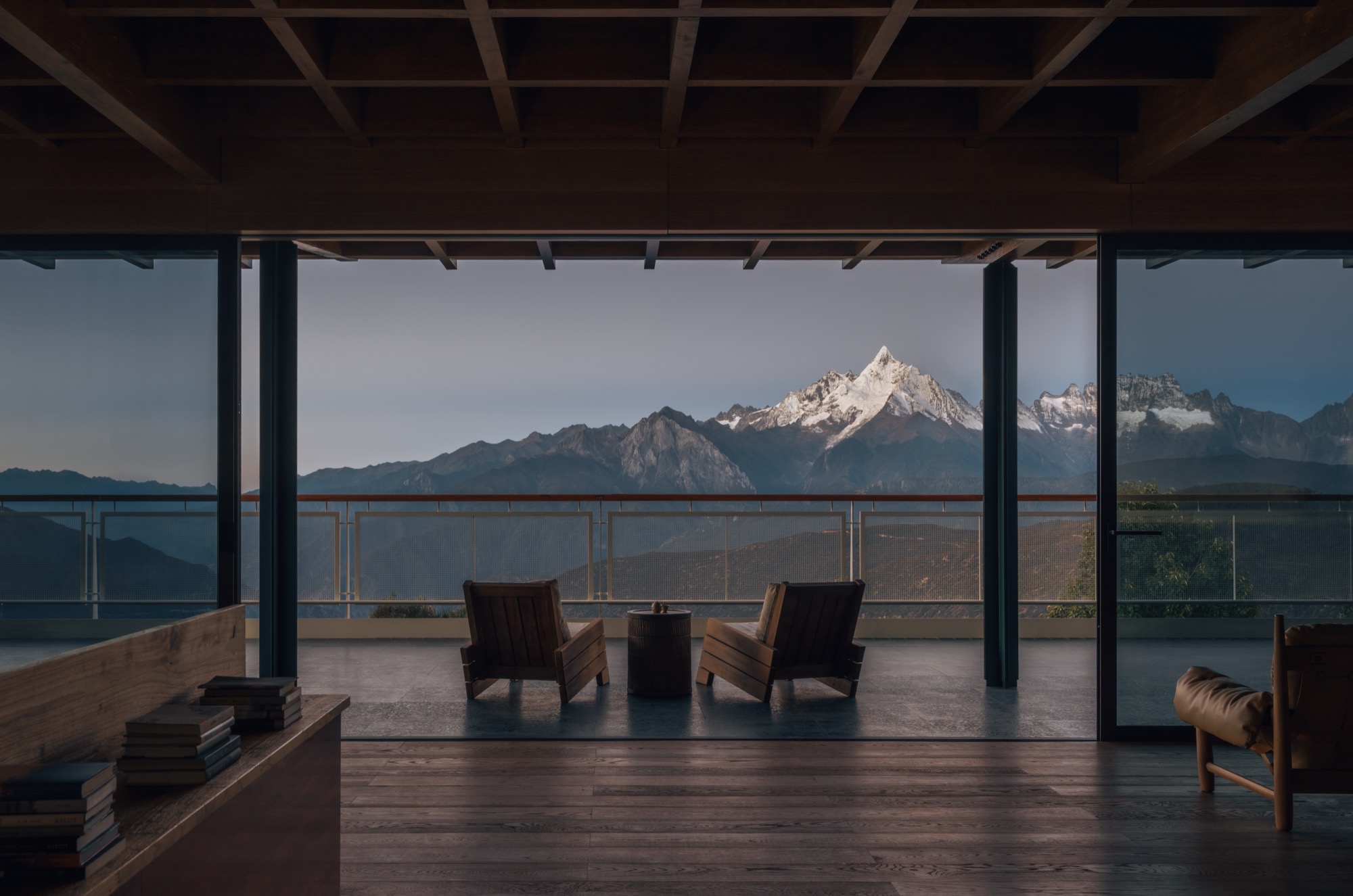
Kawagebo Snow Mountain Hotel Yunnan by Moguang Studio shapes a quiet mountain retreat

Set within the charged landscape of Kawagebo Snow Mountain in Yunnan’s Diqing Tibetan Autonomous Prefecture, this hotel project emerges not as an escape from its surroundings but as a measured response to them.
The site, positioned near the Thirteen Pagodas viewing platform and shaped by the pressures of mass tourism, offers neither isolation nor an untouched horizon. Instead, it presents a dense and often chaotic foreground of roads, temporary structures, and competing viewpoints. Against this condition, the project resists spectacle. It proposes a quieter alternative, a place where both body and mind can momentarily withdraw.


The building occupies a compact footprint, lifted slightly above ground to reclaim distance from its immediate context. This elevation allows the primary spaces to reorient toward the mountain while reducing visual and acoustic interference from the surroundings. A restrained volume clad in textured white sandstone anchors the project, its mass carefully composed to register both weight and calm. Subtle shifts in the roofline and recessed terraces sharpen its silhouette without resorting to formal excess.


Rather than borrowing imagery from Tibetan architecture, the design draws from prolonged observation of spatial practices and material logic. In local dwellings and temples, architecture unfolds through movement, light, and layered construction. Circulation is never merely functional but experiential, shaped by sequences of turning, pausing, and gradual revelation. Light enters indirectly, filtered through structure and surface, producing a continuous gradient rather than a uniform field.

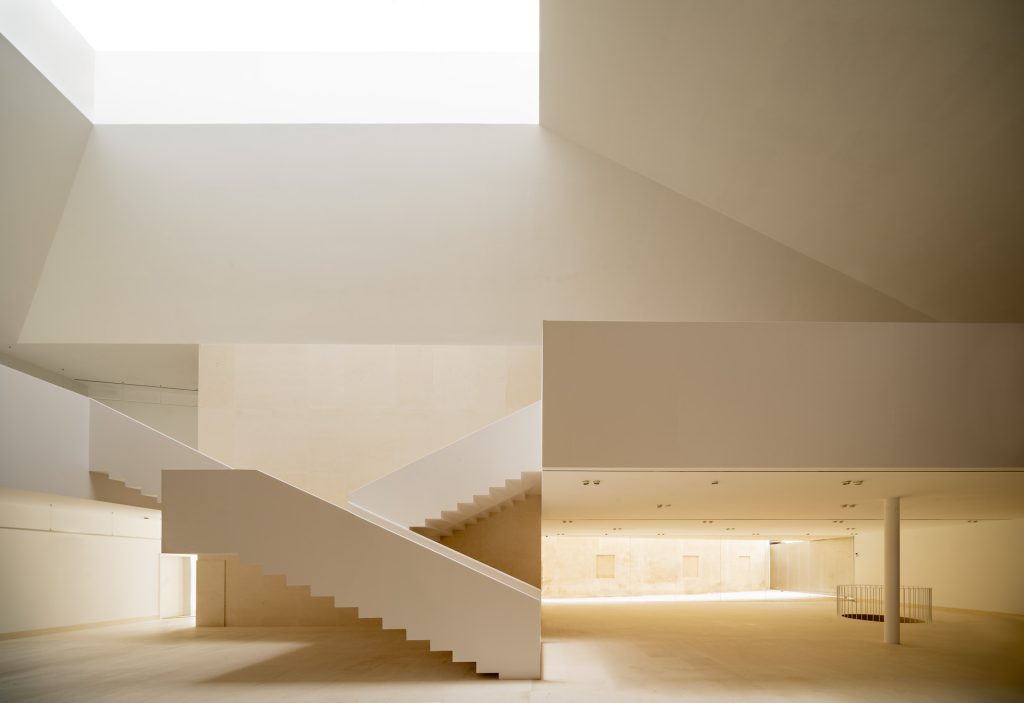
At the heart of the building, a vertical atrium organizes both environment and movement. Acting as a thermal buffer, it captures solar warmth during the day and releases it gradually as temperatures drop. Its height is moderated by layered galleries that connect different levels, transforming circulation into a slow, unfolding sequence.


Daylight enters from above and is repeatedly modulated by beams, balustrades, and surfaces, producing shifting patterns that animate the interior. The material palette reinforces this effect. Pale stone, wood wool panels, and timber elements create a nuanced field of layered whiteness, where texture and light continuously interact. The result is neither minimal nor decorative but quietly immersive, shaped by time and perception.


At the top of the building, a space opens toward the mountain landscape. Supported by a hybrid steel and timber structure, the room frames distant views while remaining meaningful in their absence. Weather conditions often obscure the peaks, and the design acknowledges this uncertainty. The space is conceived not as a viewing platform alone but as a place of stillness, where light, material, and proportion sustain presence even when the landscape recedes.


A recessed terrace extends this experience outward, marking a threshold between interior calm and the vastness beyond. Movement toward this edge becomes gradual and deliberate, reinforcing a sense of distance that is both physical and mental.


The project reinterprets spatial archetypes found in Tibetan houses through a contemporary lens. At the entrance, a darkened vestibule leads to a reflective installation that evokes water as both threshold and mirror. Within the lobby, a freestanding copper fireplace becomes a focal point of gathering, recalling the centrality of the hearth in domestic life.

These elements are not literal translations but spatial cues, guiding movement from exterior noise toward interior quiet. Together with the vertical axis of the atrium, they form a sequence that moves from the everyday toward a more contemplative state.


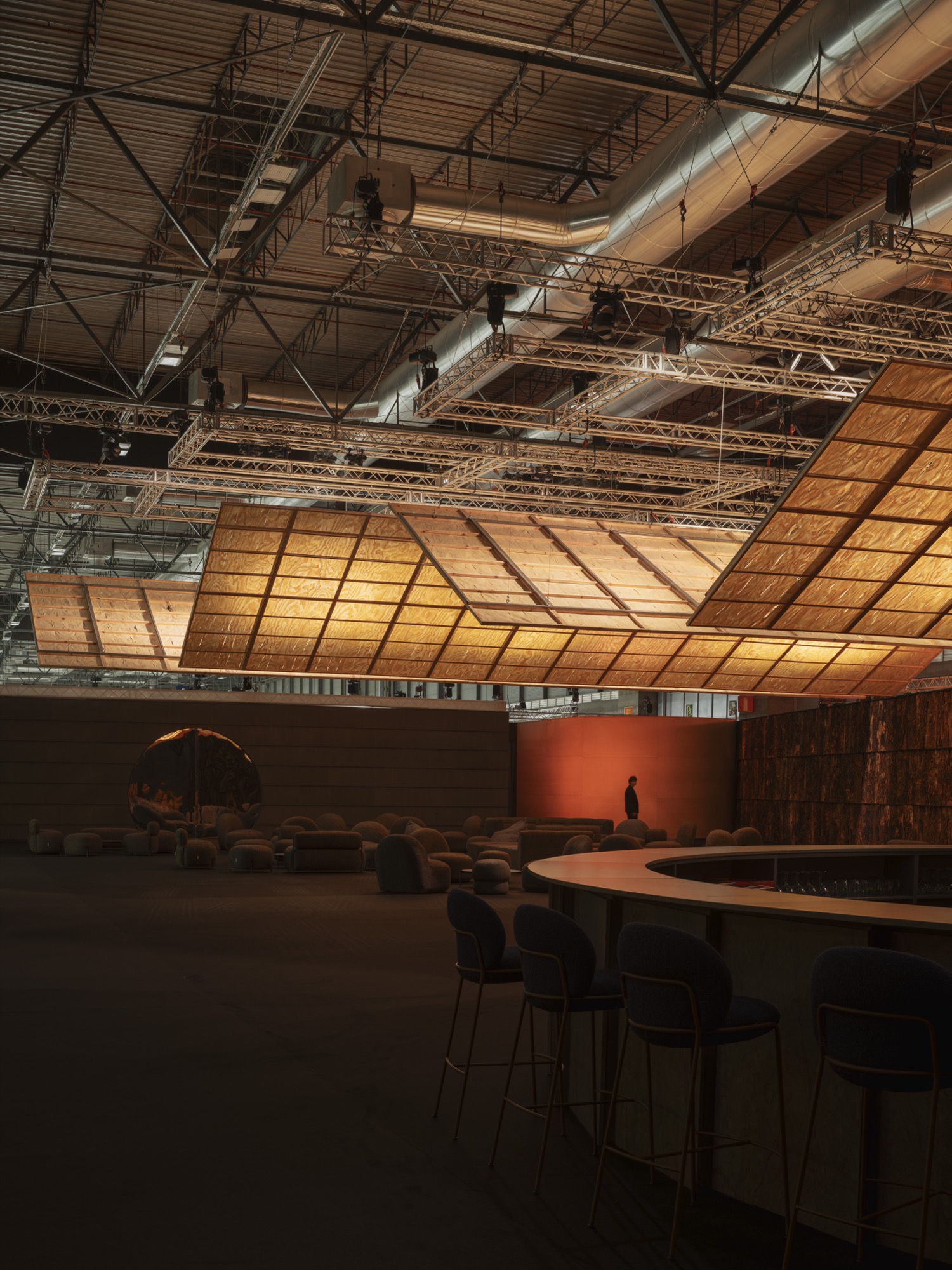
The restaurant extends this approach through a composition of brick volumes, platforms, and shifting levels. Structure and furniture merge into a continuous field, where walls, seating, and partitions emerge from the same material logic. Light enters indirectly, softened by surfaces and reflected across textures, creating a slow and tactile atmosphere.


Handcrafted textiles and materials sourced from Tibetan regions introduce another layer of continuity. Their irregularities are preserved rather than corrected, allowing traces of making to remain visible. These details, often subtle, accumulate into a sensory experience that extends beyond the visual.


Guest rooms are conceived less as standardized units and more as domestic interiors. Spaces unfold through a sequence of zones rather than fixed divisions, encouraging movement, rest, and variation. Openings are carefully proportioned to frame light and views while maintaining a sense of enclosure.


Material choices reinforce this intimacy. Timber, textiles, and muted tones create a calm and grounded environment, while small details such as seating edges, shelves, and fabrics contribute to a lived-in atmosphere. Light shifts throughout the day, altering the perception of each room and reinforcing a connection to the surrounding landscape.


Rather than constructing a singular narrative, the project assembles fragments of observation and experience. It does not attempt to replicate tradition or idealize context but engages with both through restraint. Within a setting defined by noise and exposure, it offers a controlled interior world, one that absorbs, filters, and reinterprets its surroundings.

The hotel becomes less an object and more a condition. A place to pause, to recalibrate, and to encounter the mountain not as spectacle but as distance.
Project Credit
Project name: Kawagebo Snow Mountain Hotel
Location: Kawagebo Snow Mountain National Park, Deqin, Yunnan, China
Area: 2,500 sqm
Design: Moguang Studio
Film Photography: Haiting Sun
Digital Photography: Yumeng Zhu
Video team: Director / Cinematography: Ashu Wander
Design period: November 2022 – September 2023
Completion: July 2025
More Photos