
Now Reading: Arc ZERO by James Tapscott forms luminous water dialogue in Houston
- 01
Arc ZERO by James Tapscott forms luminous water dialogue in Houston

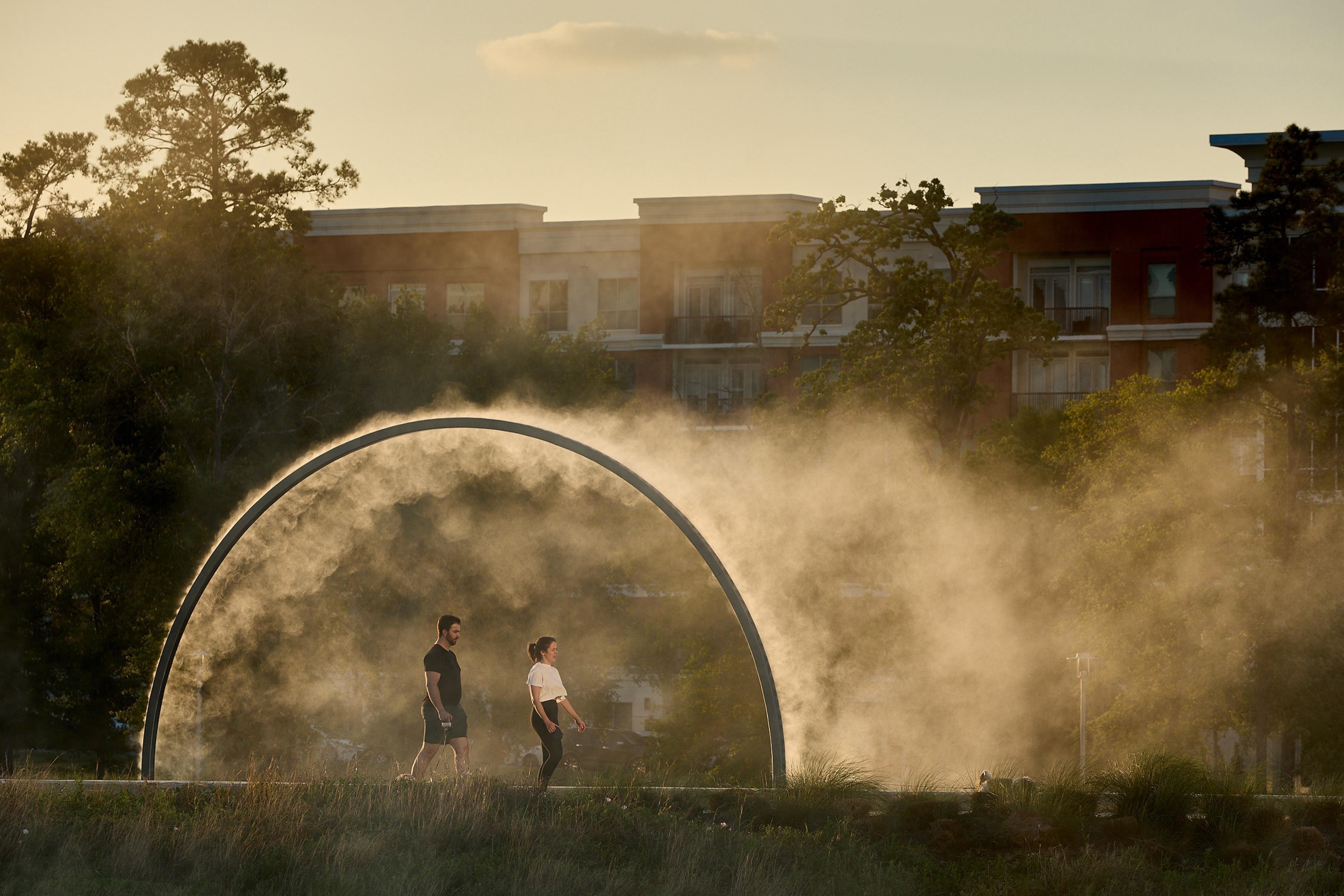

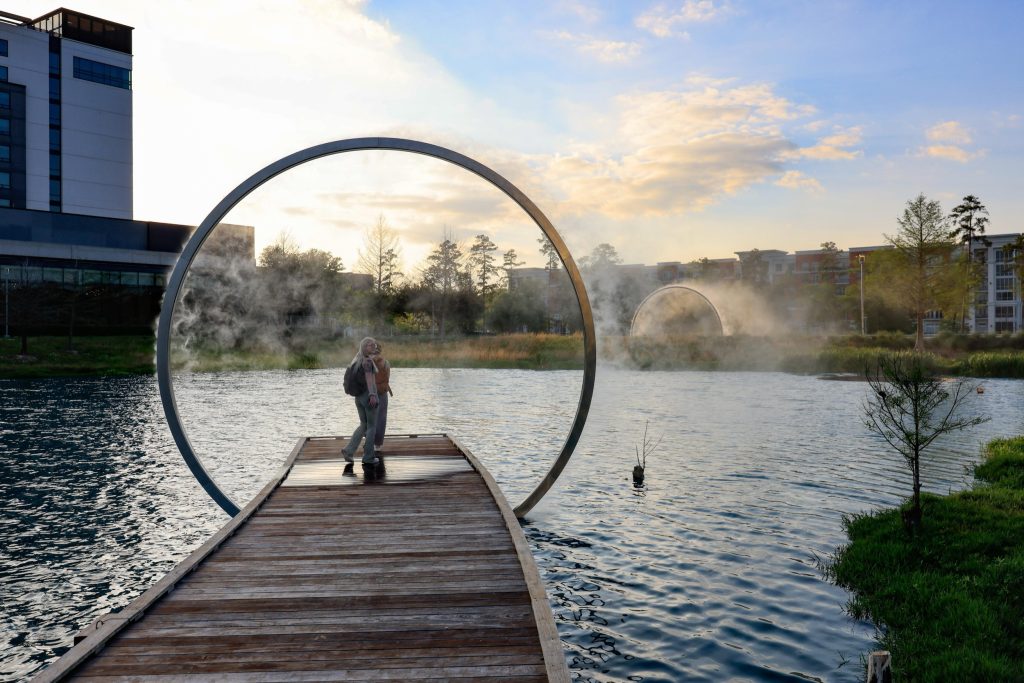
At City Place in The Woodlands, Houston, Australian artist James Tapscott presents Arc ZERO: Nimbus and Arc ZERO: Eclipse as a paired installation that unfolds across water, atmosphere, and movement. Installed together for the first time, the two works transform a landscaped water treatment park into a perceptual field where reflection, mist, and light continuously reconfigure the experience of place.
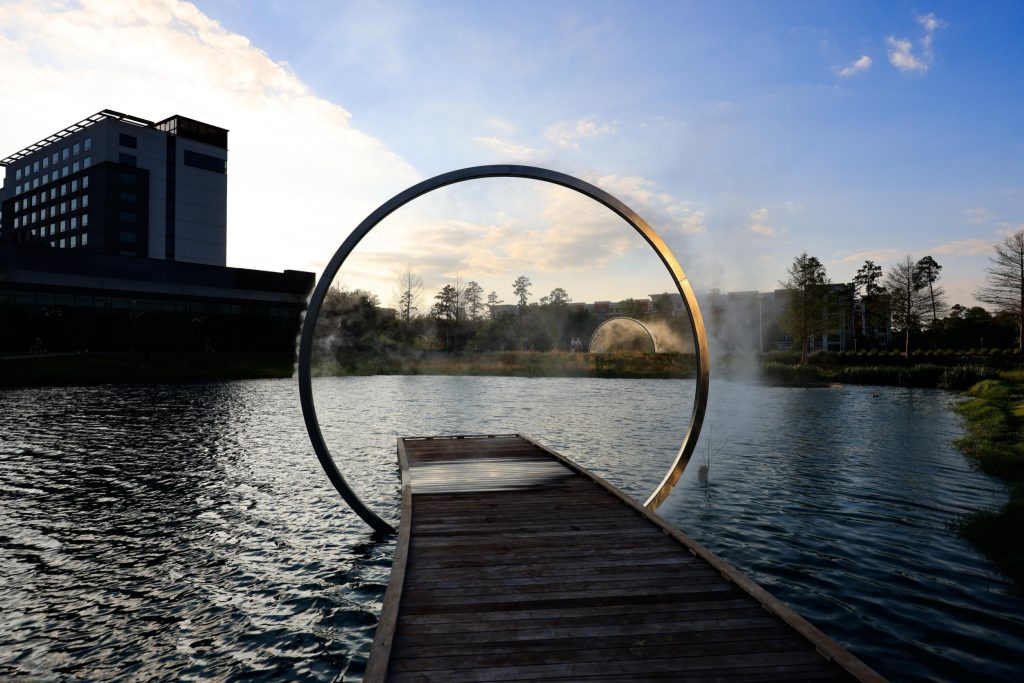
Commissioned and managed by Weingarten Art Group, the installation occupies two separate bodies of water within City Place, a public landscape structured around systems of water circulation and treatment. Here, infrastructure becomes both context and medium. The project does not impose form onto the site; it emerges through the conditions already present, extending the logic of water as flow, surface, and atmosphere. The two works operate as distinct yet interdependent spatial devices, articulating water in different states that shift between stillness and dispersion, image and immersion.
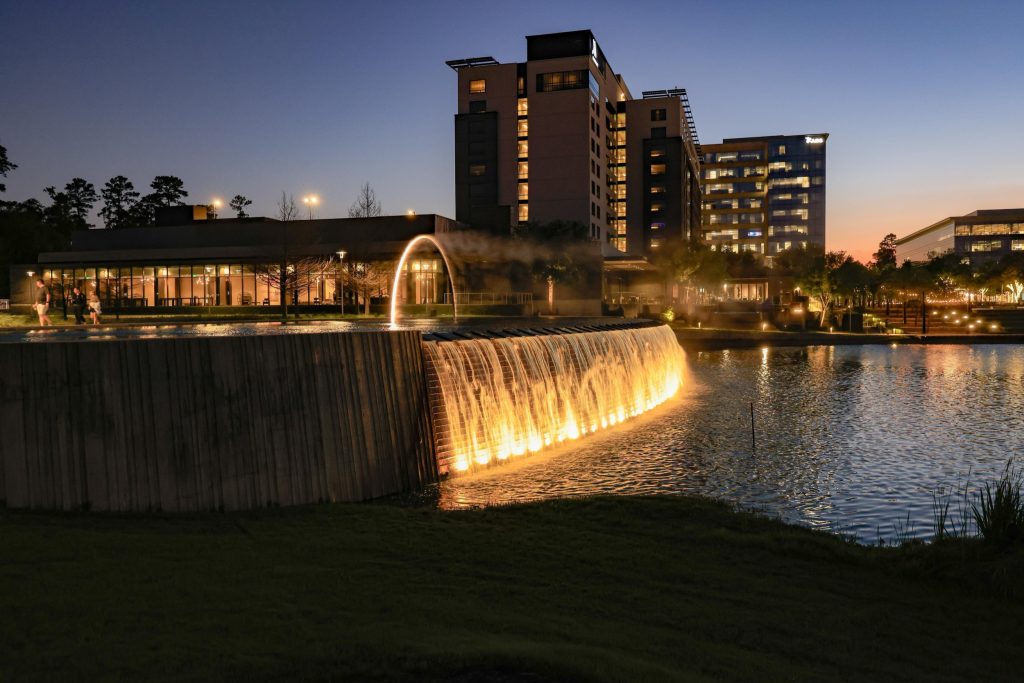
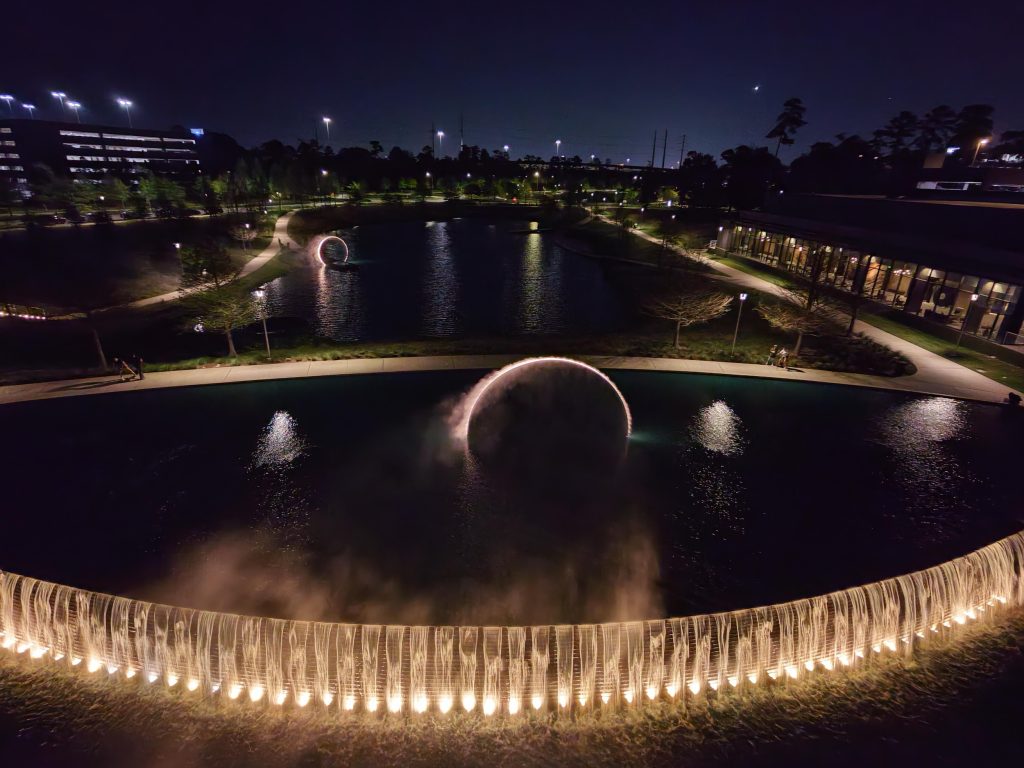
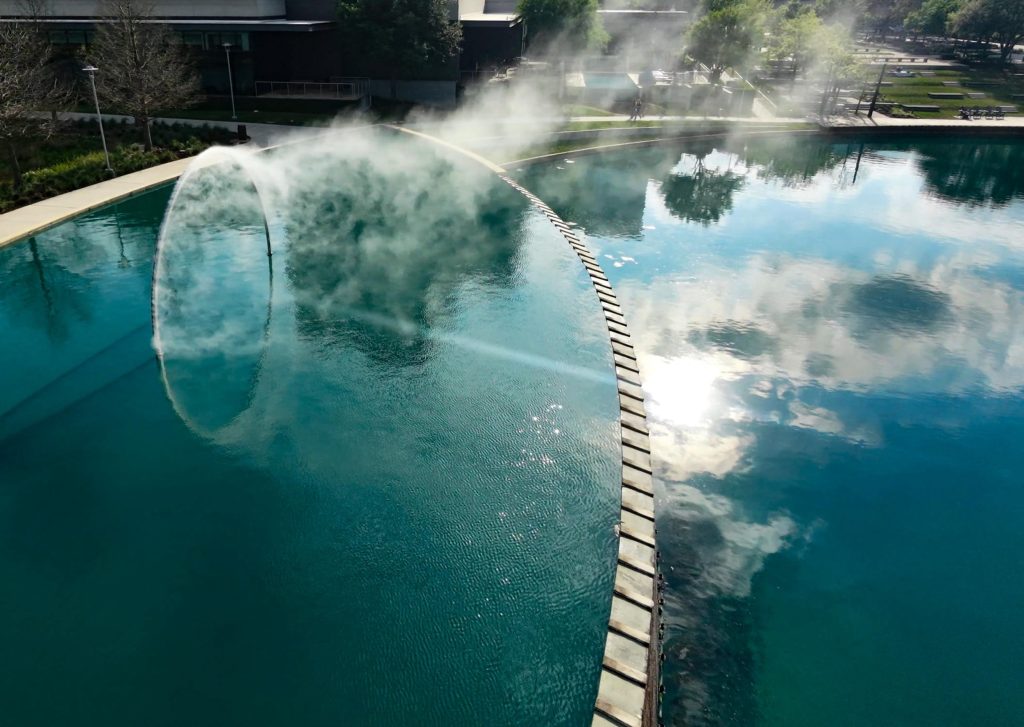
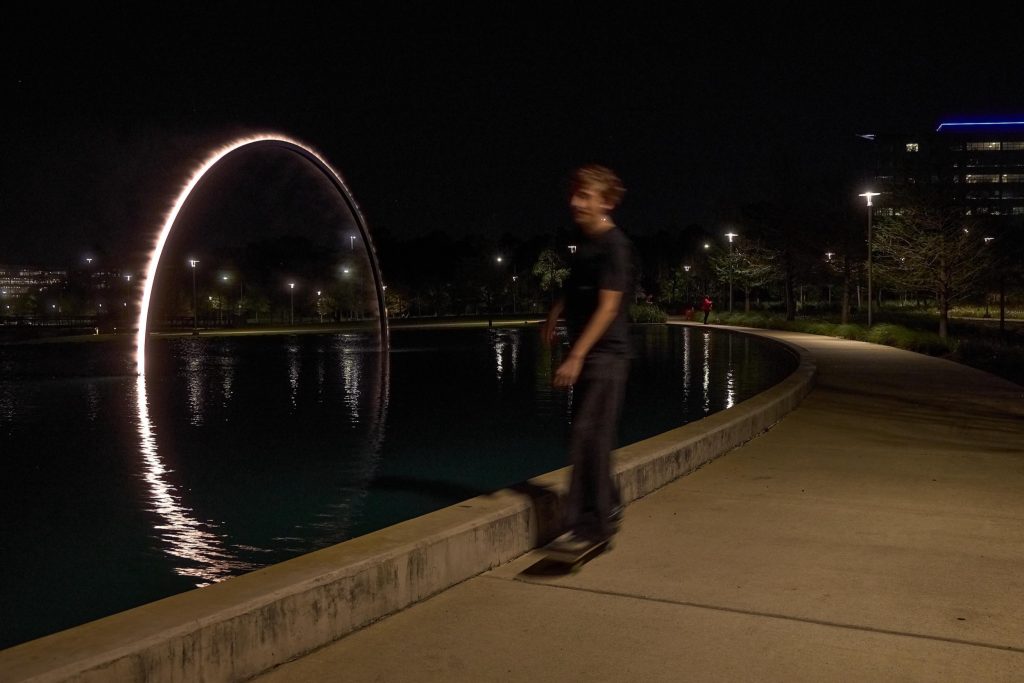
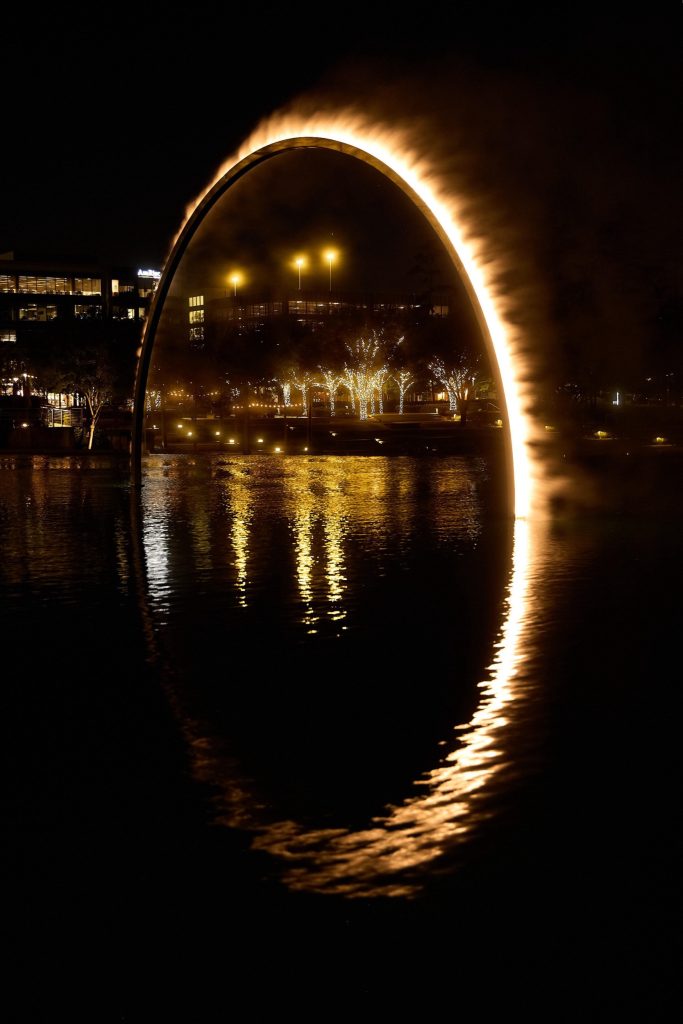
Positioned within a reflecting pond, Eclipse takes the form of a large semicircle whose completion relies on its mirrored image. The full ring emerges only through the relationship between structure and water, dissolving any clear boundary between object and environment. A continuous release of mist drifts across the surface, destabilising the reflection so that the circle is never fixed. It forms and dissolves in response to wind, light, and the viewer’s position. From a distance, the work reads as a hovering geometry, while at closer range its logic becomes contingent on alignment and movement. After dark, integrated LED lighting transforms the ring into a luminous presence, doubling its intensity through reflection and extending its visual field across the water.
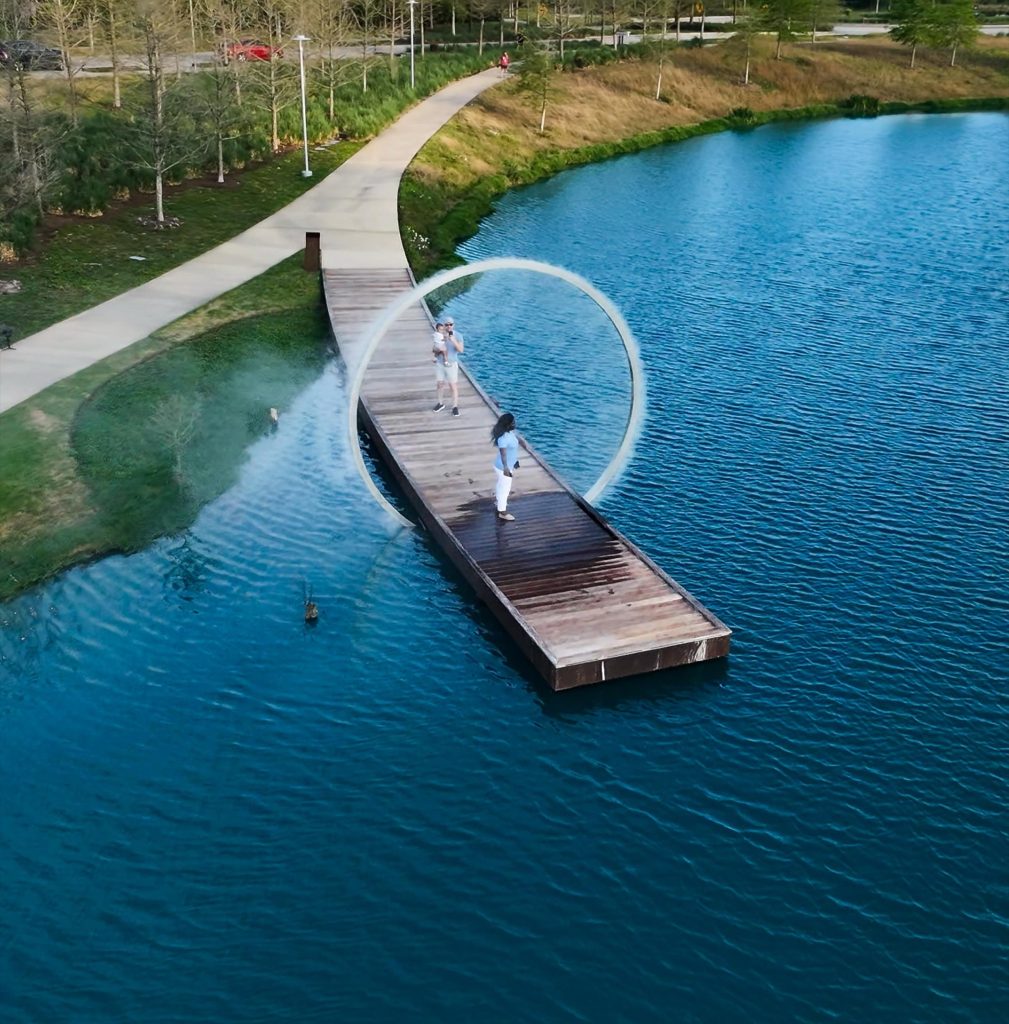
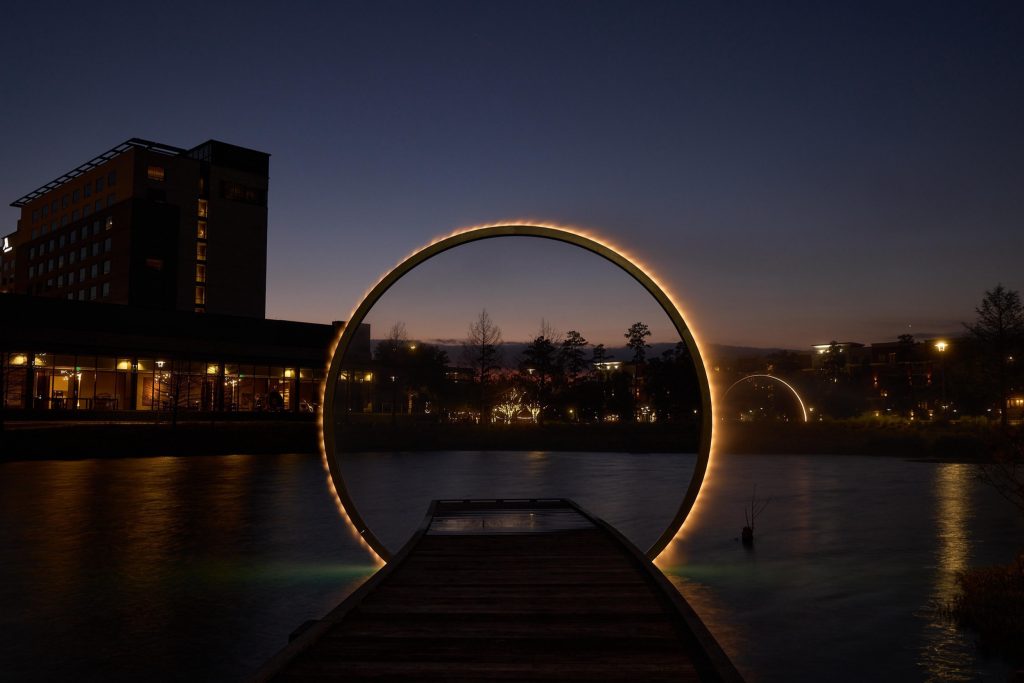
In contrast, Nimbus unfolds as an immersive counterpart. Elevated above the water and intersected by a boardwalk, the ring becomes a threshold that visitors pass through, shifting the experience from observation to participation. Mist envelops the body, forming a shifting cloud that thickens, disperses, and reforms with changing conditions. Light refracts within this suspended atmosphere, producing fleeting halos and subtle colour phenomena. The experience develops through presence and movement, where the body becomes the site through which the work is completed. At night, a soft internal glow animates the mist, introducing a temporal rhythm that extends beyond static form.
Read together, Nimbus and Eclipse establish a spatial and perceptual dialogue that neither could sustain alone. One holds water in place, framing it as image and reflection, while the other releases it into air, transforming it into a medium of movement and immersion. The landscape itself operates as a third element. Its organisation around water infrastructure enables the works to function not as isolated objects but as extensions of a larger environmental system. Meaning emerges gradually through movement, alignment, and duration.
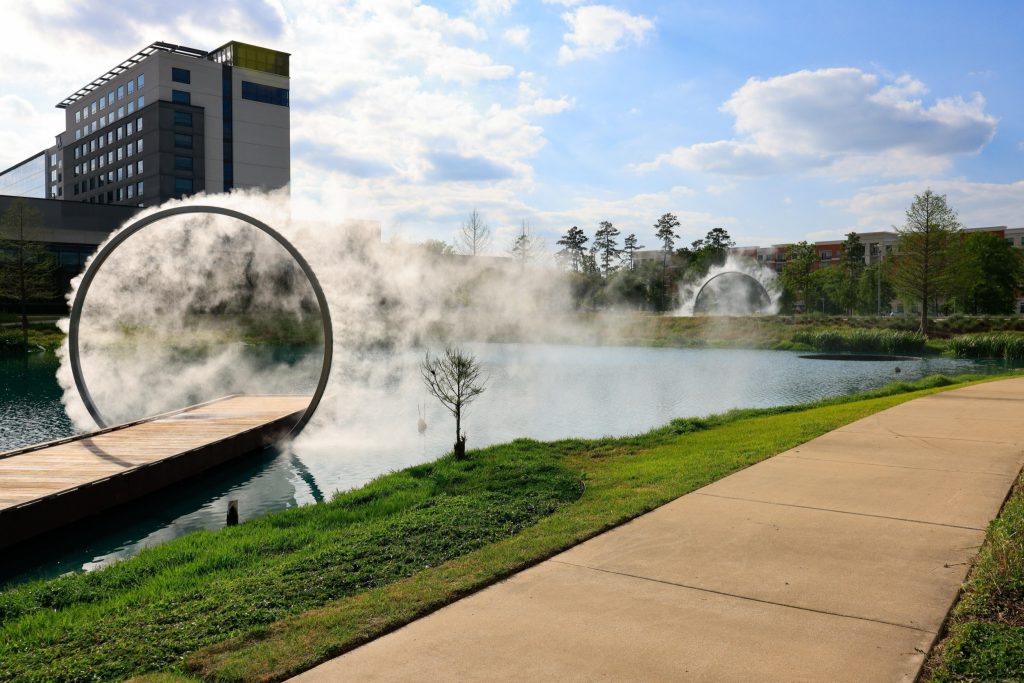
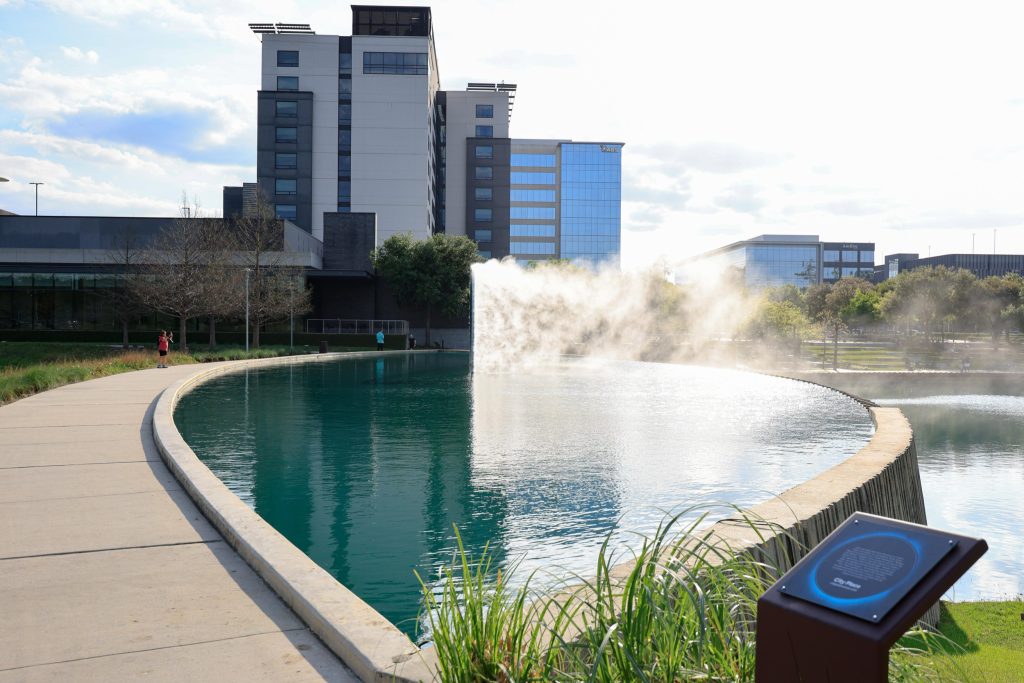
Since its inception in 2009, the Arc ZERO series has been presented internationally, with installations in cities including Seoul and Kaohsiung. The latter received the CODA Award for landscape art in 2023, while a recent Seoul installation was recognised at the LIT Awards in 2025. In Houston, the convergence of Nimbus and Eclipse reveals the full conceptual scope of the series, where reflection and immersion form a single, evolving field of experience.
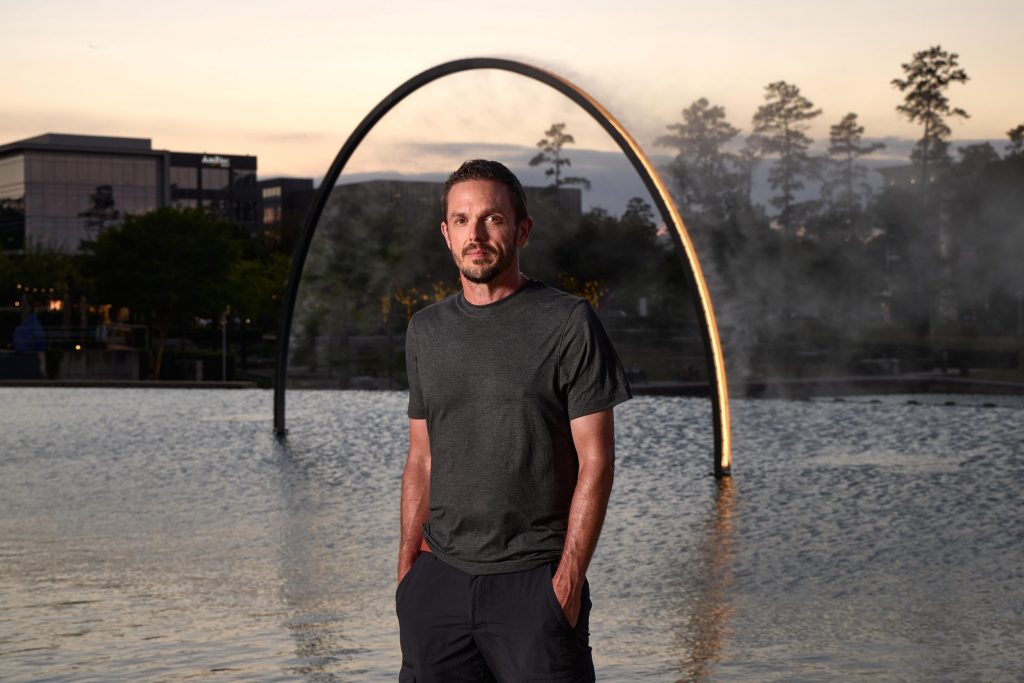

Project Credit
Location: Houston, United States
Artist: James Tapscott / @james_tapscott_art
Completion: 2026
Exhibition period: until August 16, 2026
Photo: Studio JT, Nicki Evans