
Now Reading: HW STUDIO designs inward looking house in Morelia centred on stone garden void
- 01
HW STUDIO designs inward looking house in Morelia centred on stone garden void

HW STUDIO designs inward looking house in Morelia centred on stone garden void

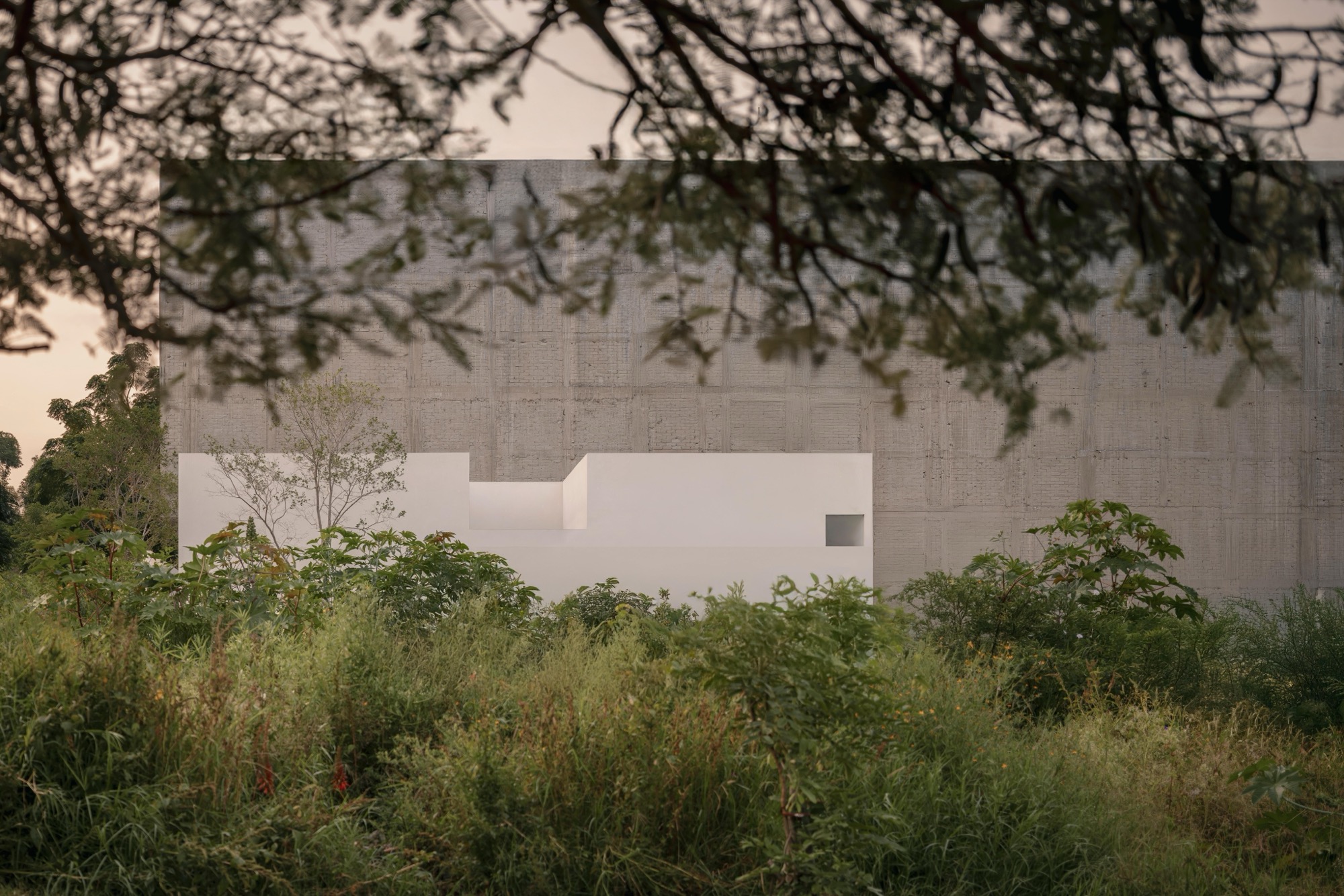
“The void is absolutely powerful because it can contain everything,” wrote Kakuzo Okakura. This idea forms the conceptual core of a compact house designed by HW STUDIO in Morelia, where architecture is not conceived as the accumulation of built mass, but as the precise construction of emptiness. Here, space is not defined by enclosure alone, but by the calibrated absence that enables movement, light, and perception.

The project is structured around a central void, materialised as a stone garden that operates as the spatial and organisational nucleus of the house. Rather than acting as a decorative courtyard, the garden establishes a fixed point of orientation. All functions are arranged in relation to it, producing a clear and legible spatial hierarchy. Circulation does not follow corridors but unfolds as a sequence of direct relationships between rooms and the void, reinforcing continuity while avoiding excess.


Externally, the house presents itself as a closed, monolithic volume. This controlled opacity reduces visual noise and protects the interior environment from the surrounding urban condition. The envelope acts less as a façade and more as a threshold device, compressing the transition between outside and inside. Upon entry, the spatial experience shifts abruptly. The interior opens toward the central garden, releasing light and depth in contrast to the compact exterior.


The ground level is divided into two primary zones placed on opposing sides of the void. On one side, the kitchen and dining space is articulated as a double height volume, allowing vertical expansion and thermal movement. Above it, a suspended volume functions as a smoke collector, integrating environmental performance with spatial expression. On the opposite side, the living area is defined by a lower, more introspective scale, where the presence of stone elements extends the logic of the garden into the interior.


The absence of a covered connection between these zones is a deliberate architectural decision. Movement between them requires crossing an open threshold, exposing the inhabitant to climatic conditions. This introduces a temporal dimension to circulation, where weather becomes an active component of spatial experience rather than a factor to be excluded.


Material and light are treated as primary architectural instruments. Shoji screens, constructed from rice paper, replace conventional glazing in key areas. Their translucency diffuses daylight, eliminating direct contrast and producing a uniform luminous field. Light is slowed, filtered, and redistributed, allowing the perception of time to emerge through gradual changes in intensity. Shadow is not residual but intentional, contributing to spatial depth and atmospheric continuity.


The upper level is reduced to a single private space. The bedroom is defined by minimal enclosure and a single circular aperture oriented toward the central tree. This opening operates as a controlled visual axis, framing a specific fragment of nature while excluding all peripheral distractions. The strategy reinforces a selective relationship between interior and exterior, where visibility is curated rather than continuous.


Openings throughout the house are limited and precisely positioned. Each corresponds to a singular external reference, ensuring that views remain intentional and spatially anchored. The result is an inward oriented architecture, where the exterior is present only through carefully edited moments.
Access to the house is achieved through a descending sequence. This gesture responds to both topographical conditions and structural efficiency, reducing foundation requirements by aligning with stable ground. At the same time, the downward movement introduces a spatial compression that enhances the transition into the interior. The act of entry becomes a controlled progression, reinforcing the separation between public and private realms.


The project operates within strict economic constraints, which inform both its construction logic and material selection. Structural systems are simplified, spans are optimised, and finishes are reduced to their essential performance. This discipline results in a coherent architectural language where each element is justified by necessity.
Rather than pursuing formal expression, the house is defined by its internal order. Geometry, material, and light are orchestrated to support a stable spatial system centred on the void. The architecture does not seek visual prominence, but instead establishes a controlled environment where use, perception, and atmosphere remain in balance.
Project Credit
Design firm: HW STUDIO / @hwstudioarq
Location: Morelia, Michoacán, Mexico
Completion year: 2025
Area: 95 square metres
Photography: César Béjar / @cesarbejarstudio, Gustavo Quiroz
More Photos