Now Reading: Projet Paysage completes civic landscape on former petrochemical site in Laval
- 01
Projet Paysage completes civic landscape on former petrochemical site in Laval

Projet Paysage completes civic landscape on former petrochemical site in Laval

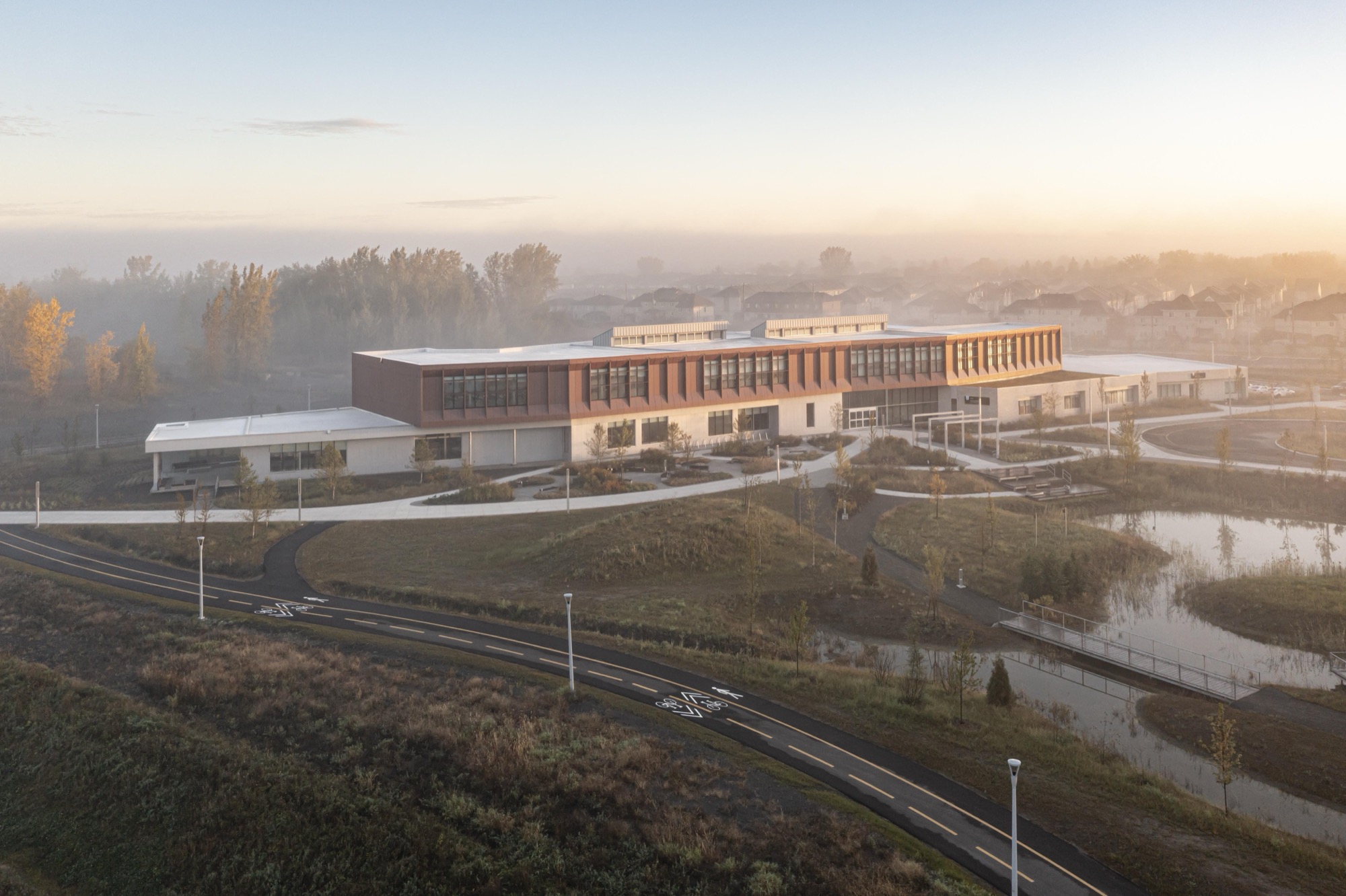
In Laval, the Espace citoyen des Confluents redefines the relationship between public infrastructure and ecological repair. Designed by Projet Paysage in collaboration with Cardin Julien, the project converts a former petrochemical brownfield into a civic ecosystem where landscape operates as living infrastructure. Opened in 2024, the 13 acre site brings together a library, cultural facilities, and municipal services within a continuously evolving terrain shaped by water, vegetation, and time.


Once occupied by a petrochemical plant, the site carries the legacy of industrial extraction and contamination. Rather than erasing this history, the design establishes new ecological conditions that allow the land to recover gradually. Fertile clay soils and proximity to wetlands inform a strategy where hydrology becomes the primary driver of spatial organization.


Rainwater and surface runoff are fully retained on site through a network of permeable paths, drainage trenches, and interconnected basins. These basins function as constructed wetlands, supporting biodiversity while regulating water flow. During periods of heavy rainfall, excess water is released into the municipal system, ensuring resilience against flooding. Landforms generated from excavated soil guide this process, shaping both ecological performance and spatial experience.


More than 300 trees across diverse species have been introduced, while spontaneous vegetation is allowed to colonize the site over time. The result is not a fixed landscape, but a living system that evolves season by season.
Hydrology is not only a technical solution but a perceptual framework. Water moves slowly across the site, visible and audible, structuring the experience of movement. Paths weave through basins and vegetated zones, offering moments of proximity to wetlands and preserved mature trees.
Even the parking area participates in this ecological logic. Its triangular geometry minimizes impermeable surfaces, while sedimentation systems filter runoff before it enters the basin network. Over time, tree canopies will extend across this area, reducing heat accumulation and reinforcing continuity with the surrounding landscape.

Through these strategies, infrastructure becomes inseparable from landscape, and environmental performance is embedded within everyday use.
From the outset, architecture and landscape were conceived as a unified system. The building acts as an anchor within the site, while the landscape orchestrates movement, views, and microclimates.
The architectural layout follows an east west orientation to optimize passive solar gain, aligning with the hydrological network and circulation paths. Openings and interior spaces extend visually and physically into the landscape, dissolving the boundary between built form and terrain. This integration ensures that environmental strategies operate across scales, from building performance to territorial systems.
The project offers a rare condition within an urban context, where a forest like atmosphere emerges over time. Footbridges and observation platforms allow access to wetland areas, while bird habitats encourage the return of wildlife. The soundscape shifts from urban noise to wind and water, creating a gradual transition into a slower rhythm.
Seasonal change plays a central role in shaping perception. Vegetation density, textures, and light conditions transform continuously, emphasizing the project’s open ended character. Rather than presenting a finished image, the landscape invites ongoing observation and participation.


Beyond its immediate program, the Espace citoyen des Confluents acts as a driver for urban regeneration. Embedded within the long term vision of the city, it reconnects fragmented districts and introduces a new model for public space in post industrial contexts.

Here, landscape is not decorative but foundational. It restores ecological processes, supports social interaction, and establishes a framework for future development. The project positions civic infrastructure as an evolving system, capable of adapting to environmental and urban change over time.
Project Credit
Project name: Espace citoyen des Confluents
Location: Laval, Quebec, Canada
Opening: Fall 2024
Site area: 13 acres
Scope of intervention: 5 acres
Landscape architecture: Projet Paysage / @projet.paysage/
Architecture: Cardin Julien
Photo: Vincent Brillant / @vincent.brillant, David Boyer / @davidboyer.photographe