
Now Reading: Valencia apartment renovation centres kitchen as social core
- 01
Valencia apartment renovation centres kitchen as social core

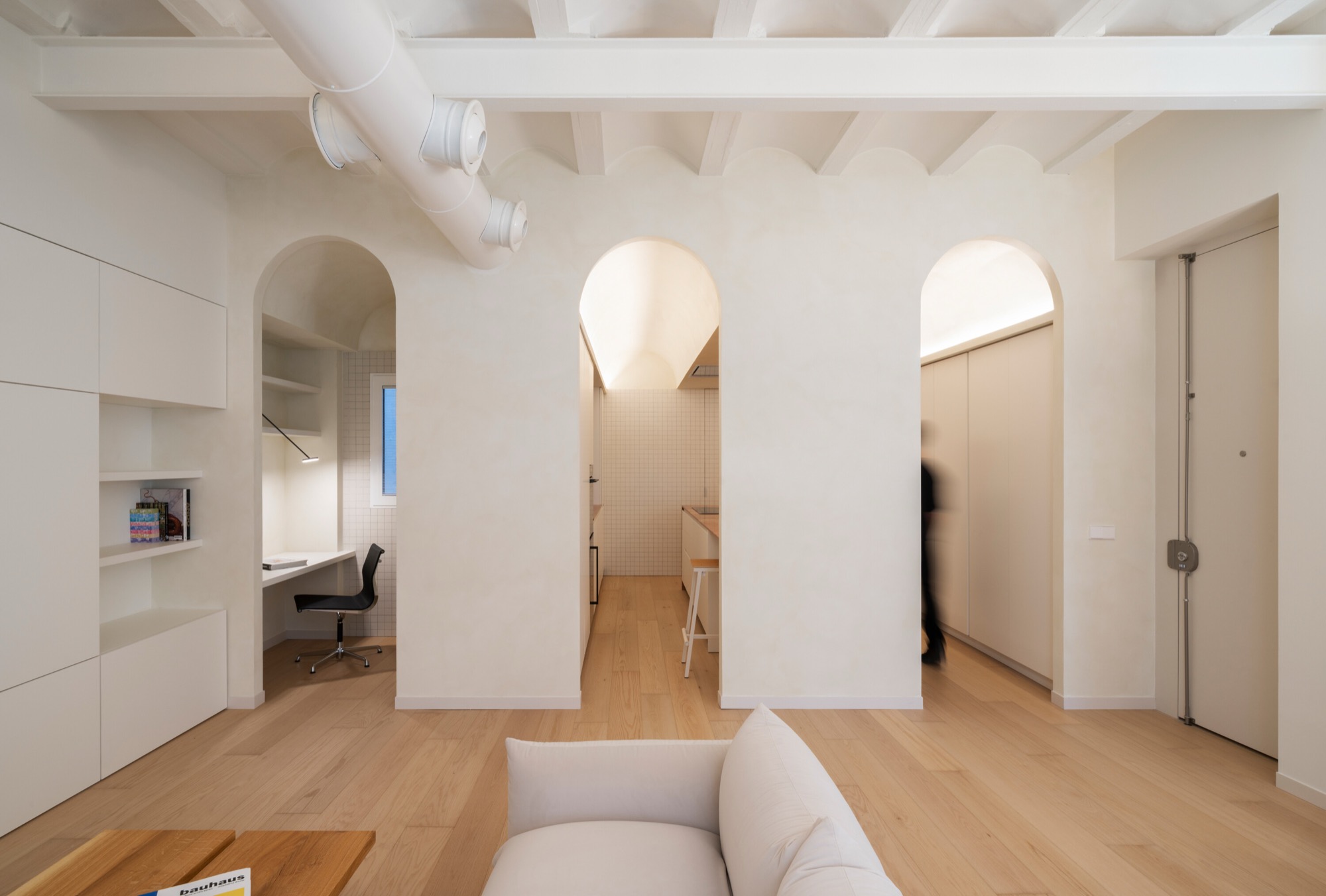

Set within a 1920 residential building in Valencia’s Eixample district, the apartment had undergone successive alterations that stripped away much of its original character, including the loss of hydraulic tile floors. What remained was a rigid, compartmentalized layout, where interior rooms were deprived of natural light and ventilation. Rather than attempting a nostalgic reconstruction, the project approaches the dwelling as a structure to be reinterpreted, retaining its latent order while redefining how it is inhabited.

The transformation is guided by a precise understanding of the owner’s lifestyle. Conceived as a space for hosting, cooking, and shared rituals, the home is imagined as a continuous social environment where activities unfold simultaneously. The kitchen becomes the center of this scenario, not as a closed service space, but as a place where cooking, conversation, and movement converge. At the same time, the need for privacy remains essential, requiring a clear separation between the day and night areas without compromising spatial continuity.


The intervention replaces the former cellular arrangement with a linear sequence organized into three programmatic bands. At the center, the kitchen operates as an articulating core, mediating between public and private realms. Rather than dividing, it connects, structuring the flow of movement through the house. Access to the bedrooms is consolidated into a single point, allowing the night area to be closed off when required while preserving the openness of the main living spaces.


The project’s defining gesture emerges through a series of extruded arches that generate barrel vaults across the plan. These elements establish rhythm and continuity, dissolving corridors and guiding movement through subtle variations in scale. Each vault corresponds to a specific spatial condition. The first defines a more intimate niche accommodating a workspace and library. The second extends along the kitchen, emphasizing its functional and social role as the central stage of domestic life. The third stretches toward the night area, acting as a distribution axis that organizes access to the bedrooms.

The curvature of these forms intensifies spatial perception, amplifying depth and enhancing the diffusion of natural light. Through calibrated compression and expansion, they reshape both movement and acoustics, reinforcing the experiential qualities of the interior. Their dialogue with the existing timber beam and vaulted floor system, preserved in the living and dining areas, establishes a balance between intervention and memory, between geometric precision and the inherited logic of construction.


Material choices follow a restrained and coherent strategy. A neutral palette of natural oak flooring and sand-toned surfaces, expressed through paint, clay plaster, and lacquer, provides a continuous backdrop. Within this field, Red Alicante marble emerges as a focal element, concentrated in the kitchen and the main bedroom, anchoring the project with a distinct material presence.

Small format porcelain tiles, measuring six by six centimeters, play a central role in defining the project’s geometry. They operate not merely as a finish but as a dimensional system that governs proportions across walls and ceilings. Surfaces are carefully set out to ensure that each plane begins and ends with complete pieces. During construction, this logic is maintained through the use of a handcrafted measuring tool composed of twenty tiles, replacing conventional instruments to guarantee precision on site.


In the night area, the same tile extends across both interior and exterior surfaces of the bathroom volumes. It shapes floors, walls, and integrated washbasins within, while continuing outward onto partitions, wardrobe fronts, and dressing areas. This continuity reinforces the perception of a unified spatial field, where boundaries between elements are softened through material consistency.
The resulting apartment is defined not by rooms, but by relationships between spaces. The kitchen occupies both the physical and symbolic center of the home, structuring a fluid environment where movement, light, and interaction unfold without interruption. Through a precise orchestration of geometry, material, and program, the project transforms a fragmented interior into a cohesive domestic landscape, attuned to contemporary modes of living.


Project Credit
Studio: Montoliu Hernandez / @montoliuhernandez
Location: Valencia, Spain
Year: 2025
Gross floor area: 101 m²
Usable floor area: 78 m²
Photo: Adrián Mora Maroto / @adrianmoramaroto