
Now Reading: Paris social housing uses timber detailing and a double envelope to improve everyday comfort
- 01
Paris social housing uses timber detailing and a double envelope to improve everyday comfort

Paris social housing uses timber detailing and a double envelope to improve everyday comfort

Design quality in social housing is often measured by what is missing. Less space, fewer finishes, tighter budgets, stricter rules. On Orteaux Street and Pajol Street in Paris, Armand Nouvet flips that logic, using basic requirements as a framework for precision: quieter interiors, better daylight, and climate comfort achieved through architectural form rather than complex systems.
Developed within a city backed pilot program with social organizations, the two residences test how far ordinary constraints can be pushed when the envelope, openings, and shared space are designed with intent. Both projects combine housing with street level retail, reinforcing the idea that social housing is not an isolated object but part of the everyday city.

The Orteaux Street project delivers 20 rental apartments, ground floor shops, and an underground garage. Its volumes are adjusted to sit within the grain of the neighborhood, while a central public garden gives the scheme a civic center of gravity.


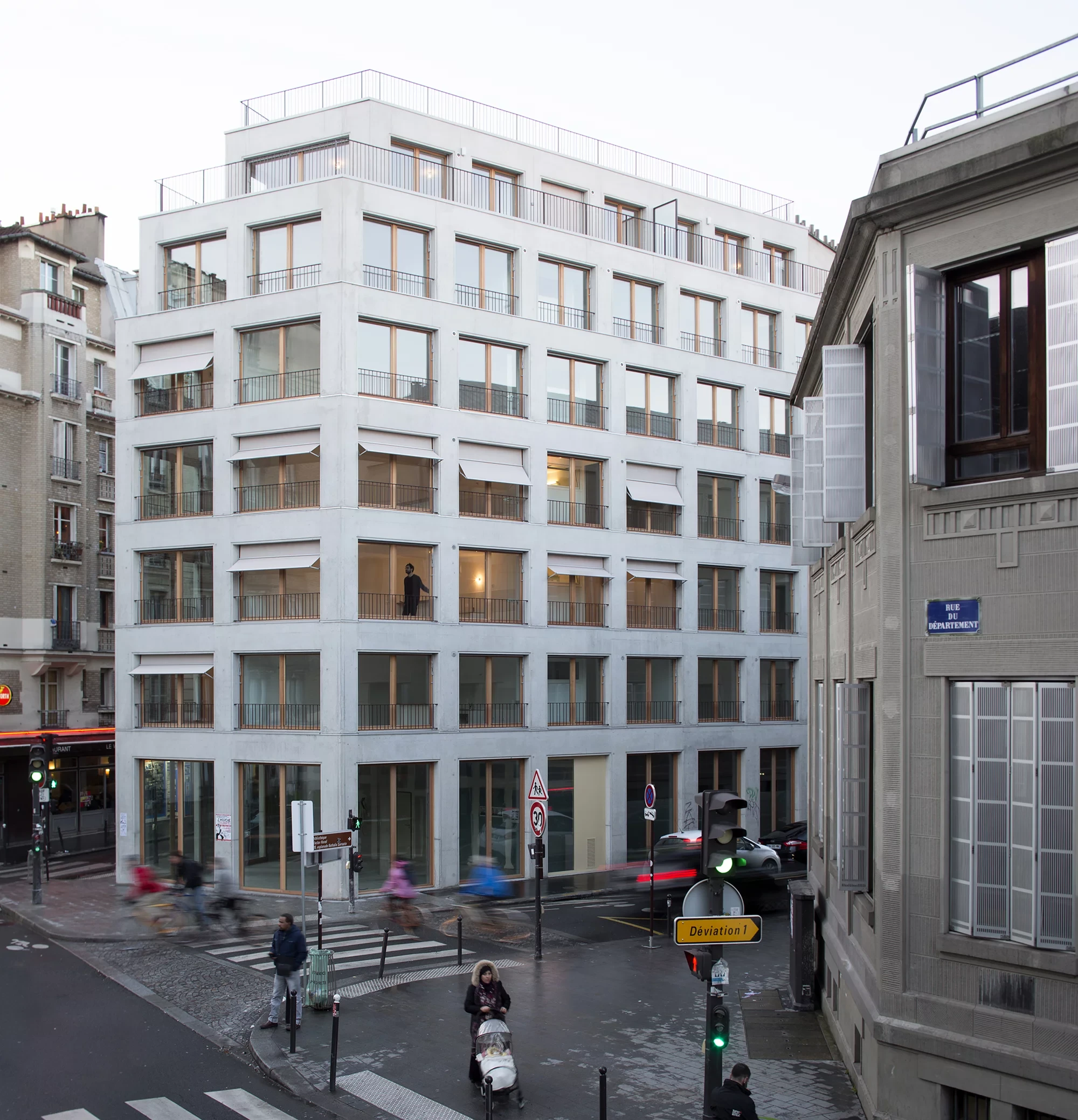
Sustainability is framed through reduction and substitution. The studio states it aims to limit concrete and instead work with renewable materials, including custom made wood elements. That ambition appears most clearly in the facade, where bespoke timber framed sliding windows introduce a measured rhythm and a tactile closeness, improving the perception of quality both outside and within the apartments.

A key technical move is the double envelope, described as an acoustic and bioclimatic device, and supported by a Trombe wall strategy. Rather than presenting performance as a matter of equipment, the design leans on low tech fundamentals: orientation, the placement of openings, the depth of the facade, and everyday components such as verandas and curtains that residents can actively use.
Each apartment includes a compact veranda that expands the usable edge of the home. It supports cross ventilation and daylight while acting as a buffer between interior life and the street, turning a modest add on into a practical spatial upgrade.

At Pajol Street, the program includes 16 apartments and two ground floor shops. Here the material tone shifts toward rawness. Brightly colored concrete helps the building sit comfortably among its neighbors, while natural wood is used for windows, doors, and smaller architectural details. The combination reads as deliberate rather than decorative: a robust shell paired with warmer points of contact where people touch, open, and inhabit the building.


Together, Orteaux and Pajol offer a restrained model for contemporary social housing in Paris. Instead of importing high tech narratives, the projects suggest that comfort can be designed into the section, the facade depth, and the everyday thresholds that shape how people live. In this reading, sustainability is not an add on. It is a discipline of choices, made visible through openings, materials, and the calm intelligence of the envelope.
Project Credit
Name: Paris social housing
Location: France, Paris
Design Firm: Armand Nouvet
Completed in 2013, 2019
Photo: Clément Guillaume