
Now Reading: The Auböcks’ anti-factory: How a Viennese workshop turned Family, craft, and networks into a design ecosystem
- 01
The Auböcks’ anti-factory: How a Viennese workshop turned Family, craft, and networks into a design ecosystem

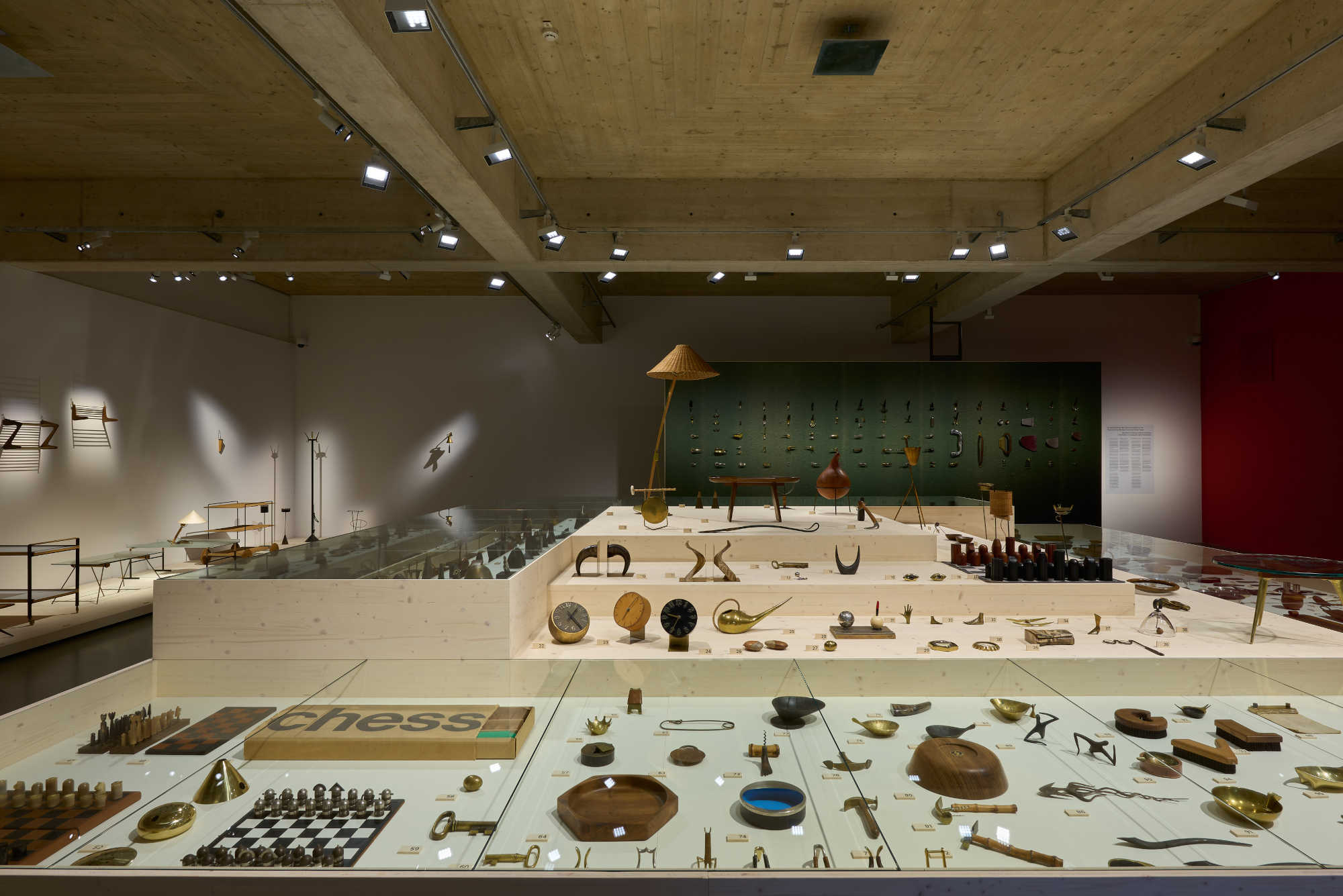

At Bernardgasse 23, Werkstätte Carl Auböck has survived more than a century of industrial logic by refusing to scale in the usual way. Instead, it scaled relationships: between generations, between specialists, between materials, and between a working archive and a global market.

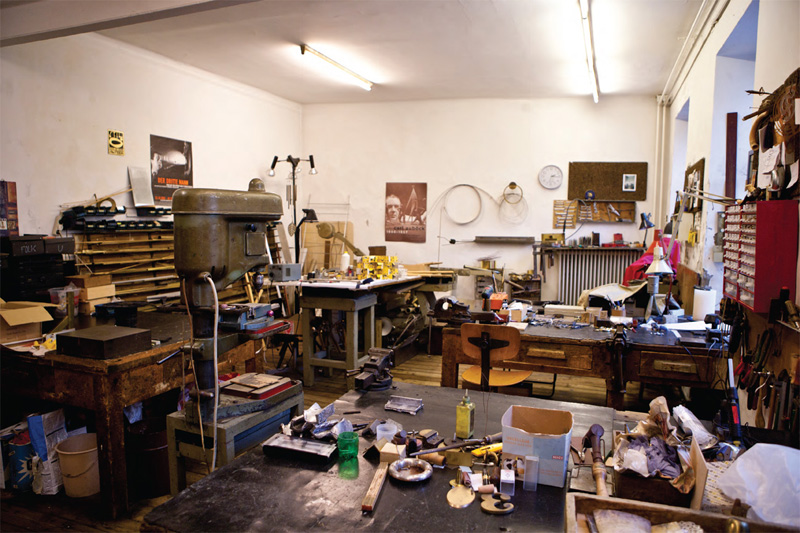
BERNARDGASSE 23, WHERE TIME IS WORKED BY HAND
The first thing you notice is the sound.
Not the bright clang you expect from an industrial floor, but a dry, patient scrape of metal on abrasive, metal on metal, a rhythm that belongs to benches rather than conveyor belts. Somewhere deeper in the townhouse, a tool lands with a dull certainty. The air feels different too: less like a showroom, more like a place where materials have a private life. You imagine drawers of parts, the quiet logic of jigs, the small pile of filings that proves time has passed.

Werkstätte Carl Auböck has stayed at this address, Bernardgasse 23 in Vienna’s 7th district, since it was founded in 1912. In the workshop’s own account, craftsmen in white coat smocks still work here today. The sentence reads almost offensively calm. In a world trained to equate growth with success, “still” becomes a provocation.
What does it mean to refuse to become a factory?
The Werkstätte began with Karl Heinrich Auböck, a bronzesmith associated with the Vienna Bronzes movement, producing bronze animals and figurines at the beginning of the twentieth century. It could have remained a decorative-arts story. Instead, the Auböcks turned it into something harder to categorize: a multi-generational ecosystem, part family enterprise, part collective of specialists, part archive, part export engine, that kept evolving without abandoning the bench.
To understand how that evolution happened, it helps to follow the evidence the way the workshop itself does: through objects, through the people whose hands make those objects possible, through the networks that carried them abroad, and through the moments when heritage becomes not a slogan but a set of operational decisions.
The first evidence looks like a table.
OBJECT 1: THE TREE TABLE AND THE MOMENT THE WORKSHOP CHANGED SPECIES
In 1919, Carl Auböck II joins the workshop. That same year, according to the workshop biography, he meets Johannes Itten in a drawing class at the Academy of Fine Arts Vienna and follows him to Weimar when Itten is appointed to teach at the Bauhaus. At the Bauhaus, he studies under Itten and works in the metal workshop under Naum Slutzky. It is a familiar modernist detour: Vienna to Weimar, craft to experiment, ornament to function.
But the Auböck story becomes interesting precisely because it is not a clean break. It is a graft.

Carl II returns to Vienna and begins designing objects the workshop history describes as more modern, more independent, moving beyond the Art Deco influence of the era. He marries Mara Utschkunova, a sculptor and later textile artist he met in Weimar. When Karl Heinrich dies in 1925, Carl II takes over the Werkstätte.
The workshop’s output shifts with him. It moves away from bronze animals into what the biography calls abstracted, functional art objects: corkscrews, paperweights, bottle stoppers, and, thanks to an era’s habits, a proliferation of ashtrays. Brass becomes the chosen medium, polished and patinated to give each piece life and soul.

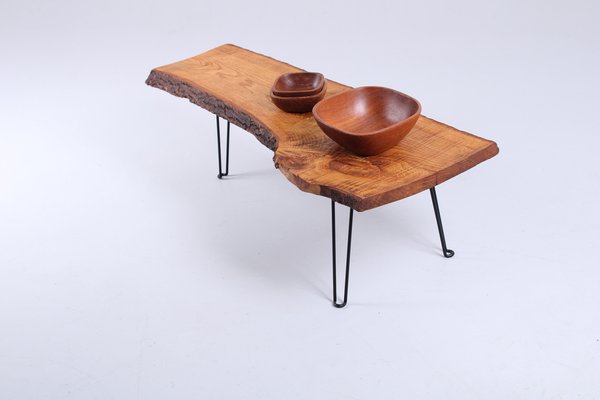
The Tree Table enters the narrative as a signature work, an objet trouvé sensibility translated into an object that could live in a modern interior. But the table matters less as an icon than as a marker of evolution. It signals that the Werkstätte is no longer only producing things; it is producing a worldview in which the everyday becomes a site for invention.
And yet a family workshop is never only family. The Auböcks’ continuity, as the interview material makes clear, lives in the distributed intelligence of the people around the family, specialists whose names rarely appear in catalogues, but whose hands define the brand more than any logo.
THE WORKSHOP AS AN “ALL-STAR BAND”
In a 2012 interview, Carl Auböck IV describes the Werkstätte as an organization structured around skill. People were assigned tasks based on what they could do best; rank reflected contribution; hierarchy remained flexible; everyone could expand expertise, but quality control stayed uncompromising.
Then he does something unusually specific for a heritage story: he names the specialists.
Busch, he says, was perfect at making Tree Tables. Schabel worked best with Novak on the delicate hinges of cigarette boxes. “It was like an all-star band,” he adds, a metaphor that lands because it suggests both discipline and individuality: a collective performance in which each player’s mastery is audible.
This single image reframes what a “family brand” is. The Auböcks may have provided stewardship and direction, but the workshop’s identity was built by an ensemble. In ecosystem terms, the family is the nucleus, not the organism.
If the Tree Table announces the Werkstätte’s modernist turn, the cigarette box hinge reveals the deeper strategy: meaning lives in small mechanisms that resist flattening into an image.
OBJECT 2: THE CIGARETTE BOX HINGE AND THE INTELLIGENCE OF SMALL MECHANISMS
A hinge is not a detail; it is a test.
In the interview, Carl IV references an internal “trade secret” the Werkstätte relied on. Processing a single material like brass, he suggests, is more or less easy. The mastery that set the workshop apart was the ability to combine multiple materials, brass with horn, cane, leather, and then integrate key details that made copying virtually impossible.


It is tempting to hear this as defensive, a craft-world answer to competition. But it reads more like a theory of value. Industrial logic scales by simplifying. The Auböck method endures by densifying, adding complexity where complexity carries meaning: in joints, transitions, tactile finishes, and the points where materials meet and human judgment becomes unavoidable.
And that judgment is, crucially, embodied.
Before any big idea reaches the market, it must pass through hands, hands that file, polish, fit, stitch, align, and test. Which brings us to the part of the Auböck ecosystem that is easiest to overlook: material finishing as an intellectual practice.
THE MATERIAL PARAGRAPH THE FACTORY CAN’T PRODUCE
Brass is sometimes discussed as if it were merely a brand signature, warm metal, mid-century glow. At Bernardgasse 23, it is treated more like a living surface. The workshop history emphasizes that brass is polished and patinated until it gains life and soul, and that phrase, half technical, half poetic, describes an entire discipline. Polishing is not a final cosmetic step; it is a form of tuning. Patina is not decay; it is a planned relationship with time. The surface is shaped to accept fingerprints, light, air, and use without collapsing into the sterile perfection of mass production.

Then comes the difficulty that Carl IV points to: multi-material mastery. It is not only that brass must meet horn or leather; it is that the meeting must look inevitable. A leather-wrapped handle cannot be merely attached; it must feel grown onto the object, its seam aligned and tensioned so the hand reads continuity rather than assembly. A hinge cannot simply move; it must move with a kind of quiet inevitability that makes the mechanism feel like it has always existed. These are not luxury touches. They are technical decisions, made in millimeters, that industry typically removes to increase throughput. At the Werkstätte, they are where authorship lives.


CARL II AND CARL III: TWO KINDS OF MODERNISM
The interview draws a useful contrast between the second and third generations. Carl II, Carl IV says, was a multitalented artist, an innovator rooted in the workshop. Carl III, by contrast, was a true modernist, an architect and metalworker by trade, later a professor of Metal Product Design at the University of Applied Arts Vienna, and connected internationally through institutional roles, including work for UNIDO and leadership in international design organizations.
The workshop biography anchors that shift in a transatlantic moment. Carl III was born in 1924. In 1951, during postgraduate studies at MIT, he meets Charles Eames, Benjamin Thompson, and George Nelson, and reconnects with figures linked to his father’s Bauhaus orbit such as Walter Gropius and Herbert Bayer. The interview adds the kind of detail that turns biography into a scene: Gropius arranges for Carl III and Henning Larsen to stay for a week at the home of Charles and Ray Eames.
It is tempting to frame this as a graduation story, craft becomes industrial design, Vienna becomes global. But the Auböck ecosystem doesn’t move by replacement; it moves by expansion. Carl III brings new knowledge back to Vienna. He is influenced by international designers like George Nakashima and Isamu Noguchi, and by what his son later calls the era of prefabrication. He applies prefabrication ideas in a Vienna housing estate built with Roland Rainer. And inside the workshop, the boundary between craft and industrial design becomes porous: prototypes and models are produced, tested, refined.
This bridge becomes clearest in an object you can eat with.
OBJECT 3: FLATWARE PROTOTYPES IN SOLID BRASS, TESTED AT THE TABLE
The workshop biography associates Carl III’s industrial-design output with major recognition, most notably that he designed the Neuzeughammer flatware pattern #2060 and links it to awards at the Triennale di Milano, including the Compasso d’Oro. In a journalistic register, it’s safest to frame this as what the archive and workshop history state.
But the more revealing evidence is tactile and domestic. In the interview, Carl IV recalls that before serial production, models and prototypes were made at the Werkstätte in solid brass so they could literally test eating with them.
That detail does more than humanize the story. It defines the Auböck method: even when the work enters industrial systems, judgment stays rooted in the body. The mouth becomes a sensor; the hand becomes a standard. Design is not only a drawing; it is lived.
The interview also notes that the Werkstätte produced models and prototypes for other companies and designers, and that this practice continues. Bernardgasse 23, in other words, is not only a place that produces a brand line; it is a micro-laboratory that sells capability, an ecosystem node where ideas become matter.
But capability still needs circulation. A workshop can be brilliant and still vanish if it cannot reach the world. The Auböcks’ reach was not achieved by scaling production; it was achieved by scaling networks.
Postwar America becomes a crucial part of that network, not only as a market but as an engine of image-making.
POSTWAR VISIBILITY: “THE OTHER AUSTRIA,” RETAIL MODERNISM, AND THE POWER OF NETWORKS
In the interview, Carl IV describes a postwar moment in which American forces sought to bolster Austria’s image, to show it was not only associated with Nazi culture but also home to creative, forward-looking people, attractive for investors and the market. In that account, the U.S. government photographer Yoichi Okamoto is sent to Vienna to capture “the other Austria,” photographing workers, farmers, artists, and craftsmen such as Carl Auböck at work.
Even read simply as family narrative, the design lesson is sharp: design history travels through images of making. A photograph of a craftsman at the bench can perform cultural work far beyond the object itself.
Retail infrastructure mattered too. Carl IV points to Benjamin Thompson, Gropius’s partner at The Architects’ Collaborative and successor at Harvard, who founded the D/R (Design Research) stores in Boston, New York, and San Francisco and introduced European modern design to American consumers, including the work of Carl Auböck alongside names like Marimekko and Tapio Wirkkala. Again, the phrase “according to Auböck family accounts and workshop history” is not a hedge; it is good practice, signaling provenance.
There are also more intimate channels: emigrant networks that tied Vienna to American department stores and companies, and friendships that became distribution routes. The interview mentions Charley Berg, brother of composer Alban Berg, as an early connector, and describes how Austrian emigrants in the 1930s, working as buyers for American car companies and department stores, maintained ties and helped generate orders; designs sometimes arose spontaneously in conversation.
Internationalization here reads less like corporate strategy than like social topology. In an ecosystem, relationships are infrastructure.
And sometimes, that infrastructure leads somewhere unexpected.
OBJECT 4: THE GREYHOUND HOOD ORNAMENT AND THE WORKSHOP’S PRAGMATIC FLEXIBILITY
Yes, Carl IV says, the Werkstätte catered to the automobile industry. Car companies hired the workshop to produce hood ornaments; older employees still reminisce about how important that line of business was; the first ones were supposedly greyhound statuettes.
A greyhound hood ornament sits awkwardly beside Bauhaus metal pedagogy, and that is precisely why it matters. A workshop that lasts a century does not last by maintaining ideological purity. It lasts by adapting without losing its core language of making.
The Auböck documents repeatedly dissolve the design world’s favorite binaries: artisanal versus industrial, collectible versus commercial, heritage versus innovation. Bernardgasse 23 remained a craft workshop, but it took industrial commissions. It produced its own line, but it also prototyped for others. It stayed local, but it built global retail relationships.
This flexibility, however, requires a kind of labor that design histories too often overlook: the labor of markets, logistics, and steady presence.
That labor appears in the story through Justine Auböck.
JUSTINE AUBÖCK AND THE WORK OF KEEPING THE WORKSHOP VISIBLE
After Carl II dies in 1957, the workshop biography notes that Carl III runs the Werkstätte together with his wife, Justine. It lists international clients such as Tiffany & Co. and Saks Fifth Avenue in New York, Ginza Shiseido Boutique in Tokyo, Harrods in London, and Christofle in Paris, markers of reach and legitimacy as recorded by the workshop history.
The interview explains how such reach was sustained: Justine took over business operations with a strong focus on international markets. Each year, she participated in six major trade shows in Europe and overseas until the late 1980s, presenting collections designed by Carl III and later by Carl IV.
This is the unglamorous engine of the ecosystem: repeated travel, repeated presentation, repeated relationship maintenance. A workshop survives not only by making objects that deserve attention, but by ensuring someone repeatedly shows up so the world remembers to look.
If the Werkstätte was an all-star band, Justine was the one keeping the tour alive.
A MEETING, A COFFEE, A SKETCH: DESIGN BORN IN CONVERSATION
The interview also offers something biography cannot: a glimpse of the workshop’s social method.
Carl IV describes meetings with clients that began with Turkish coffee and cigarettes, relaxed talk, and then the technical discussion, knowledge exchange that could lead to solutions. In the same interview, he notes that orders from emigrant buyers sometimes produced designs spontaneously through conversation.
This is not merely color. It suggests that at Bernardgasse 23, design is often an outcome of relationships. Objects do not always arrive as heroic studio declarations; they emerge through dialogue, through problem-solving, through the workshop’s capacity to translate a social situation into form.
In an era that fetishizes individual authorship, this relational method feels almost unfashionable. Yet it may be one of the most contemporary features of the Auböck ecosystem: design as the residue of sustained interaction, not just of vision.
That method also shapes how the workshop thinks about classics, and why it resists the luxury market’s obsession with artificial scarcity.
Object 5: The hand-shaped bottle opener and a refusal of manufactured scarcity
The workshop history describes Bernardgasse 23 as the birthplace of an iconic hand-shaped bottle opener. The object has become a shorthand for the brand: witty, tactile, an everyday action turned into a moment of character.
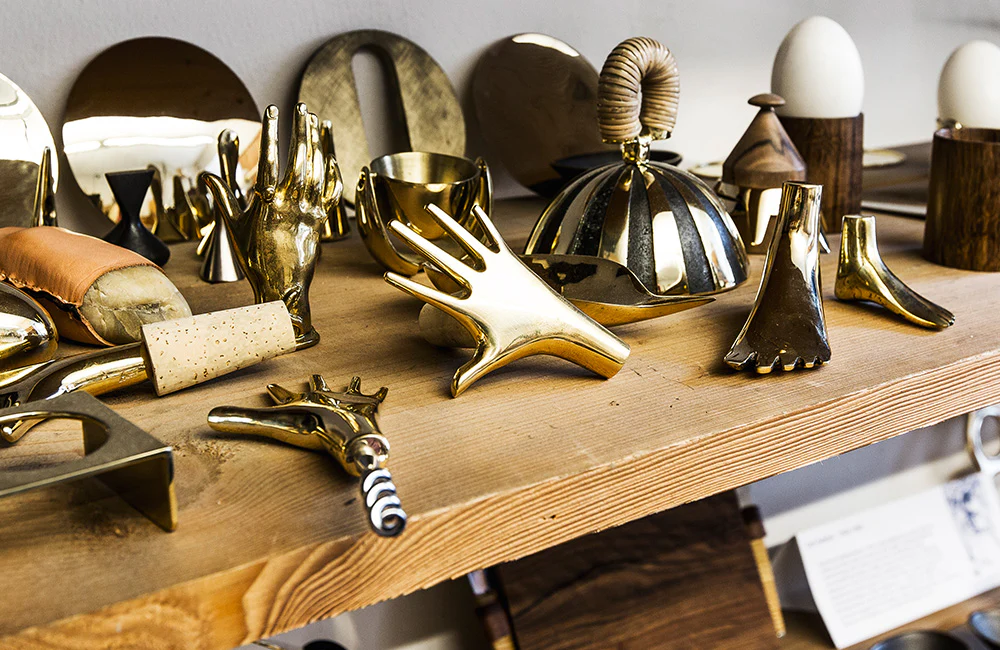
But the more radical stance is how the Werkstätte treats its catalogue. According to the biography, limited editions were never the goal. Classic designs can still be purchased at any given time. The collection remains flexible: pieces are archived or substituted out as contexts shift.
In the interview, Carl IV distances the Werkstätte from the inflated prices of the vintage market, arguing that the workshop never aimed to generate luxury. Price, in his framing, should reflect design quality, materials, workmanship, and perhaps rarity; luxury is what happens after necessities are met.
In a market where heritage is often used to justify scarcity, this stance is quietly disruptive. It redefines the classic not as a relic to be hoarded but as a tool meant to remain alive through use.
Keeping classics alive without becoming static requires another organ in the ecosystem: the archive, not as a mausoleum, but as a living engine.
The archive becomes an engine: the 1997 exhibition that changed the market
After Carl III dies in 1993, the workshop history records that leadership passes to Justine and then to her children, Maria Auböck and Carl Auböck IV. In 1997, the siblings stage a comprehensive solo exhibition at the Wien Museum and oversee the publication of books about historical product catalogues as part of the Carl Auböck Archive.


The interview supplies the scene that turns these facts into reportage.
Carl IV describes approaching the museum director with the idea of an Auböck exhibition. The director is polite, distant, until Carl IV places a small 1920 gouache titled Flying Machine on the table. The director’s reaction shifts. The museum schedules the show with priority. The exhibition becomes a huge success, and the market changes shape: international clients multiply; collectors reveal themselves; vintage dealers and auction houses adopt a term that begins to function like a category, “Auböck design.”
The interview is blunt about why this matters. The secondary market thrives on stories, fashion, marketing, and magazine visibility. Before the exhibition, pickers were irrelevant; afterward, modern antique dealers became partners, responding to demand for what Carl IV calls time products.
Here the Auböck ecosystem reveals an unusually modern sophistication: it does not treat history as a static asset. It curates history into a present tense capable of supporting both meaning and livelihood.
And yet, even as the archive amplifies value, the workshop refuses to let the objects become pure fetish. It keeps making. It allows function to remain elastic.
OBJECT 6: THE IVY VASE THAT BECOMES A “RED WINE DECANTER”
One of the interview’s most revealing passages is about how objects survive time. Carl IV notes that shifts in style rarely made pieces disappear; more often, what changed was the function people projected onto them. An object now referred to as a red wine decanter, he says, was originally intended as an ivy vase for plants rooting in water. The Werkstätte rarely produced vases for cut flowers and never for bouquets; the idea was to have something alive on the table, to watch it grow.
This small correction reads like an ethics of design. Auböck objects are open scripts. The market renames them; the objects keep living. The workshop’s job is not to police interpretation but to preserve the integrity of making so interpretation remains possible.
If there is a point where the Auböck model meets the limits of the present, it is here: in the scarcity of skilled hands and skilled eyes.
THE FRAGILITY OF SKILL, AND WHY THE ECOSYSTEM MATTERS
A workshop ecosystem is only as resilient as the broader ecosystem of craft it can draw upon.
Carl IV’s interview emphasizes how specialization and mastery were embedded in the Werkstätte’s culture, and how certain delicate tasks depended on the right pairings of craftspeople. He also points to the rarity of eyes that can recognize workmanship beyond stamps, suggesting that material literacy itself is becoming scarce.
This matters because it frames craft not as romance but as infrastructure. When skill pipelines break, heritage becomes performance. Bernardgasse 23 has avoided that fate by treating the workshop as an evolving collective rather than a frozen tradition.
That evolution includes editorial work too: correcting the story as it is transmitted, keeping lineage legible.
One small glitch illustrates the point.
A NECESSARY CORRECTION: WHEN FAMILY HISTORY MEETS TRANSCRIPTION
In the interview transcript, a bracketed line appears to mislabel the generations: “After my grandfather [CA II] passed away, our father [CA II] took over…” In context, the father is Carl Auböck III.
It’s minor, but instructive. Continuity depends on stewardship not only of objects, but of narrative accuracy. The Auböcks’ story survives because it is continually curated, through archives, exhibitions, and the quiet editorial labor of keeping the lineage clean.
That stewardship supports the workshop’s core claim: that its objects carry a tactile difference recognizable even without branding.
OBJECT 7: THE WOODEN BOWL AND THE CLAIM OF IMMEDIATE RECOGNITION
Carl IV makes one of the most forceful arguments for craftsmanship without sentimentality. Many pieces are stamped, he says, but those with an eye can tell by workmanship. Then he offers a simple example: wooden bowls have been produced for millennia across cultures, yet if someone held a large wooden Auböck bowl, they would know the difference immediately, even if they didn’t know what “Auböck” was.
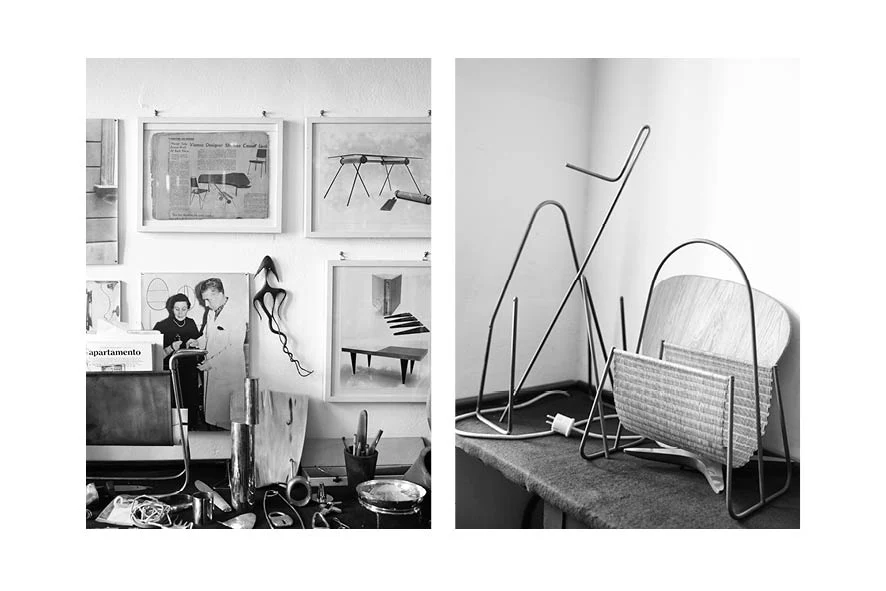
This is not a branding claim. It is a claim about communication through touch, about an object’s ability to transmit the intelligence of its making directly to the body.
In an era when design is often encountered first as a scrollable image, that may be the most radical part of the Auböck model: the insistence that the real experience cannot be flattened.
IN THE AGE OF INDUSTRY, THE AUBÖCK MODEL IS NOT A REJECTION – IT’S A COUNTER-PRINCIPLE
It would be easy to treat Werkstätte Carl Auböck as an exception: a charming holdout. The documents suggest something more pragmatic. The workshop engaged modernity repeatedly, through export routes and retail infrastructure, through industrial commissions, through prototype work for others, through decades of trade-show visibility, and through an archive that actively reshaped market perception.
What makes the Auböck model relevant now is not that it rejects industrial logic, but that it offers a counter-principle to it.
Industrial logic says value is created by scale. The Auböck ecosystem suggests value can be created by density, density of skill, density of material intelligence, density of relationships, density of time.
To keep that conclusion grounded, it helps to return to three mechanisms that appear explicitly in the source materials:
First, the workshop’s “trade secret”: multi-material mastery and key details, a form of embodied protection and meaning that can’t be copied by image alone.
Second, the workshop as laboratory: flatware prototypes in solid brass tested by eating, a reminder that design judgment lives in the body, not only in systems.
Third, the logistics of visibility: Justine’s decades of trade shows, the steady work of maintaining international presence without turning the Werkstätte into a scaled manufacturer.
Together, these mechanisms explain why Bernardgasse 23 could remain fixed while the workshop’s influence moved outward.
Yes, the model is vulnerable. It depends on rare skills. It depends on a market willing to pay for workmanship rather than hype. It depends on each generation choosing stewardship over exit. But it also offers something the industrial system struggles to produce: objects that carry meaning as a function of how they are made, not merely how they are sold.
CLOSING: THE ADDRESS NEVER MOVED, BUT THE ECOSYSTEM NEVER STOPPED EVOLVING
From Vienna Bronzes to Bauhaus-inflected brass, from ashtrays and corkscrews to industrial flatware and prototypes, from hood ornaments to global retail, from a family workshop to a living archive capable of reorganizing market perception, the Auböck story is not a tale of preservation. It is a tale of adaptation without dilution.
Bernardgasse 23 remained the fixed point. Everything else, the band of specialists, the multi-material intelligence, the conversations over coffee and cigarettes, the trade-show circuits, the exhibitions, the archive, operated as a moving system around it.
In the end, Werkstätte Carl Auböck doesn’t merely survive industrial time. It converts time into something you can hold: a hinge that moves the way it should, a surface that carries patina rather than wear, an object that remains available not because it is endlessly replicated, but because the culture of making behind it stayed alive.
The address never moved.
The workshop never stopped moving.