
Now Reading: Mark Wallinger: Four decades of political provocation and poetic insight
- 01
Mark Wallinger: Four decades of political provocation and poetic insight


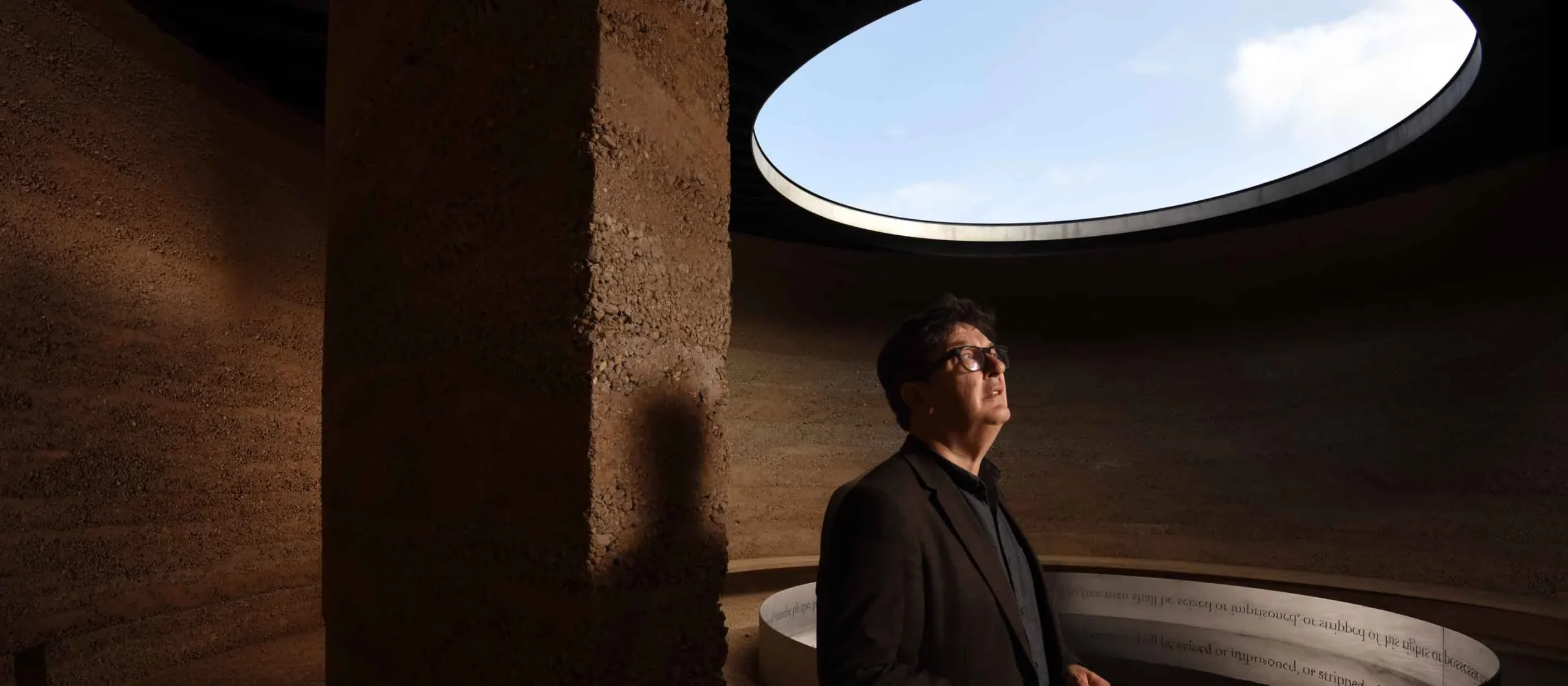
Mark Wallinger stands as one of Britain’s foremost contemporary artists, renowned for his masterful blend of wry humor, incisive social critique, and profound exploration of human identity. Born in 1959 in Chigwell, Essex, Wallinger has forged a career spanning more than four decades, encompassing painting, sculpture, video, installation, and public art. He represented Britain at the Venice Biennale in 2001, was nominated for the Turner Prize in 1995, and ultimately won it in 2007 for his powerful work State Britain. More than merely an artist, Wallinger is a thinker who deploys art to interrogate power, democracy, and the self. This profile delves into his biography and education, artistic philosophy, key projects, published books, and most recent endeavors, drawing on authoritative sources such as newspapers, art magazines, and interviews.
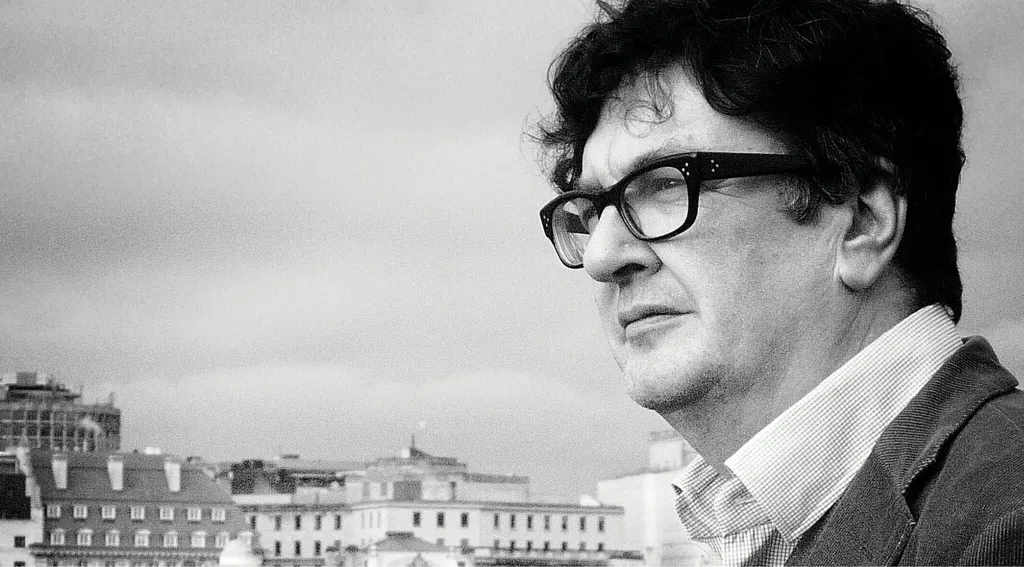
Mark Wallinger was born on May 25, 1959, in Chigwell, Essex, a quiet suburb of London. From an early age, his family nurtured his passion for art: his father, a fishmonger, taught him to draw, while his sister later pursued acting. Wallinger has recalled believing that all children spent weekends at the National Gallery and the V&A, a testament to the creatively enriching environment of his upbringing. He attended West Hatch High School in Chigwell from age 11, where his interest in art began to take shape. Yet his formal artistic path emerged later, after part-time work at Collett’s, a radical bookstore on Charing Cross Road in the early 1980s. This job exposed him to progressive political and social ideas, sparking a lifelong fascination with “the politics of representation and the representation of politics”—a thread that runs through his oeuvre.

Wallinger’s education commenced at Loughton College in Essex (1977–1978), where he took foundation courses in art. He then moved to Chelsea School of Art in London (1978–1981), earning his bachelor’s degree. At Chelsea, he immersed himself in contemporary movements, honing skills across painting and sculpture. In 1983, he pursued a master’s at Goldsmiths College, University of London, graduating in 1985. Goldsmiths was a crucible for the Young British Artists (YBAs), and Wallinger later lectured there from 1986. This period marked his shift from traditional art to conceptual practices, where he began probing social themes through diverse media.

Post-graduation, Wallinger rose swiftly. His first solo show in London in 1986 heralded a career milestone, later commemorated in a Thames & Hudson monograph marking 25 years of practice. He lives and works in London, holding honors such as Honorary Fellowships from Goldsmiths and the London Institute, and an honorary doctorate from the University of Central England, Birmingham. Wallinger’s life mirrors Britain’s social evolution—from Thatcherism to Brexit—profoundly shaping his work.
At the heart of Mark Wallinger’s practice lies a fascination with self-reflection, politics, and society, often laced with sharp wit and deep critique. In a 2018 interview with The Talks, he described self-reflection as both “literal and metaphorical,” noting how a mirror shows everything yet has no substance. He insists art must be “clear, open, exposed,” eschewing repetition while harboring a “magical leap” where genuine risk exists for artist and viewer alike.
Wallinger frequently delves into “the politics of representation,” using images to expose how they manipulate human emotions. In a 2016 Studio International interview—following months of psychoanalysis—he revealed how his work mirrors the inner psyche, as seen in the id Paintings series, where he used his body to create symmetrical imprints evoking Rorschach blots. For him, art is about recognizing the unexpected: following intuition, then substantiating it through research.
Religion and society loom large. In a 2004 conversation with The Art Newspaper, Wallinger explored religion’s societal role, unafraid of grand themes. He critiques the art market for fostering “branded products” over true creativity. A 2024 YouTube dialogue with Ben Quash saw him examining the Bible through an artistic lens, underscoring the artist’s duty to question belief.
Wallinger champions art’s democratic potential. In an interview with Sue Hubbard, he lamented how history “strangles painting,” preferring works rooted in the real world to avoid arrogance. This ethos shines in his eclectic media, from video to public sculpture, making art accessible and thought-provoking.
Wallinger’s portfolio brims with landmark works; here, we examine five exemplars: Ecce Homo (1999), Sleeper (2004), State Britain (2007), Labyrinth (2013), and Writ in Water (2018). These reveal his versatility and depth.
Ecce Homo (1999–2000) was the inaugural sculpture on Trafalgar Square’s Fourth Plinth in London. This life-size marble figure depicts a modern Christ, standing silently amid war heroes. Drawing from the Latin “Behold the Man,” it underscores human fragility against power. Critiquing traditional heroism, it placed Christ in a square emblematic of British imperialism. Shown at the 2001 Venice Biennale—where Wallinger represented Britain—it now resides in collections like Tate. The Guardian hailed it as a symbol of democratic art, inviting personal interpretation. With high production costs and exquisite casting, Ecce Homo established Wallinger as a public artist sparking debates on religion and authority.

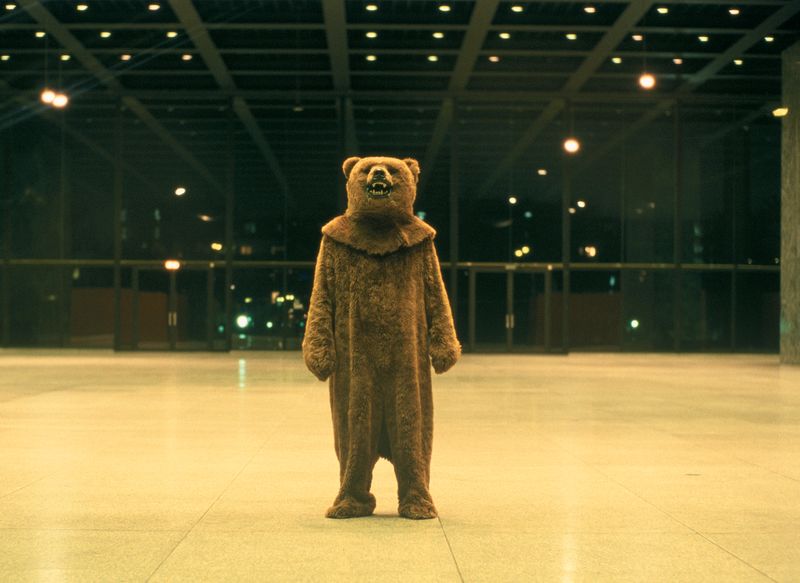
Sleeper (2004) is a single-channel video capturing Wallinger in a brown bear suit wandering Berlin’s Neue Nationalgalerie over 10 nights. The bear, Berlin’s emblem, probes identity, isolation, and boundaries. In interviews, he linked it to Grimm fairy tales of princes turned bears and Marx’s view of history repeating as tragedy then farce. Spanning 154 minutes and filmed late at night, it evokes loneliness and surveillance. Artforum praised its acerbic humor, where Wallinger is “bear and not bear.” This performance piece fuses the personal with the political, echoing post-Cold War Berlin’s divisions.
State Britain (2007) meticulously recreates Brian Haw’s anti-Iraq War protest camp outside Parliament. Wallinger documented it before its 2006 removal under a law banning protests within 1km of Parliament. Installed at Tate Britain, the legal boundary bisected the gallery, half in the “exclusion zone.” It won the 2007 Turner Prize, lauded for its “visceral intensity.” In a Guardian interview, Wallinger admired Haw’s resistance to Britain’s “folly and hubris” in foreign policy. Challenging free speech, it transformed the museum into political space; Artforum analyzed it as art defying law.


Labyrinth (2013) marked the London Underground’s 150th anniversary with 270 unique circular labyrinths installed at every station. Each symbolizes urban journeys and disorientation. Inspired by the Cretan myth, it likens the Tube to a modern maze. Interactive—visitors trace paths with fingers—the Guardian noted how Wallinger democratizes daily art. Costly in printing and installation, it succeeded in broadening access.


Writ in Water (2018), in collaboration with Studio Octopi, is a public architectural work at Runnymede, site of the 1215 Magna Carta sealing. A circular rammed-earth structure leads to a reflective pool; Clause 39 appears inverted, legible only in reflection. Titled from John Keats’s epitaph, it evokes law’s transience. Tate and the Guardian praised it as emblematic of fragile democracy requiring constant defense.


Wallinger’s latest solo exhibition, Gravity is the Weakest Force in the Universe, ran at Tension Fine Art in London from April 5 to May 31, 2025, featuring new works blending painting and installation to probe gravity and identity. He also contributed to New Horizons: Growing Sheffield’s Art Collection at Sheffield Museums in 2025.

That year, he participated in My People Will Return: In Air, In Water, In Light at Tick Tack in Antwerp (November 14–December 31). The Proteus Paintings series, highlighted on HENI’s Instagram, employs plasticine for abstract impressions. Stubbs and Wallinger: The Horse in Art at Tate Britain extended to July 2025, pairing his horse paintings with George Stubbs’s. In 2023, he joined The Wild Escape, a museum collaboration on naturalism. These continue Wallinger’s themes of reflection and society.
In sum, Mark Wallinger remains an ever-evolving artist, wielding art to challenge and mirror the world. His career affirms that art can be profoundly intellectual yet widely accessible, political yet intimately personal.