Now Reading: Inflating the City: The Eventstructure Research Group and the art of public play
- 01
Inflating the City: The Eventstructure Research Group and the art of public play

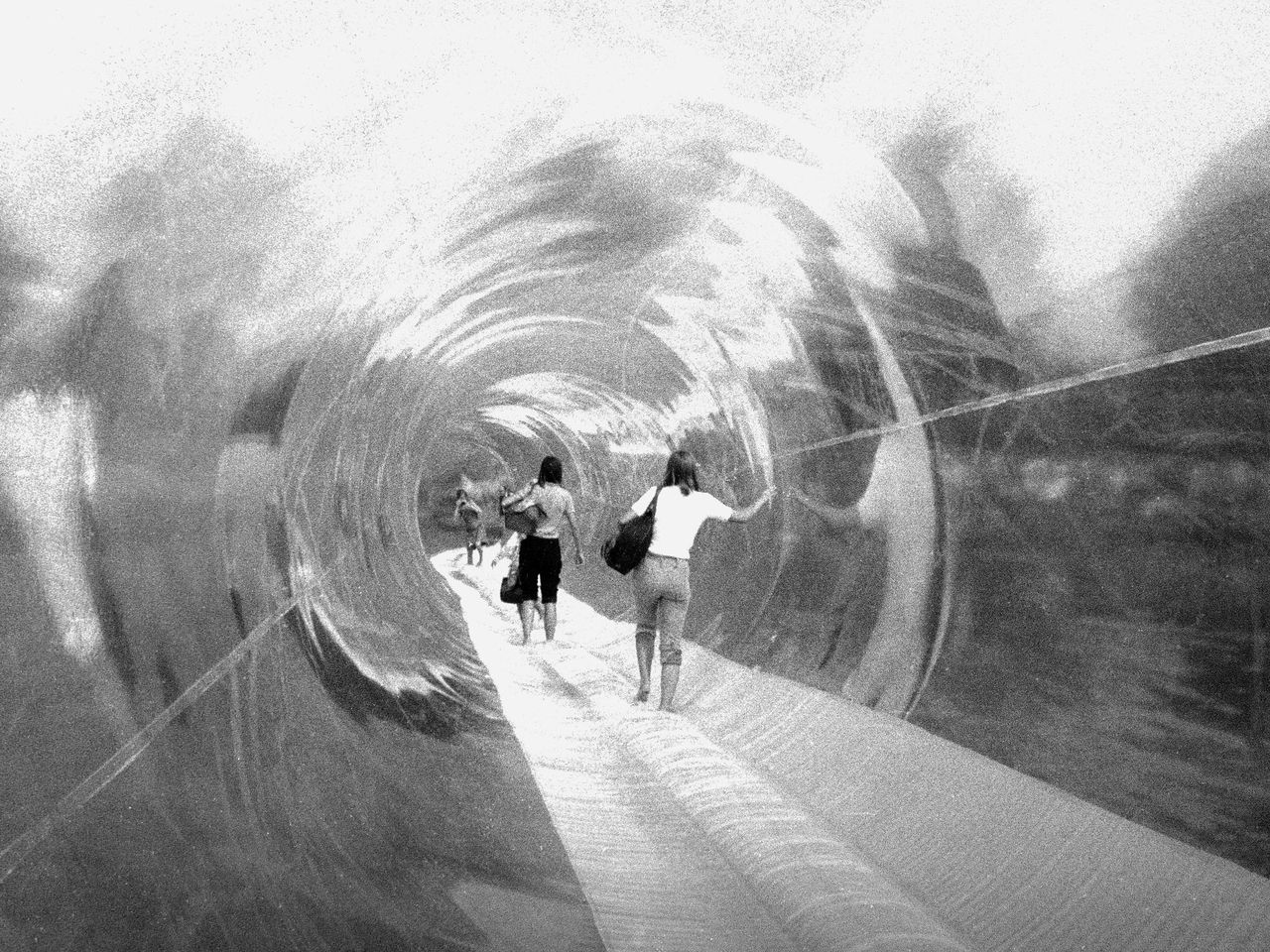

In late-1960s Amsterdam, a city long fluent in improvisation, a small group of artists began treating air as a civic material. Their works arrived lightly, often without warning, and disappeared just as easily. Yet while they lasted, they quietly reorganised public space. A tube became a corridor. A cushion became a plaza. A lake became a route.
AIR AS A CIVIC MATERIAL
You can picture the moment of arrival. A membrane unfurls, a motor hums, a volume swells into place. Within minutes, the city has a new interior, one that belongs to no one in particular and therefore to everyone who dares to enter. People step in without asking. Someone laughs, someone hesitates, and then the whole scene tips into use.

This was the practice of the Eventstructure Research Group (ERG), active from the late 1960s into the early 1980s. Rather than producing objects to be observed, ERG designed situations to be entered. Their inflatable structures were not monuments but permissions: invitations to climb, crawl, bounce, and move together. Art, in their hands, was not something to look at but something to use.
That ethos resurfaced clearly in 2023, when Sky & Game: Eventstructure Research Group 1967–1982 was presented at the Van Eesteren Museum in Amsterdam. The exhibition did more than recover a forgotten chapter of postwar art. It reminded us that play, when placed in public space, can be a serious civic act.
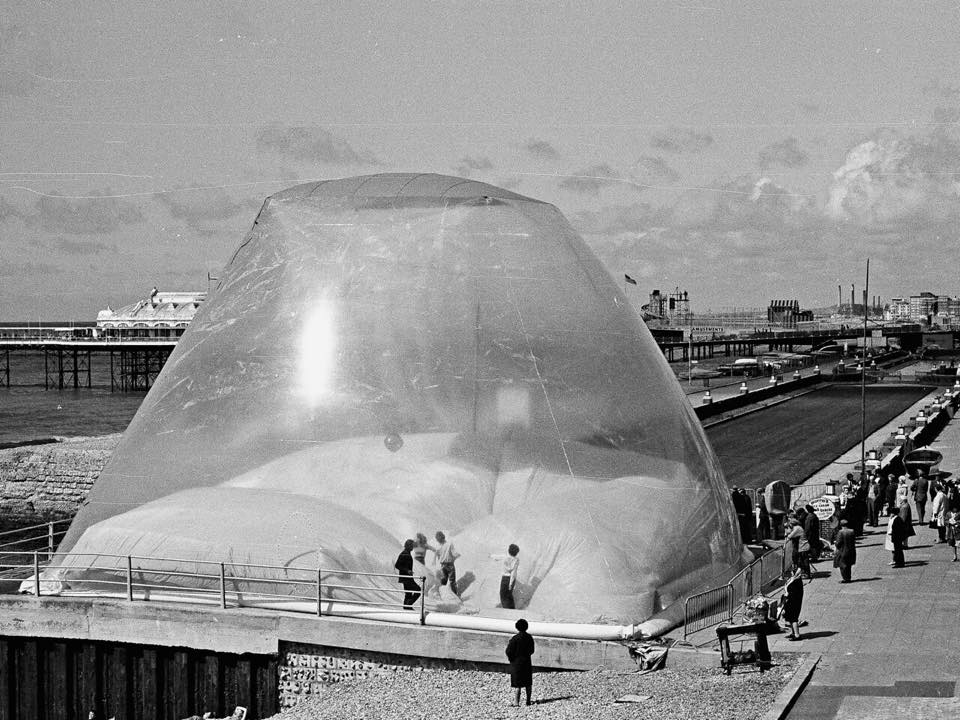
EVENT RATHER THAN OBJECT
ERG emerged at a moment when artists across Europe were questioning the neutrality of the gallery and the authority of the museum. Protest culture, media experimentation, and a growing belief that art could no longer remain insulated from everyday life reshaped the late 1960s. For ERG, the implication was simple: shift attention away from the finished object toward the event itself.
Inflatables offered a direct answer. They were quick to assemble, easy to transport, and immediately legible. More importantly, they resisted permanence. An inflatable appears, gathers people, alters behaviour, and vanishes. Nothing holds still long enough to become a monument or a commodity. Temporality was not a limitation; it was the point.
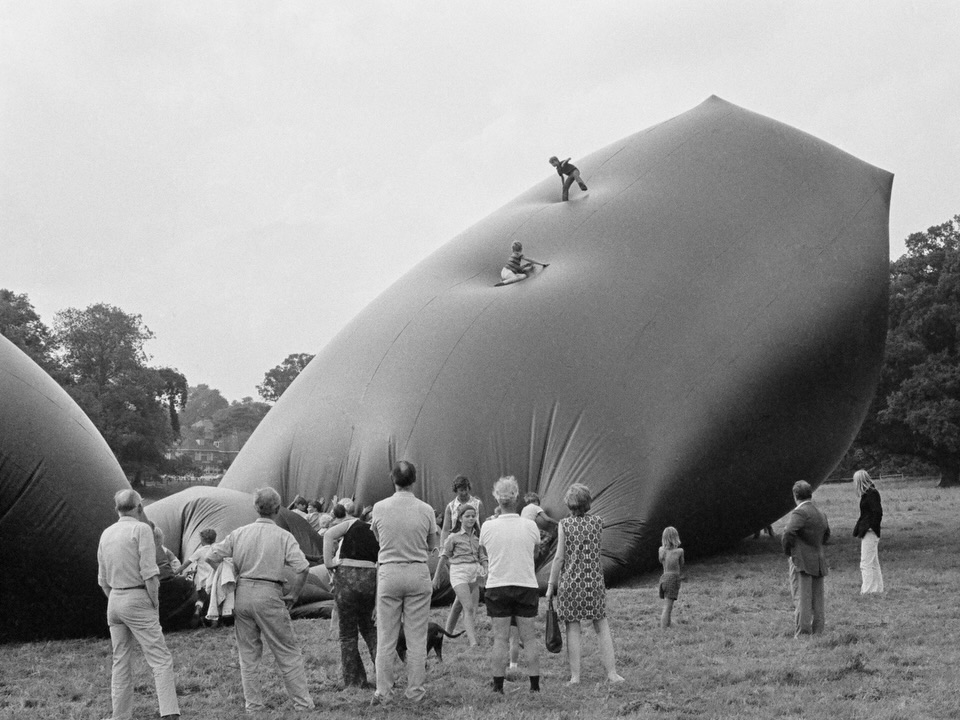
In 1969, ERG clarified this stance in their text “Concepts for an Operation Art,” arguing for work that prompts self-action rather than contemplative distance. The event becomes the artwork. Authorship becomes porous. Once inflated, the structure belongs as much to its users as to its makers.
A GRAMMAR OF AIR
One of ERG’s earliest projects, Corpocinema (1967), treated cinema as an environment rather than a screen. Projection, performance, and an inflatable enclosure collapsed the separation between image and audience. Viewers did not sit at a distance; they moved within the work. Cinema became spatial, collective, and unstable, functioning less as a medium than as a temporary condition.

That logic soon moved decisively into the city. Pneutube, documented in a 1969 installation in Amsterdam, consisted of a large pressurised tube placed in public space. Neither sculpture nor architecture, it functioned as a temporary interior. People entered, crawled, paused, and emerged again, briefly detached from the usual rhythms of the street. The tube did not insist on meaning. It offered access, and through that access it redrew the boundary between spectator and participant.

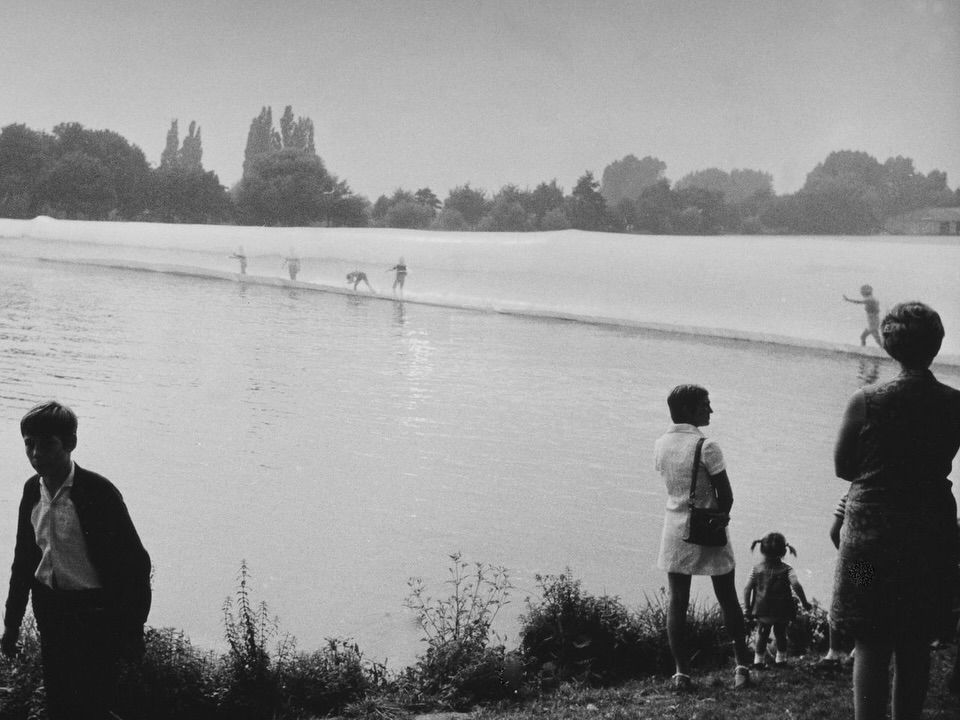
With Waterwalk (1969), ERG extended their experiments toward the improbable. Using air pressure and buoyancy, the structure made “walking on water” feel briefly plausible. Physics was not denied but renegotiated. A familiar landscape became an interactive surface, producing wonder rooted in bodily experience rather than visual illusion.

SCALE, CROWD, AND COLLECTIVE MOVEMENT
The early 1970s brought a shift in scale. Waterwalk Tube (1970) transformed ERG’s aquatic experiments into something almost infrastructural. Most famously installed on Hanover’s Maschsee, the 250-metre-long inflatable tube allowed participants to traverse a body of water together. The meaning lay less in the image than in the logistics. It held only as long as people moved through it collectively.

This attention to behaviour rather than spectacle also shaped ERG’s presence in outdoor exhibitions. At Sonsbeek 71, a historically experimental context, ERG’s inflatable pavilion projects framed information as something to be entered rather than consumed. Film, sound, and presence were treated as civic materials, capable of forming temporary publics.

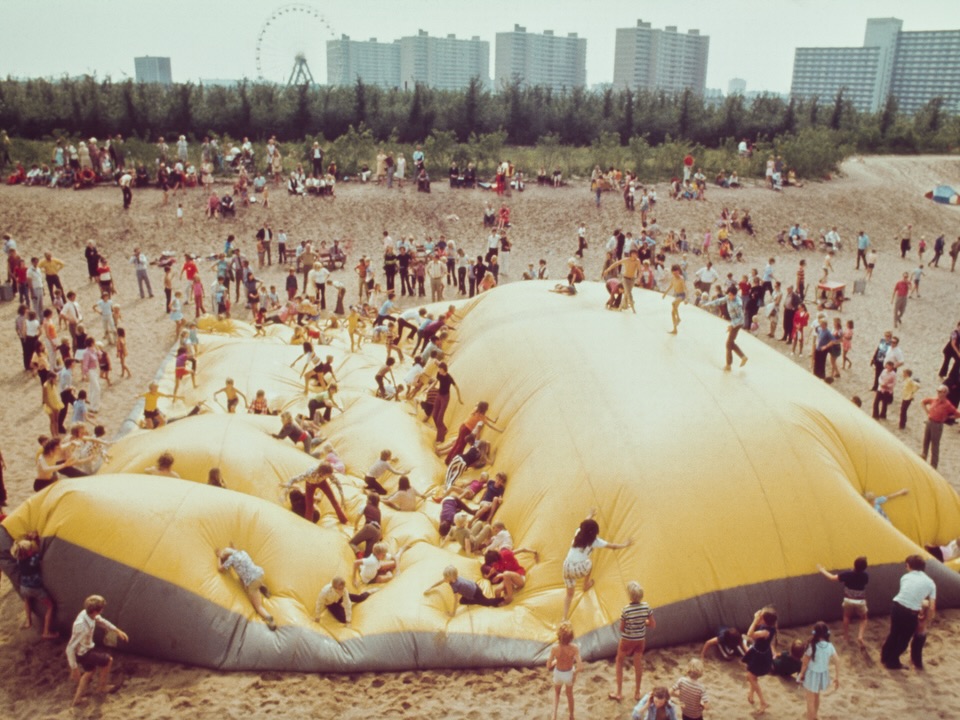
Around the same time, projects such as Airground and Aqua Airground turned open ground into elastic fields of play. These inflatable playgrounds invited jumping, sliding, and collective imbalance. Social hierarchies dissolved quickly. Adults and children, strangers and friends, all negotiated the same unstable surface. At Floriade 1972, Aqua Airground was presented to large audiences, incorporating water into the structure so that the ground itself behaved like weather: responsive, shifting, impossible to dominate.
DISPERSION AND AFTERLIFE
By the late 1970s, the members of ERG increasingly pursued individual paths, and the group’s collective operation gradually dissolved. Yet the work did not disappear. It dispersed. ERG’s projects survive primarily through drawings, photographs, and filmed documentation, materials that record not only form but use.
This dispersion is essential to understanding their legacy. ERG did not aim to produce lasting objects. Their works were designed to be experienced, remembered, and reimagined rather than preserved intact. Documentation became the site where these temporary events could continue to circulate, not as replicas but as propositions, portable instructions for another city, another crowd, another afternoon.

The 2023 Sky & Game exhibition approached ERG precisely through this lens. Rather than reconstructing inflatables as museum artefacts, it treated documentation as an active space, capable of restoring the group’s operational logic. ERG appears not as a closed chapter, but as a toolkit for thinking about public space today.
INFLATING THE PUBLIC
ERG’s legacy is not stylistic. It is methodological. They demonstrated that simple technology can produce complex social effects, and that art can function as a temporary civic instrument. Their inflatable structures offered a way to reorganise space quickly, invite participation, and assemble publics without coercion.
In an era increasingly comfortable with interaction mediated by screens, ERG’s work insists on something stubbornly physical. It reminds us that public space is shaped not only by buildings or regulations, but by what bodies are allowed to do together and how quickly that permission can be withdrawn.
ERG did not inflate objects. They inflated the idea of what a public can be.
And in doing so, they left behind a question that still feels urgent: how much of the city is reserved for unbought joy.
REFERENCES
- Van Eesteren Museum. Sky & Game: Eventstructure Research Group 1967–1982, exhibition texts, archival materials, and curatorial research, Amsterdam, 2023.
- Shaw, Jeffrey. Artist writings, interviews, and project documentation on the Eventstructure Research Group.
- Latham, John. Writings and interviews on “event structure” and time-based art, 1960s–1970s.
- Youngblood, Gene. Expanded Cinema. New York: E. P. Dutton, 1970.
- Bishop, Claire. Artificial Hells: Participatory Art and the Politics of Spectatorship. London: Verso, 2012.
Photo Cover
Waterwalk Tube (1970), Maschsee Lake, Hanover: Participants walking inside the 250-meter transparent inflatable tube, creating a temporary bridge across water as collective civic infrastructure.
Credit: Eventstructure Research Group archive / Jeffrey Shaw Compendium