
Now Reading: Nadav Kander and the slow violence of Modernisation
- 01
Nadav Kander and the slow violence of Modernisation


Across rivers, nuclear test sites, and the human body itself, Nadav Kander photographs the traces of power not as spectacle, but as atmosphere. His images examine how landscapes absorb ambition, how damage persists without visibility, and how photography can remain ethical when clarity itself begins to fail.
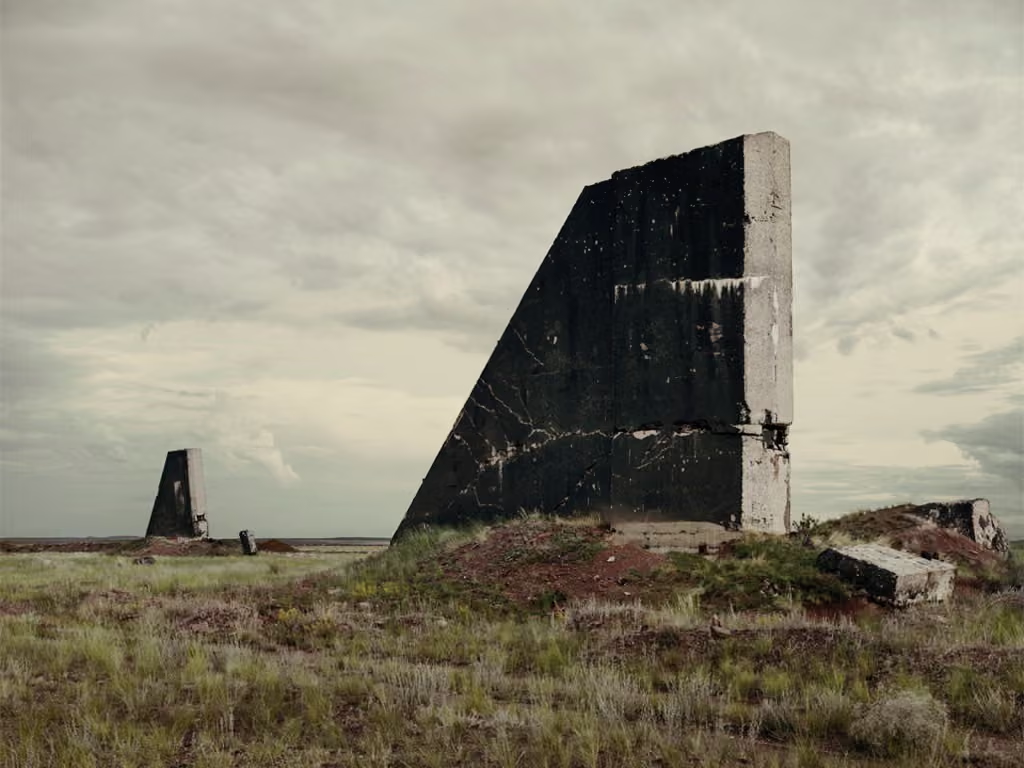
WHEN THE HORIZON BECOMES EVIDENCE
In contemporary photography, few artists have approached landscape with the moral patience and formal restraint of Nadav Kander. His images rarely shout. They do not trade in spectacle, catastrophe, or the visual drama of collapse. Instead, they offer something more unsettling: scenes that appear calm, balanced, and meticulously composed, yet carry an undertow of unease. The disturbance does not announce itself. It settles slowly, through scale, atmosphere, and omission.
Something has happened here, Kander’s photographs seem to suggest. Something irreversible. And life continues anyway.
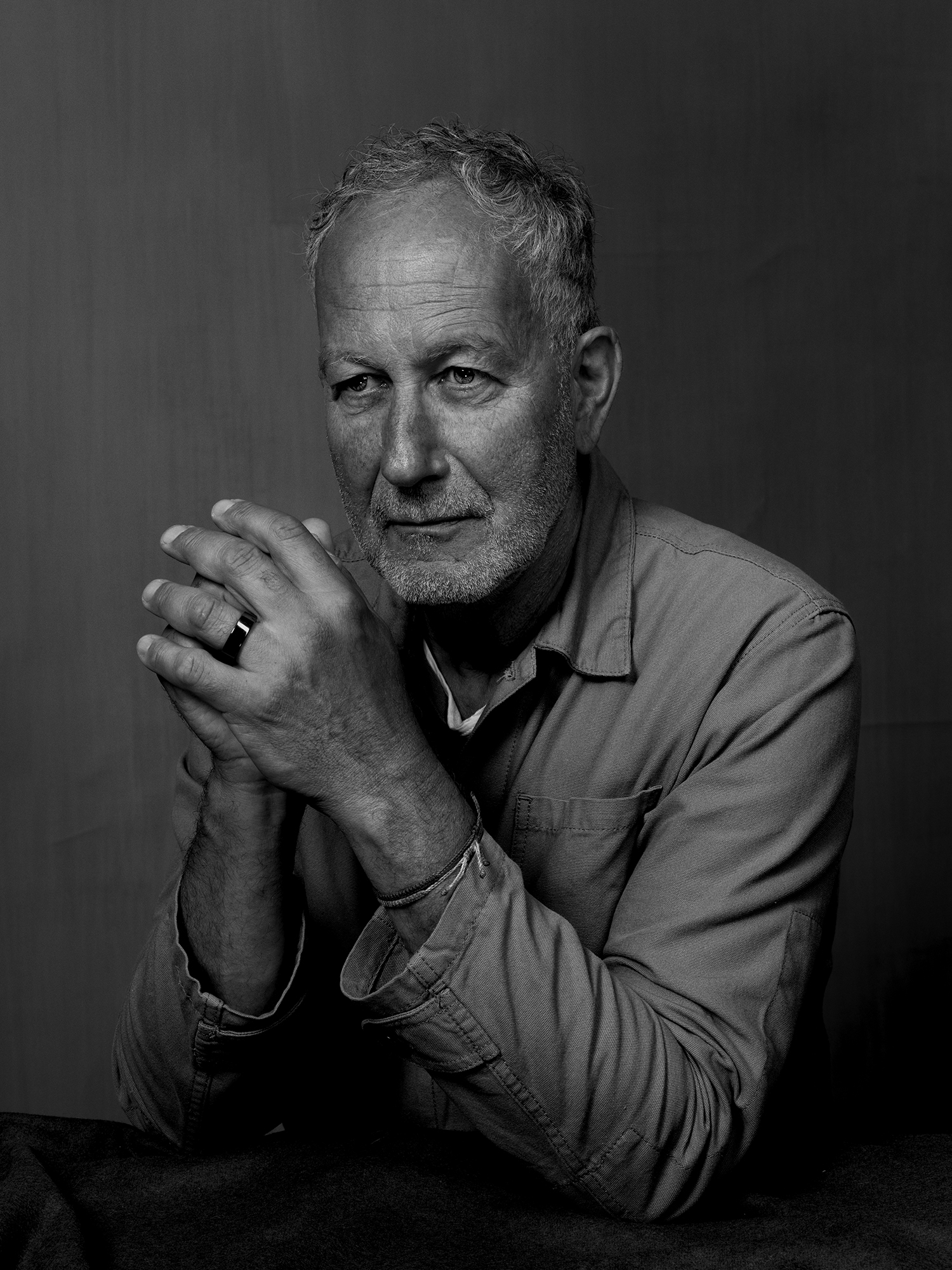
Born in Tel Aviv in 1961, Kander moved to South Africa as a child and later settled in London in the mid-1980s. This biography matters not as anecdote, but as a condition of seeing. Growing up across political systems and cultural boundaries, he developed a heightened sensitivity to environments shaped by forces larger than the individual. Migration, power, and impermanence are not themes he adopts from the outside; they are lived pressures that surface repeatedly in his work.
Rivers, borders, industrial margins, and emptied spaces recur not as motifs, but as questions. What remains when ideology, technology, and ambition have passed through a place? How does land remember decisions made elsewhere? And what responsibility does photography bear when the most consequential transformations of our time unfold without spectacle?
Although Kander is widely known for portraiture commissioned at the highest levels of public life, his most sustained and consequential practice unfolds in landscape. He uses terrain not as background, but as evidence. In his photographs, the environment becomes a quiet archive of progress, extraction, secrecy, and dislocation.
LANDSCAPE NOT AS SCENERY, BUT AS CONDITION
Kander’s landscapes resist the conventions of both classical landscape photography and straightforward environmental documentary. They are neither celebratory nor didactic. They hover between observation and introspection, between what can be named and what is only sensed.
Human figures, when present, are often diminished, turned away, or rendered anonymous. They appear not as protagonists, but as witnesses, often barely legible against the scale of their surroundings. This choice is not stylistic ornament. It reflects an ethical position.

Kander does not photograph to explain the world. He photographs to remain with uncertainty. The camera becomes a tool for dwelling in ambiguity, acknowledging that many of the most consequential transformations of our time unfold slowly, invisibly, and without drama.
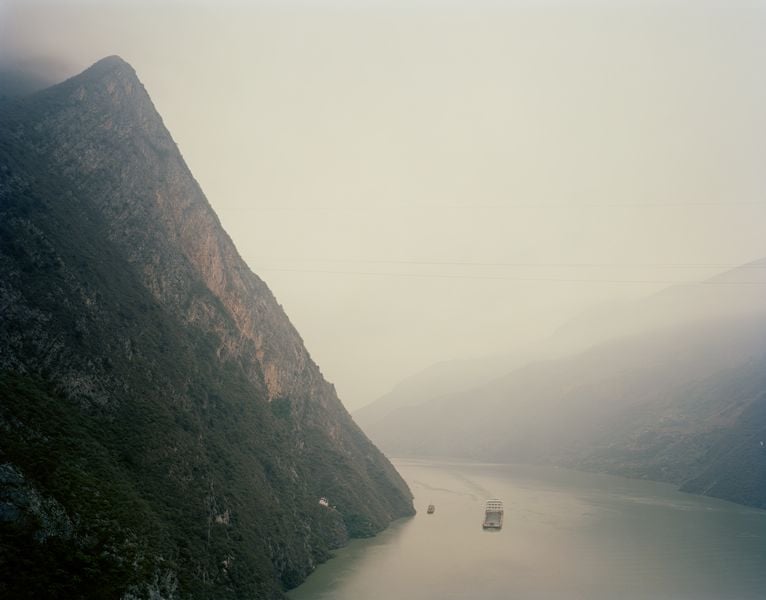
Formally, restraint governs the work. Cool tonal ranges dominate: greys, muted blues, pale greens. Light is diffused by mist, haze, or low cloud, flattening depth and softening edges. These atmospheres do not romanticise the landscape. They complicate it. Distance becomes difficult to measure. Orientation falters. The viewer is held in suspended judgment, close enough to feel implicated, yet denied the comfort of an overview.
This discipline allows Kander to approach environmental degradation, industrialisation, and political power without reducing them to illustration. The images do not argue. They accumulate.
THE YANGTZE: MODERNISATION AND THE WEIGHT OF SCALE
Kander’s landmark series Yangtze – The Long River occupies a pivotal place in contemporary photography on urbanisation and environmental change. Created over several years in the mid-2000s, the project traces China’s longest river at a moment when the country’s pace of development was reshaping not only its cities, but its ecological and cultural foundations.
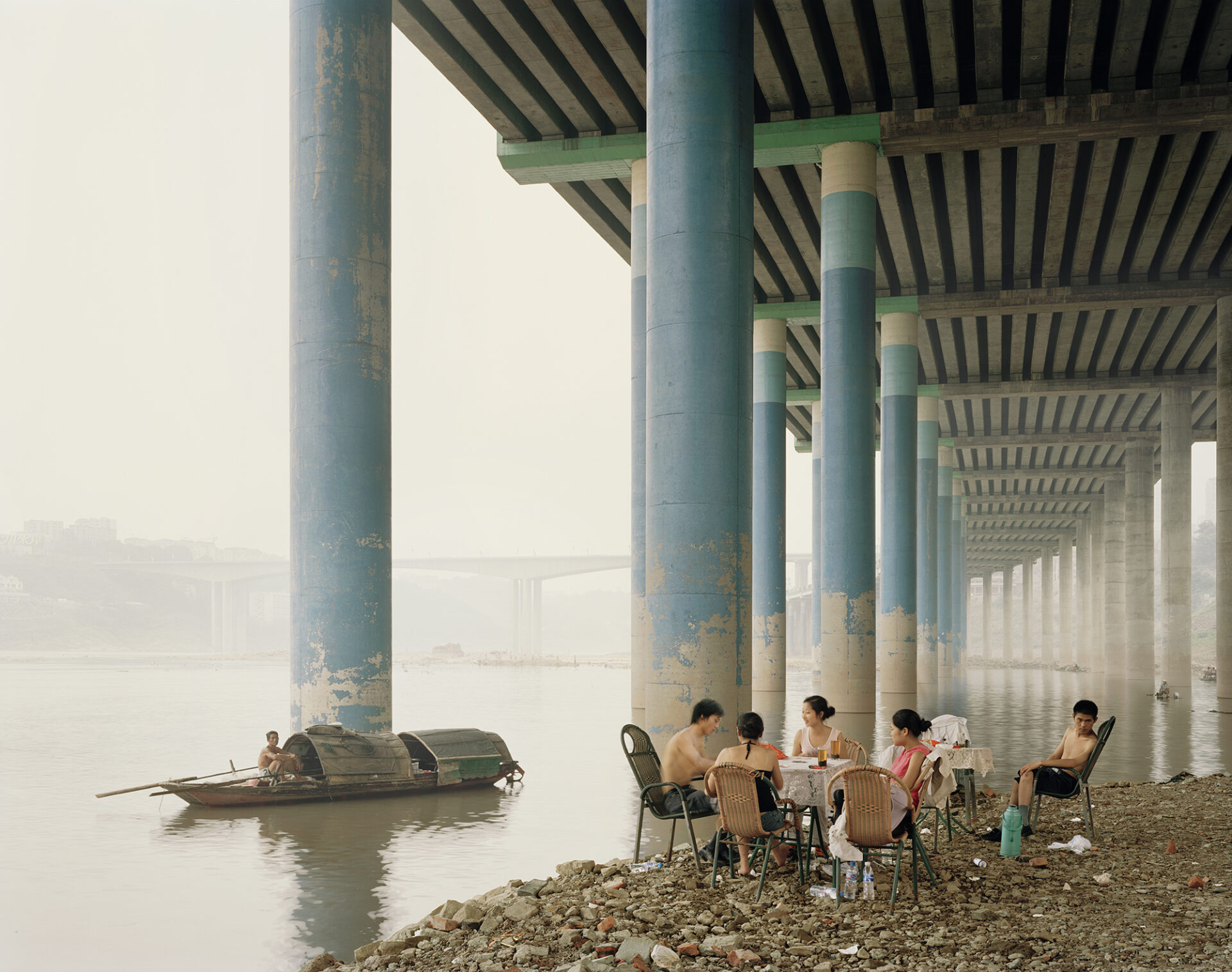
The work unfolded against the backdrop of China’s vast infrastructural expansion, most notably the construction of the Three Gorges Dam, completed in 2006. As one of the largest hydro-engineering projects ever undertaken, the dam reshaped water flow, displaced communities, and transformed entire riverine ecologies along the Yangtze basin. While Kander does not photograph the dam directly, its presence is implicit throughout the series. Altered riverbanks, suspended haze, and the scale of construction register its consequences as atmosphere rather than event.
Kander framed the Yangtze as a metaphor for constant transformation, photographing along its length from mouth to source and working intuitively, resisting the urge to illustrate what he already knew. This method explains why the images feel less like reportage and more like a slow, cumulative recognition.
Rather than adopt an aerial or panoramic perspective, Kander positions himself at the river’s edge. He photographs from within the landscape at a human scale, where transformation is felt as daily reality rather than abstract data. Infrastructure, from bridges to factories and construction sites, often looms behind or beside ordinary gestures.
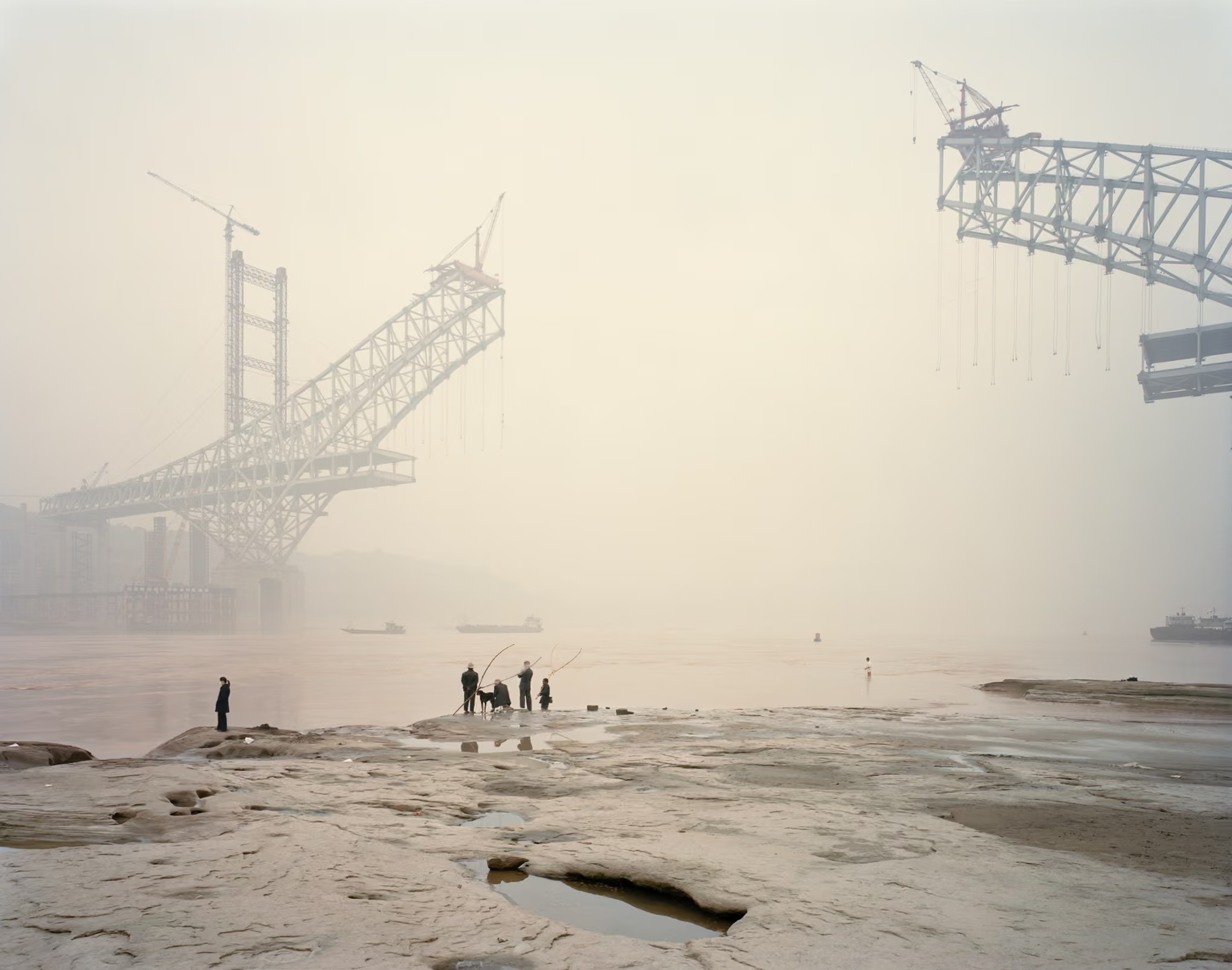
In one emblematic image, a lone figure stands on the riverbank, his back turned to the camera. Behind him, a massive bridge rises mid-construction, its concrete pylons cutting through a sky thick with haze. The river occupies the foreground, dull and opaque, reflecting little light. Nothing appears broken. And yet everything feels provisional.
Scale does the work. The bridge overwhelms the human figure without drama, asserting a future that has already arrived. The haze collapses distance, merging water, land, and sky into a single atmospheric field. The calm of the image is what unsettles. It suggests a world already reorganised, where progress has settled into the terrain and life continues in its shadow.
THE POLITICS OF LOOKING
Kander’s refusal of the elevated, managerial view is not merely aesthetic; it is political. Aerial photography has long been associated with control, surveillance, and planning. It produces legibility. It turns lived terrain into diagram.
By remaining grounded, Kander resists this logic. His photographs do not claim mastery over the landscape. They admit limitation and invite the viewer to share it. In Yangtze, this approach makes scale ethically legible. The riverbank is not an abstraction. It is where bodies stand, bathe, work, wait, and look back at the structures rising behind them.
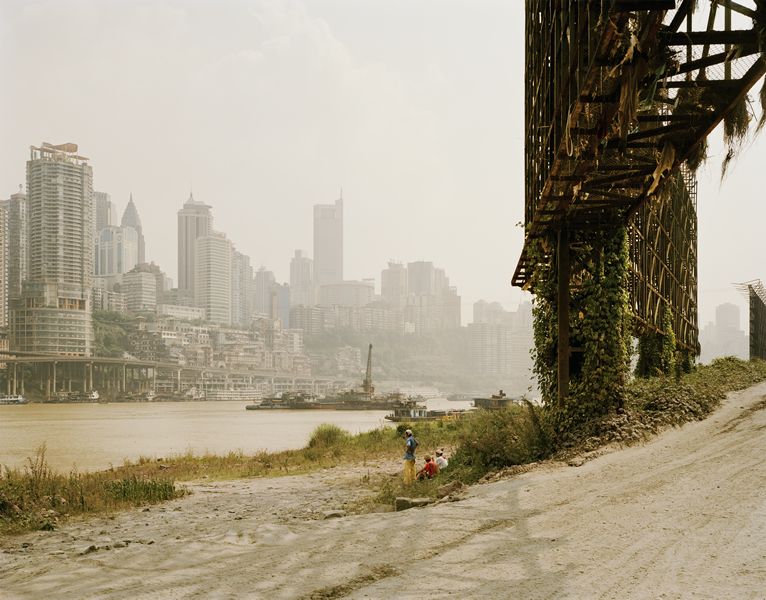
Credit: Nadav Kander, from Yangtze – The Long River series
For architects, this way of seeing offers a parallel mode of spatial thinking. Infrastructure appears not as object, but as ideology. Bridges, dams, and platforms operate as systems that reorganise scale, compress time, and redefine human proportion. In this sense, Kander’s photographs function as post-occupancy evaluations of power, revealing what large systems do to everyday space long after construction has ended.
DUST: AFTER THE EVENT AND THE PROBLEM OF THE INVISIBLE
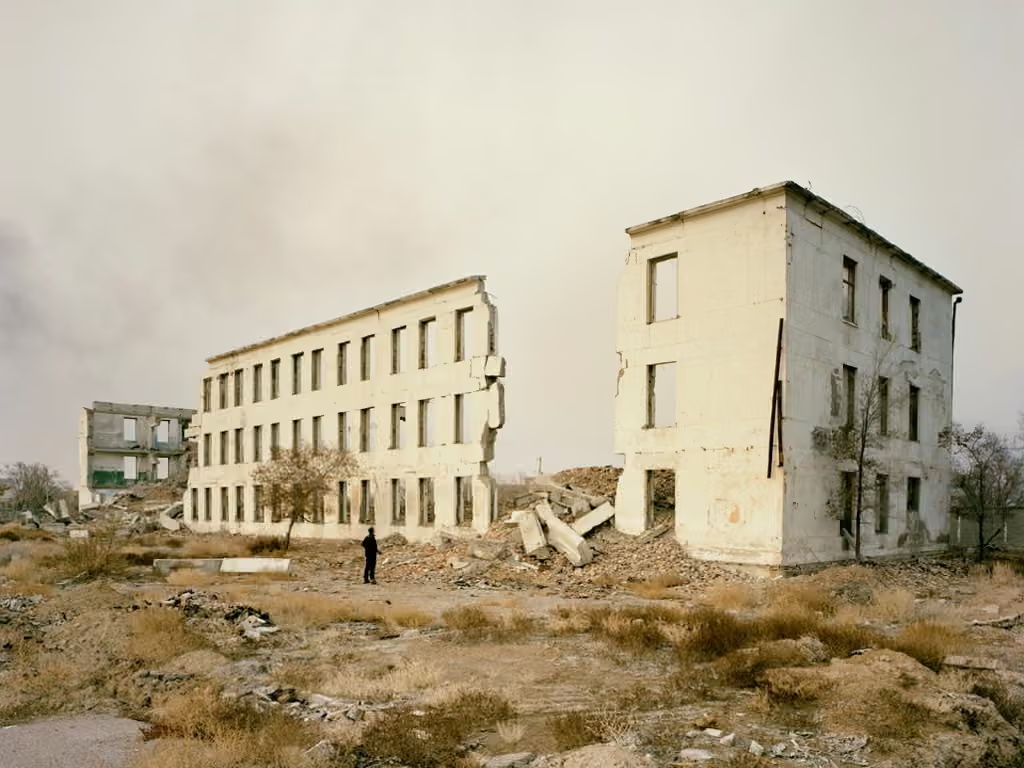
If Yangtze addresses the visible machinery of progress, Dust turns toward its aftermath. Published in 2014, the project follows Kander into landscapes shaped by nuclear testing, military secrecy, and long-term contamination. He photographed the desiccated shoreline of the Aral Sea and restricted zones around Priozersk and Kurchatov, two formerly closed cities near the Kazakhstan–Russia border.
Between 1949 and 1989, the Semipalatinsk Test Site functioned as the Soviet Union’s primary nuclear testing ground, hosting 456 underground and atmospheric detonations. The environmental and human consequences continue to unfold across generations. Yet Kander’s photographs refuse the iconography of disaster. There are no explosions, no visible victims, no spectacular ruins.
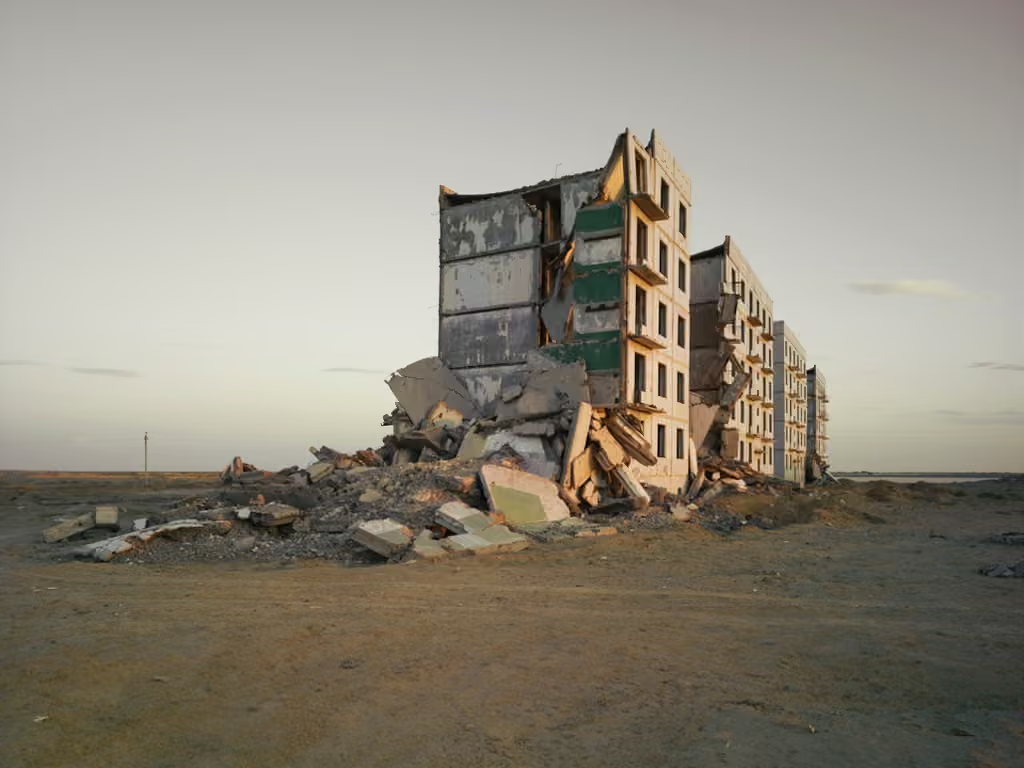
One image shows an abandoned settlement at the edge of an immense steppe. Low buildings sit beneath an expansive sky, their windows dark, their outlines softened by distance and dust. The ground appears stable, almost benign. The danger is not visible.
The emptiness is charged rather than peaceful. The horizon offers no relief, no sense of exit. Colour drains from the scene, leaving a palette of ashen greys and washed-out blues. Here, catastrophe is not an event. It is a condition. The photograph asks the viewer to sit with a landscape that looks intact while carrying harm that cannot be seen.
RIVERS, DARKNESS, AND THRESHOLDS
Water remains central to Kander’s practice. In Dark Line – The Thames Estuary, the river becomes a psychological threshold rather than a landmark. Photographed repeatedly over years, the estuary appears as a liminal zone that is neither fully land nor sea, neither natural nor industrial.
The horizon opens wide, yet offers little resolution. Light fades quickly. The water resists interpretation. The estuary becomes a space of return rather than discovery, structured by duration and solitude.
This sensibility deepens in After Dark, a body of work that treats darkness not as drama, but as a condition of perception. Vision falters. Detail recedes. The camera records what remains when the eye can no longer claim mastery.

Across these projects, Kander returns to the same tension that animates Yangtze and Dust: the desire to see clearly, and the reality that the most consequential forces shaping contemporary life are often diffuse, atmospheric, and resistant to depiction.
INFLUENCE AS DISCIPLINE
Kander’s dialogue with broader art histories is best understood not through lists of references, but through method. Influence, in his work, operates as pressure rather than decoration. He has described influence as a springboard, something to push against rather than imitate, and has expressed concern about the contemporary tendency to borrow too directly instead of invent.
This position helps explain why his photographs can be formally beautiful while refusing reassurance. Beauty becomes surface tension, holding discomfort in place rather than resolving it. Influence, for Kander, is a discipline: a way of staying honest about complexity.
BODIES. 6 WOMEN, 1 MAN
At first glance, Bodies. 6 Women, 1 Man (2013) appears to depart from Kander’s landscapes. Nude figures, coated in white and turned away from the camera, stand against a dark studio void. Faces are withheld. Identity is suspended.
Seen alongside his landscape work, the series reveals continuity rather than rupture. In Yangtze and Dust, the human figure is diminished by scale. In Bodies, the figure becomes monumental yet strangely anonymous.

In one image, a figure stands in three-quarter view, her shoulder catching the light. The white coating turns skin into surface, flesh into something almost geological. The absence of the face denies psychological access. The body is present, exposed, yet withheld.
The studio becomes a void rather than a neutral space. The marble-like surface suggests permanence while emphasising vulnerability. The same paradox that runs through Kander’s landscapes returns here: visibility entangled with erasure.
A QUIET WARNING
Kander’s photographs are often described as serene. This is accurate, but incomplete. Their calm is not reassurance. It is the calm of systems already set in motion, beyond easy reversal. Like a river constrained by concrete banks, the world in his images continues to flow, but within altered limits.
What Kander offers is not a lesson, but a method. His work demonstrates how attention can remain critical without becoming didactic, and how representation can engage power without claiming mastery over it. By refusing spectacle and remaining grounded, his photographs create space for reflection rather than resolution.

In an era saturated with images that demand instant reaction, Kander asks for something slower and more difficult: sustained looking. The responsibility his work gestures toward does not emerge from outrage or clarity, but from recognising how deeply systems of power have already settled into the landscapes we inhabit, and how quietly they continue to shape what we see, build, and accept as normal.
REFERENCES
- Nadav Kander – Official Website (biography and projects)
- Prix Pictet – Yangtze – The Long River, Earth Cycle (2009)
- Nadav Kander – Dust (Hatje Cantz, 2014)
- Flowers Gallery – Dark Line – The Thames Estuary
- Flowers Gallery – After Dark (2025 exhibition)
- Nuclear Threat Initiative – Semipalatinsk Nuclear Test Site (1949–1989; 456 nuclear tests)
- World Photography Organisation – Sony World Photography Awards: Outstanding Contribution to Photography (2019)
Photo Cover
Misty Yangtze river scene embodying Kander’s restrained, atmospheric approach to landscape.
Credit: Nadav Kander, from Yangtze – The Long River series