
Now Reading: Ricardo Bofill: Surreal Spaces, Communal Dreams
- 01
Ricardo Bofill: Surreal Spaces, Communal Dreams


From an abandoned cement factory outside Barcelona to labyrinthine social housing and monumental civic stages, Bofill treated architecture as a social instrument, a way to remake how people meet, move, and belong.

In 1973, on the outskirts of Barcelona in Sant Just Desvern, Ricardo Bofill (1939 – 2022) encountered a deserted cement factory and recognised it as something more than industrial residue. He began converting the site into what would become La Fábrica, a compound of silos, galleries, courtyards, and gardens where a studio, a home, and a long experiment in reuse could coexist.
The image has become iconic: vines against concrete, light cutting into former machine rooms, workshops unfolding inside a structure designed for extraction and dust. Yet the deeper significance is not aesthetic alone. La Fábrica establishes a method that returns throughout Bofill’s work: architecture as an apparatus for transforming social life. His most compelling buildings do not simply arrange rooms; they choreograph movement and exchange. They pull the private outward toward shared space and, just as importantly, they give shared space a sense of dignity that modern housing too often denies.
Bofill’s practice, Ricardo Bofill Taller de Arquitectura, grew into a prolific international atelier. Numbers are easy to quote, but they are not what keep the work alive in the public imagination. What endures are the spaces: the red labyrinth of La Muralla Roja in Calpe, the stacked courtyards of Walden 7 in Sant Just Desvern, the monumental theatre of Les Espaces d’Abraxas in Noisy le Grand, and the long urban corridor of Antigone in Montpellier. These projects are photographed because they are visually arresting, but their provocation runs deeper. They suggest that collective life can be made attractive again, not as ideology, but as experience.
This essay argues that Bofill’s most lasting contribution lies in a precise fusion: classical reference without nostalgia, modular geometry without coldness, and social ambition without sentimentality. His architecture makes a wager that contemporary cities can still produce communal dreams, if design is willing to treat circulation, threshold, courtyard, and the public room as the true material of the built environment.
BIOGRAPHY AND FORMATIVE INFLUENCES
Bofill’s early life and education unfolded under the Franco regime, a political climate that shaped cultural expression and urban development in Spain. His formation is often told through rupture: a young architect pushed out of institutional comfort, then re shaped by exposure beyond Barcelona before returning to found a studio that would treat architecture as a social project rather than a purely formal one.
In 1963 he established the Taller de Arquitectura as a deliberately heterogeneous collective. The point was not branding. It was method. By gathering architects and engineers alongside thinkers and makers from other fields, the studio positioned design as an instrument that could absorb social observation, political pressure, and cultural imagination. That choice helps explain why Bofill’s buildings so often behave like systems rather than objects. They are designed to organise social patterns, to produce encounters and friction, to model alternative ways of living in the city.
The late 1960s were the Taller’s experimental furnace. Modular aggregation, spatial complexity, and a fascination with city making in section rather than only in plan all fed into housing prototypes that refused the corridor block as an unquestioned norm. A project like Kafka’s Castle, completed in 1968, reads less like a conventional apartment building than a constructed terrain, where the path matters as much as the destination. Even at this early stage, Bofill’s interest lies in choreography and psychology: how access, delay, and adjacency shape daily life.

The Mediterranean and North Africa also fed his imagination, not as exotic imagery but as operational models for dense urban living. Courtyards, compact clusters, and layered circulation offered an alternative to the isolated slab and the neutral hallway. These precedents suggested that intimacy and collectivity need not be opposed, that a city can be thickened through nested thresholds and shared voids. In Bofill’s later work, the kasbah becomes less an image than a grammar, a way of writing density so that it supports both privacy and encounter.
From these influences emerged a research ambition that would echo across decades: the idea of a three dimensional city assembled from repeatable units, flexible enough to adapt, complex enough to produce social life through form. In the Taller’s hands, that ambition was not a single finished object but a framework, a manifesto scale way of thinking about housing and urbanism as intertwined.
Bofill is routinely placed under the umbrella of postmodernism, and that categorisation is not wrong. His buildings often play with classical motifs, symmetry, and exaggerated scale, and they do so in deliberate contrast to late modern austerity. Yet postmodernism alone does not explain the internal mechanics of his work. His style is not merely about quotation; it is about organisation, legibility, and the politics of everyday space.
At the core of his philosophy is a belief that domestic architecture can act as urban infrastructure. Stairs, landings, bridges, courtyards, and shared terraces are treated as civic materials, not as leftover circulation. In the projects where his ambition is most concentrated, the apartment is a unit within a larger spatial apparatus where shared movement produces social visibility. The in between becomes the point: the thresholds where you glimpse a neighbour, the crossings that make presence unavoidable, the stacked courtyards that turn light and air into shared phenomena.
This systemic impulse coexists with monumentality. In France, especially from the late 1970s into the early 1980s, Bofill pursued a language of classical grandeur at the scale of housing and civic complexes. Columns, arches, and cornices appear oversized, not as nostalgia but as a claim that the everyday deserves symbolic weight. His classicism is less about the past than about hierarchy. It asks why spatial dignity is reserved for institutions while housing is left to anonymity.
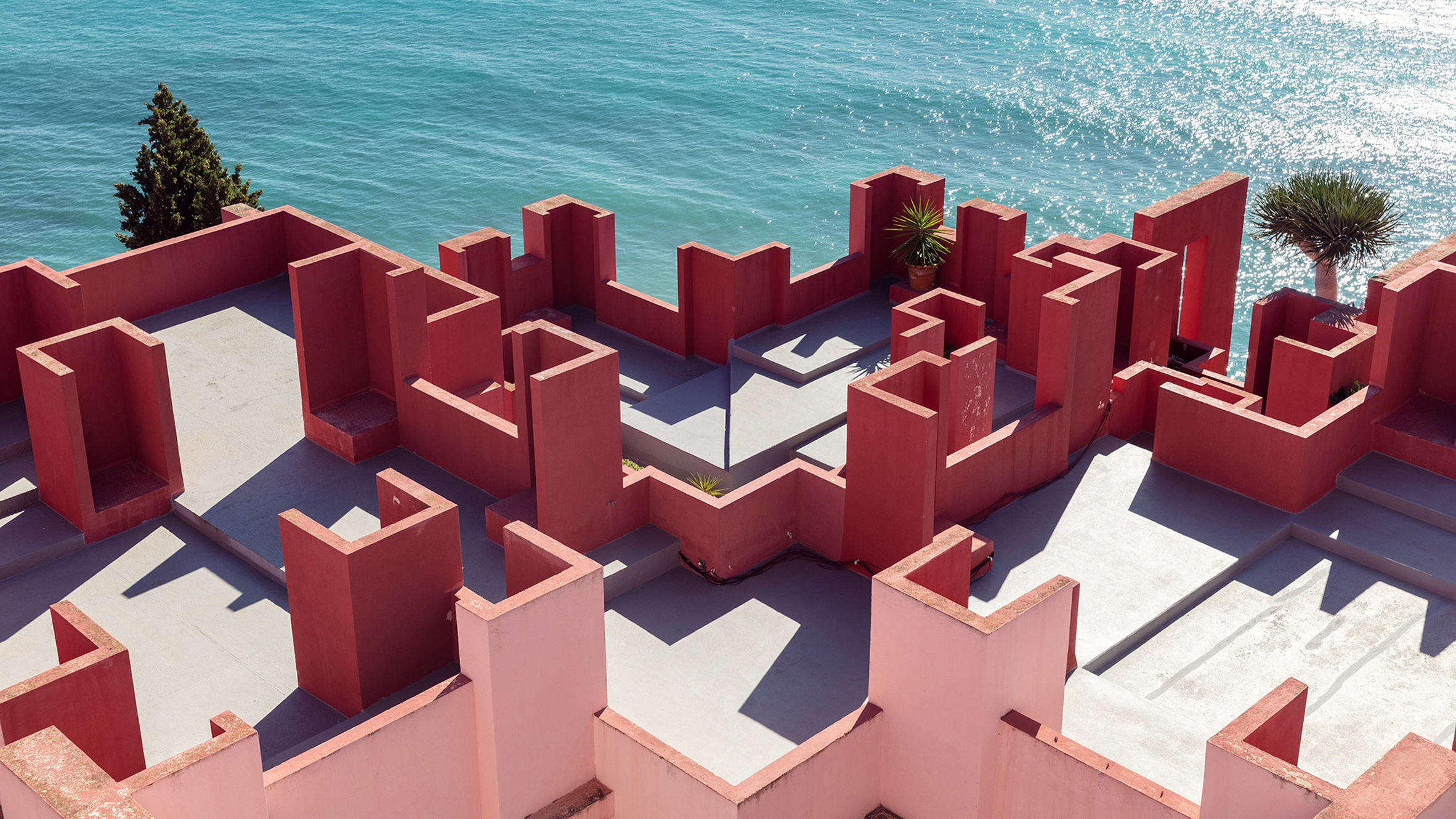
Colour and atmosphere form a third strand of his approach. In La Muralla Roja, saturated reds and blues are not superficial styling. They recalibrate perception, intensify shadow, and turn circulation into an optical event. Architecture becomes a device for orientation and disorientation, a lived sequence of chromatic thresholds that makes daily movement feel strange, vivid, and newly noticed.
Finally, Bofill’s work anticipates contemporary debates about reuse, not as a technical fix but as a cultural practice. La Fábrica is not adaptive reuse as category; it is adaptive reuse as daily life, as studio culture, as a long conversation between industrial ruin and designed landscape. Transformation can be radical without being tabula rasa. Continuity can be more provocative than novelty.
Criticism has always accompanied these ambitions. Technical failures, maintenance burdens, and the social fragility of large housing experiments are real. But these difficulties do not erase the significance of the work. They clarify the stakes. To design collective dreams at full scale is to accept that architecture is not only form but responsibility.
LA FÁBRICA, SANT JUST DESVERN
Conversion began 1973
La Fábrica begins with a material fact and ends as a spatial thesis. A cement plant becomes a studio and a home, but the project does not hide the industrial past. It works with remnants: silos, machine rooms, tunnels, towering voids. Portions are removed, others opened, and gardens are inserted as if the building is learning to breathe differently.
What makes it persuasive is its refusal of cosmetic transformation. Nature does not decorate the concrete; it negotiates with it. Light enters through gaps that feel carved rather than glazed. Routes unfold through spaces never intended for inhabitation, so that movement itself becomes an awareness of prior life. The project proposes that the city’s discarded structures can become cultural infrastructure, not through sanitisation but through recalibrated use. Reuse is not only a strategy; it becomes a way of constructing rituals and working cultures.

LA MURALLA ROJA, CALPE
Designed 1968, completed 1973
If La Fábrica is a private laboratory, La Muralla Roja is an outward facing proposition about collective life. It organises apartments through staircases, bridges, platforms, and courtyards inspired by the circulation logic of Mediterranean hill towns and kasbah like density.
Its intelligence lies in how it multiplies choices. There is no single corridor that dictates movement. Routes interlock and overlap, producing moments of encounter and separation, visibility and privacy. Shared circulation becomes a kind of urban theatre, not through spectacle but through inevitability. Residents see one another in passing. Community becomes more likely, not through programming but through form.

Colour intensifies this experience. Reds and pinks amplify the sensation of enclosure. Blues deepen shadow and sharpen contrast. The building becomes an optical instrument: at different hours, the same stair can feel flat or sculptural, the same courtyard calm or disorienting. La Muralla Roja is often flattened into image culture, yet its deeper argument is experiential. Shared space can be designed as pleasure rather than leftover. The labyrinth can be social rather than punitive.
WALDEN 7, SANT JUST DESVERN
Completed 1975
Walden 7 is Bofill’s most direct attempt to compress a city into a building. It is a vertical cluster of courtyards and bridges, stitched together by routes that behave like streets. Plan and section cooperate to create an internal urbanism where the in between becomes the project’s heart.
The ambition is social as well as formal. Density is framed as community rather than isolation, but only if shared space is treated as primary architecture. Courtyards operate as collective rooms stacked through the building’s height, so that light and air become communal phenomena. Bridges create moments of pause and view, turning circulation into shared orientation.


Walden 7 also carries a harder lesson. Utopian housing does not succeed once and remain stable. It demands stewardship. Collective form lives or fails through care, maintenance, and a willingness to treat housing as civic heritage rather than disposable development.

LES ESPACES D’ABRAXAS, NOISY LE GRAND
Constructed 1978 to 1983, opened early 1980s
In France, Bofill’s language shifts toward monumental classicism. Les Espaces d’Abraxas stages mass housing as an urban monument: a triptych of forms that reads like a civic theatre. Prefabricated concrete performs as if it were carved stone. Columns and cornices scale up into a language of public weight, insisting on symbolic dignity where housing is usually anonymous.
The project has been criticised for its overbearing presence, and the critique is not trivial. Monumentality can overwhelm the intimacy of domestic life. Yet Abraxas remains a sharp provocation. In the landscape of peripheral development around Paris, it refuses invisibility. It gives the outskirts a face, a spatial identity, a civic presence. It asks whether the everyday can claim the dignity of monuments, and what kind of public life might emerge if it does.

LE LAC: LES ARCADES DU LAC AND THE VIADUC, SAINT QUENTIN EN YVELINES
Developed 1971 to 1983
Le Lac extends Bofill’s French period into a different classicism, shaped less by theatre than by landscape. Here, housing is composed as an urban garden: axes, voids, and water are treated as shared civic structure. The ensemble frames the street and the square as deliberate forms rather than accidental leftovers.

What matters is the ambition to make public space feel designed. Housing does not simply sit beside the lake; it composes the lake’s edge. The viaduct becomes a civic gesture, an inhabitable bridge that turns landscape into a shared experience. Classicism in this context is less about quotation than proportion and procession, giving everyday life a calibrated sense of ceremony.
ANTIGONE, MONTPELLIER
Initiated 1979
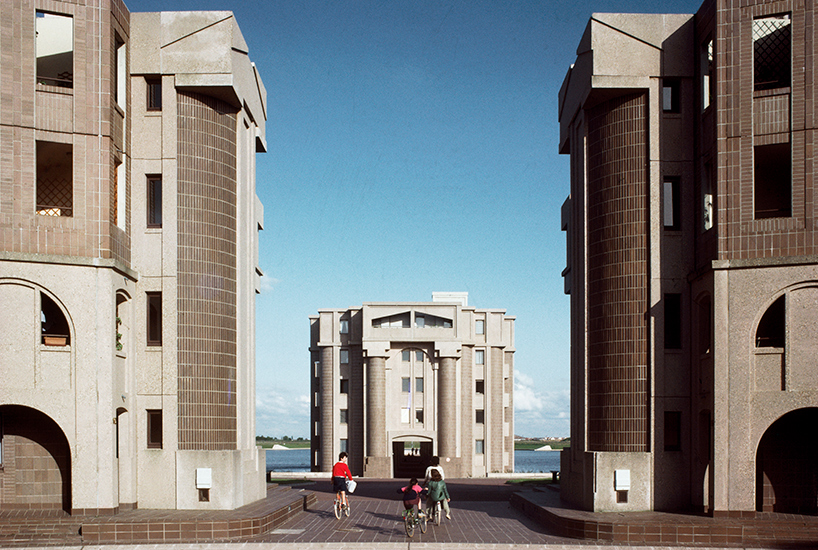
Antigone is the clearest example of Bofill thinking at the scale of an urban district. It unfolds as a long sequence of plazas, arcades, and monumental frames, extending the city with instantly legible identity. It is not a single building but a corridor of public rooms.
The district shows both the power and risk of Bofill’s urban classicism. On one hand, it creates continuity and structure, public space that reads as a shared narrative rather than a series of parcels. On the other, it raises questions about representation: what does it mean to deploy a language of antiquity to shape contemporary expansion. In Antigone, the answer is pragmatic. Cities need coherent public rooms, not only functional infrastructure. Civic legibility is treated as a public good.

PLACE DU MARCHÉ SAINT HONORÉ, PARIS
Completed 1997
If Antigone represents urban design as monumental sequence, Place du Marché Saint Honoré shows Bofill working inside existing fabric. The ambition here is not utopia through housing but civic refinement through insertion. The project negotiates between the inherited logic of a Parisian square and contemporary programme, using passage and transparency to maintain permeability. It suggests a quieter kind of publicness, where buildings participate in the city as shared interiors rather than sealed objects.
W BARCELONA, BARCELONA
Opened 2009
W Barcelona, often called Hotel Vela, stands as a waterfront landmark. It shows how Bofill could operate within contemporary skyline language while retaining an instinct for legibility. The building functions as a sign at the city’s edge, a silhouette that anchors perception. Even here, where programme is hospitality and form is sleek, the project participates in the collective imagination of Barcelona rather than merely its real estate economy.

Bofill’s legacy cannot be reduced to movement labels or surface aesthetics. His work remains urgent because it speaks to problems that have only intensified: loneliness in dense cities, the commodification of housing, and the necessity of reuse.
His influence is visible in three intertwined ways.
First, he rehabilitated the idea that housing can be a civic project. Walden 7 and La Muralla Roja show that circulation can be designed as social infrastructure and that shared space can be shaped as pleasure rather than leftover.
Second, he normalised reuse as cultural practice. La Fábrica remains a persuasive demonstration that industrial ruins can become creative engines through negotiation, not sanitisation, and that continuity can be more radical than novelty.
Third, he expanded postmodern vocabulary beyond irony. His classicism often operates as a demand for dignity and legibility rather than a joke at modernism’s expense. Abraxas remains controversial, but it refuses the assumption that mass housing must look and feel like compromise.
The Taller continues beyond him, which complicates any attempt to freeze the legacy into a closed chapter. What persists is not only a catalogue but a set of propositions about how people might live together, and what architecture can do to make that togetherness desirable.
Ricardo Bofill’s architecture is often called surreal because it looks unreal, and utopian because it refuses modest expectations. But its deepest force is pragmatic. It insists that collective life is shaped by design choices development too often treats as secondary: the stair instead of the corridor, the courtyard instead of the void, the shared terrace instead of the sealed unit.
From the industrial metamorphosis of La Fábrica to the labyrinths of La Muralla Roja and Walden 7, from the monumental theatre of Abraxas to the urban sequence of Antigone, Bofill treated architecture as a social instrument. The question his work leaves behind is not whether we should imitate its style. It is whether we still have the courage to design for communal dreams at full scale, and accept the long responsibility of keeping them alive.
Aerial view of La Muralla Roja in Calpe, Ricardo Bofill’s iconic postmodern labyrinth of vibrant geometric forms and colorful walls. Credit: Photo by Sebastian Weiss