Now Reading: Chakrajeevan Udyan in Ahmedabad turns safety into landscape form
- 01
Chakrajeevan Udyan in Ahmedabad turns safety into landscape form


SAFETY AS THE FIRST MATERIAL
Chakrajeevan Udyan began with a sober fact, observed over time rather than assumed: many women, children, and senior citizens did not feel safe in the park, and so they often avoided it. Hsc Designs treated that absence as the real site condition. Before proposing objects, the team studied climate, light, and patterns of daily use, then rebuilt the park around a clear ambition: to make the space preferable for those who had been pushed away, without narrowing who the park is for.
Three priorities held the project together from start to finish: safety, legibility, and ease of access. In this park, those principles are translated into geometry, sightlines, and the everyday comfort of being present.

A PATH THAT ORGANISES BEHAVIOUR
A continuous, gently winding pathway threads through the park as a lucid spine. It does not simply connect programmes; it makes the park readable. The route opens into distinct spatial rooms that visitors can grasp instinctively, so movement feels natural and return is effortless. The layout guides behaviour without leaning on excessive instruction.

The central viewshed is kept intentionally open, allowing parents and grandparents to observe play while children can locate their families quickly. Children’s areas and senior citizen zones sit within deliberate visual reach, creating a shared field of care across generations. Seating pockets for caregivers, teenagers, and young adults recur at regular intervals, supporting both supervision and lingering, the two social conditions that most effectively turn public space into a community asset.


Vandalism and misuse are addressed through form. Blind corners, deep recesses, and hidden pockets are reduced. Edges are gentle, transitions remain visible, and circulation reads at a glance. The park invites activity without inviting concealment, and it feels open without feeling exposed.

CIRCULAR ECONOMY, BUILT INTO THE GROUND PLANE
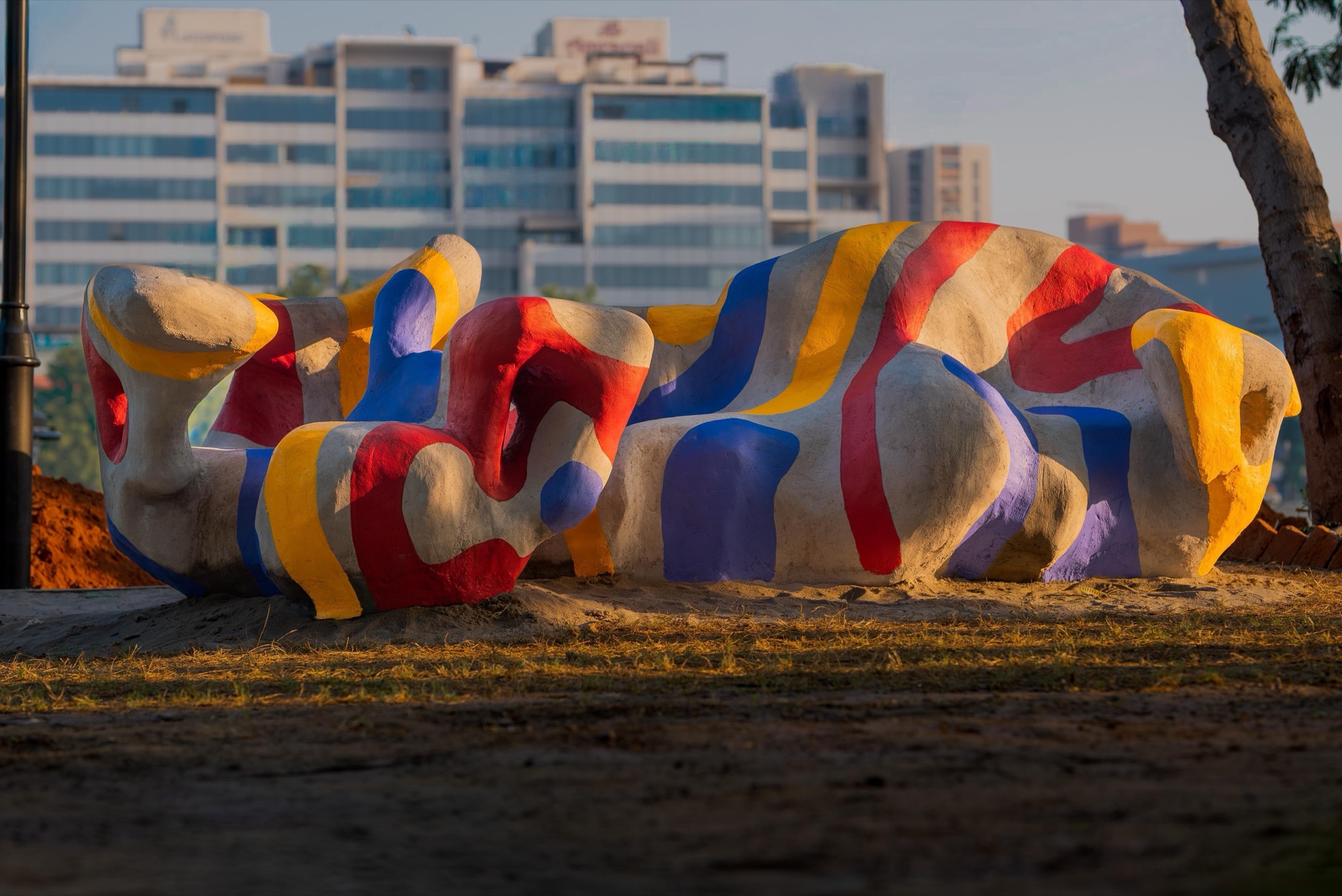
Sustainability is not treated as an accessory here. It becomes a second foundation, shaping materials and assembly from the outset. The project reuses, regenerates, and recycles over 30,000 square feet of material, including concrete, tiles, mild steel rods, bricks, tyres, and wood. These reclaimed elements are recast as pathways, gazebos, trellises, edging, benches, and play structures, turning what would have been waste into the park’s primary infrastructure.


According to the studio’s calculations, this reuse strategy avoids approximately 36 tons of CO₂. To make scale legible beyond specialist audiences, the practice translates that figure into everyday equivalents: roughly 1,700 trees cultivated for ten years, around 150,000 kilometres of car travel avoided, electricity for about 25 Indian homes for a year, and close to 81 domestic flights not taken. In a public park, where “green” can otherwise remain a mood, these comparisons tie design choices to atmospheric consequence.
INDIANNESS, NOT AS MOTIF BUT AS MATERIAL TRUTH
The character of Chakrajeevan Udyan is rooted in familiar local substances, revealed rather than concealed. Discarded concrete pipes become climbable rings and shaded portals. Reclaimed mild steel rods form light trellises and slender frameworks. Salvaged tiles create durable, textured paths that register footfall and time. Reconditioned timber and repurposed tyres become benches and playful inserts that encourage informal gathering without needing event programming to justify presence.


As the park ages, the materials are allowed to deepen. Fired tile shifts in the sun. Mild steel develops a warm patina, protected where necessary through careful detailing and clear sealers. Concrete holds the grain of shuttering and the rhythm of its casting. Timber carries the touch of hands and the small marks of use that come with affection rather than neglect. The park resists a polished image in favour of an honest one, because public space is lived space.

DETAIL AS A PROMISE OF ENDURANCE
Assembly matters here as much as selection. Welds are clean and continuous. Edges at grip points are eased for comfort. Drainage channels and weep holes are present but discreet. Joints invite inspection and repair. Systems are robust, modular, and serviceable, acknowledging that a park must withstand monsoon cycles, heat, and the exuberance of daily use, then continue to perform without requiring costly replacement.

This ethic of repair becomes part of the project’s sustainability logic. Longevity is not only the product of durable materials; it is designed into how the park can be maintained, adjusted, and cared for over time.
DESIGNED AROUND THOSE WHO USE IT MOST
Proportions across the park follow the anthropometrics of the bodies most likely to occupy them. Heights, reaches, footholds, and grasp points are calibrated to promote confidence in children and ease for elders. Senior seating includes supportive backs and armrests that assist the act of standing up and lowering down. Shade falls across these seats during hotter hours through solar study and careful placement.


Surfaces are non-slip without feeling abrasive. Path widths accommodate wheelchairs and prams with dignity, without forcing anyone to yield or apologise. Wayfinding remains implicit, embedded in geometry rather than imposed through excessive instruction. In Chakrajeevan Udyan, the plan becomes the sign.

The making of this landscape is also a civic proposition. By embedding sightlines, shared thresholds, and collective guardianship into the spatial order, the park encourages good conduct through the simple fact of mutual presence. It stays playful without becoming permissive, and it stays open without becoming unsafe.
Chakrajeevan Udyan ultimately reads as a public garden for everyday dignity. It is accessible, circular in spirit, and proudly local, a place where the youngest and the oldest can meet in the open and feel at home.
Project Credit
Design: hsc-designs.com / @hsc_designs
Project: Chakrajeevan Udyan
Location: Ahmedabad, India
Status: Completed
More Photos