
Now Reading: Moments of Stillness: Thibault Drutel’s Symmetric Subway and the poetry of transit infrastructure
- 01
Moments of Stillness: Thibault Drutel’s Symmetric Subway and the poetry of transit infrastructure

Moments of Stillness: Thibault Drutel’s Symmetric Subway and the poetry of transit infrastructure

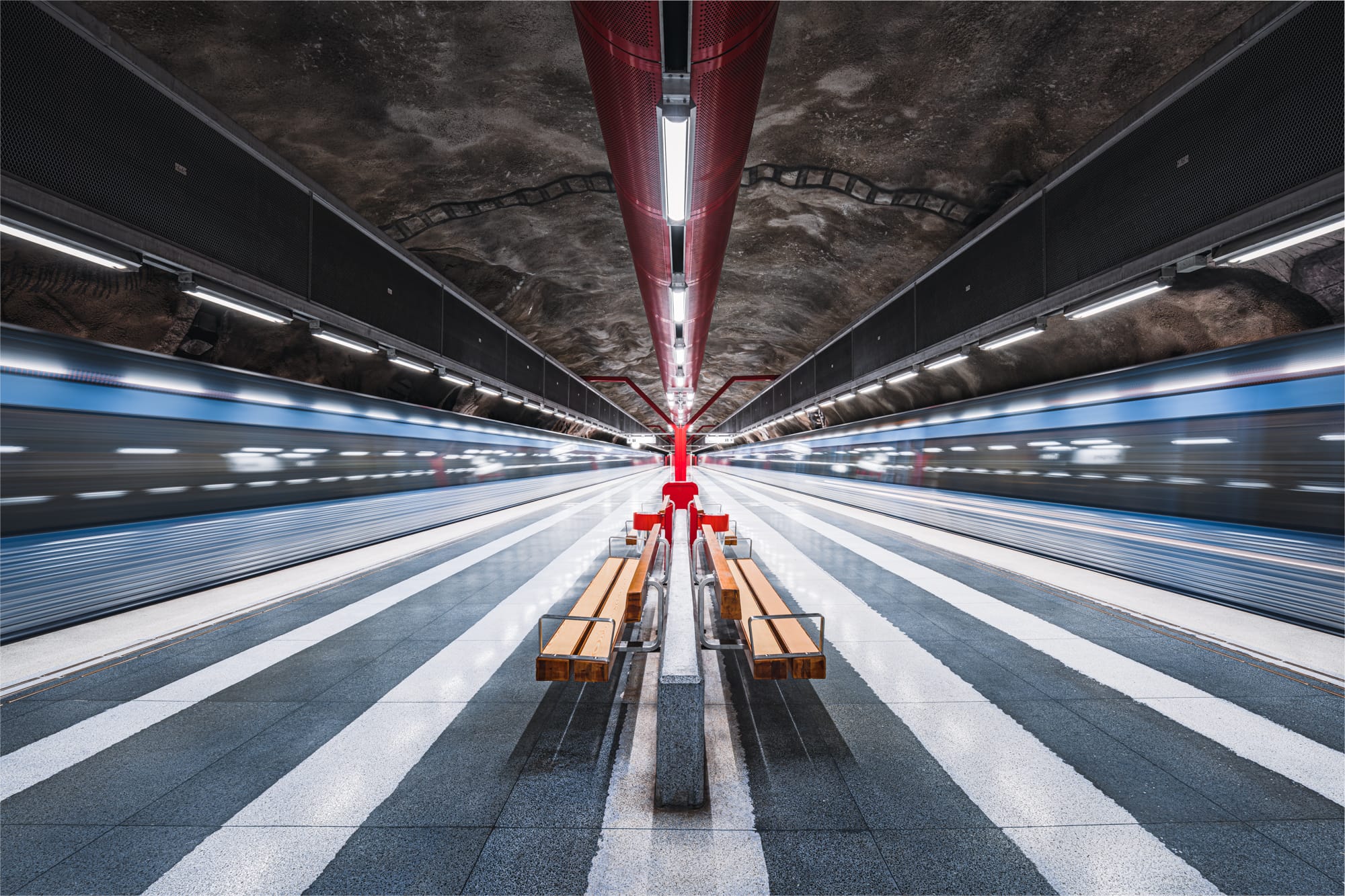
Beneath Europe’s cities, where movement is usually read as speed and utility, French photographer Thibault Drutel finds a different register: a quiet, almost ceremonial order. His ongoing series Symmetric Subway turns underground stations into carefully tuned chambers of geometry, light, and controlled time, where the daily commute becomes an image of precision rather than haste.

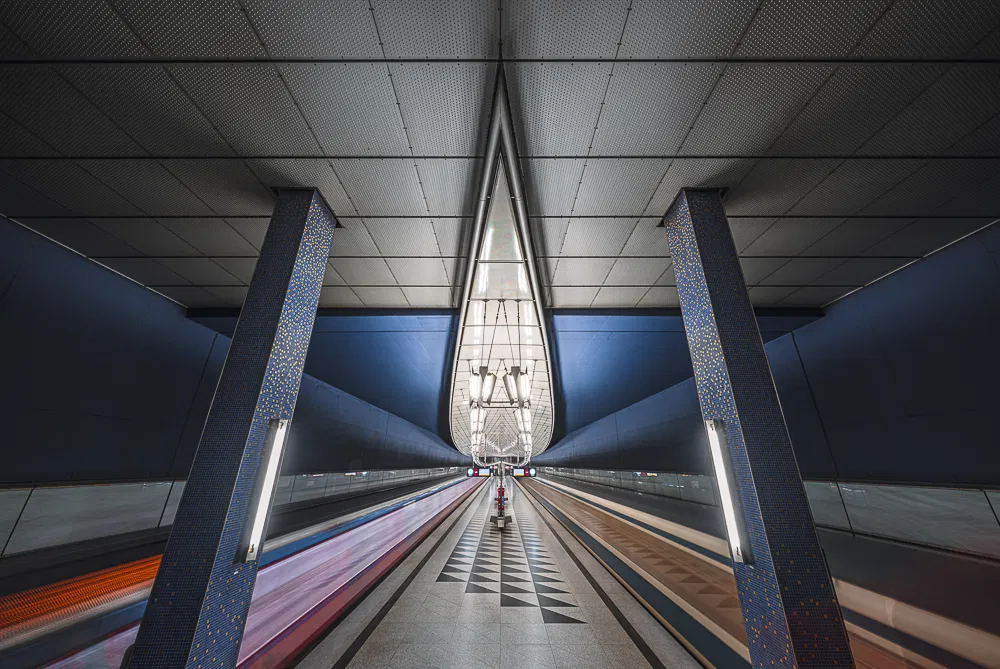
Munich offers one of the series’ most emblematic settings. The city’s U-Bahn began operating in October 1971, developed in the wider lead-up to the Olympic-era transformation of Munich’s infrastructure. Today the network reaches 100 stations (MVG’s official count), and in 2024 the U-Bahn recorded 452 million passenger journeys—a figure that underscores how intensely these spaces are inhabited, even when Drutel’s frames appear empty.

That emptiness is not an evasion of urban life, but a method. Working with a fixed tripod and long exposure, Drutel treats time as a material: trains pass as luminous bands, while platforms, tiles, and structural lines remain anchored, almost immovable. The resulting tension is the series’ signature. Architecture reads as permanence, engineered and disciplined, while movement becomes a visible trace: a veil that briefly occupies the station before it disappears.

Crucially, the absence of human figures intensifies the stations’ authored character. Signage, lighting, wall rhythms, and the calibrated symmetry of opposing platforms become the true protagonists. Drutel’s own articulation is direct and formal, focusing on stations “distilled to their pure form,” where geometry and “engineered rhythm” come forward. In Munich, with its crisp surfaces and decisive linearity, this approach produces images that feel less like documentary records than like spatial studies: the station as a constructed idea, the train as a measure of time.

Symmetric Subway is not limited to a single city’s aesthetic. Drutel extends the same rigorous gaze across multiple European networks, including Hamburg, Berlin, Brussels, and Stockholm, mapping how each system carries its own visual logic—from harder post-war volumes to cooler minimalist restraint. Across contexts, the series repeatedly locates the point where function unexpectedly becomes poetic: mirrored perspectives, repeating patterns, and artificial light used not as atmosphere, but as structure.

In an era defined by acceleration, these photographs do not argue for nostalgia or slowness. They propose something sharper: attention. By holding the shutter open just long enough, Drutel reveals the latent choreography embedded in public infrastructure, and reminds us that the most utilitarian spaces often carry the most disciplined forms of design.
References
- Thibault Drutel — official portfolio/project page for syMMetric subWay (artist statement and series overview).
- Aesthetica Magazine — feature on Drutel’s Symmetric Subway (29 May 2025), includes the quoted statement about human absence and geometry.
- Münchner Verkehrsgesellschaft (MVG) — press release announcing 2024 ridership totals (published 14 January 2025; includes the 452 million U-Bahn figure).
- MVG — “MVG in figures / Facts and figures” publication (network statistics including station count context).
- Munich.travel — historical overview of Munich in the 1970s referencing the U-/S-Bahn expansion and the 1971 opening context.
Photo Cover
Josephsburg station, Munich: A luminous train blur slices through flawless geometric symmetry, capturing stillness amid motion. Credit: © Thibault Drutel