Now Reading: Illuminating the Ethereal: Urban Landscapes Through a Poetic Lens by Peter Ydeen
- 01
Illuminating the Ethereal: Urban Landscapes Through a Poetic Lens by Peter Ydeen


In the quiet corners of Easton, Pennsylvania – where industrial remnants intersect with the glow of streetlights, Peter Ydeen has forged a photographic practice that transforms the ordinary into the contemplative. Working at the intersection of architecture, design, and fine art, Ydeen approaches urban landscapes not as neutral backdrops but as emotionally charged fields of perception. His photographs invite viewers to slow down, to reconsider the built environment as a site of memory, projection, and quiet revelation.
His most recent project, Waiting for Palms, on view at AOC F58 – Galleria Bruno Lisi in Rome (from December 1 to December 19, 2025), marks a significant expansion of this inquiry. Curated by Camilla Boemio, the exhibition traces Ydeen’s movement from the nocturnal streets of American suburbia to the sunlit architectures of Morocco and Egypt. Rather than functioning as documentary travel photography, the series probes questions of looking, cultural distance, and ethical representation, extending Ydeen’s long-standing investigation into how photography mediates space, presence, and imagination.
From sculpture and architectural model making to photography, Ydeen has remained committed to uncovering beauty within the overlooked and the everyday. His work consistently suggests that urban space, when observed attentively, holds a quiet poetry that exceeds its functional description.
EARLY FOUNDATIONS: FROM SCULPTURE TO ARCHITECTURAL THINKING
Born in 1957, Peter Ydeen’s artistic formation is rooted in a rigorous fine-arts education and decades of hands-on engagement with form, material, and spatial representation. He earned a Bachelor of Arts in painting and sculpture at Virginia Tech, studying under Ray Kass, whose emphasis on direct observation and plein-air practice left a lasting impression. Working outdoors in the Virginia landscape, Ydeen developed an early sensitivity to light, atmosphere, and the relationship between built and natural environments.
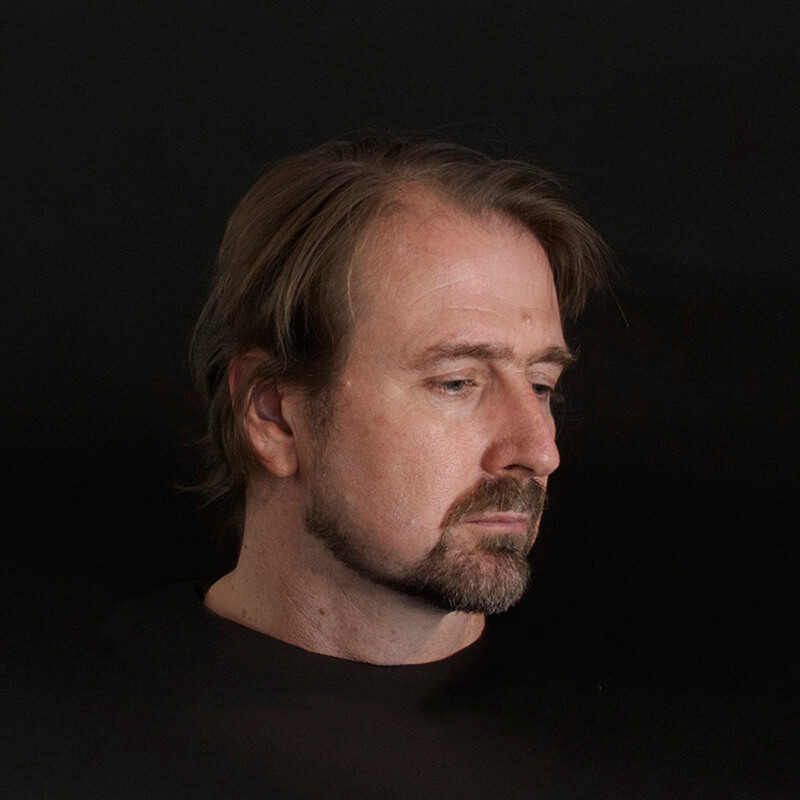
He later completed a Master of Fine Arts at Brooklyn College as a fellowship recipient, where he studied with artists including Robert Henry, Phillip Pearlstein, and Alan D’Arcangelo. Their divergent approaches ranging from perceptual realism to conceptual abstraction, encouraged Ydeen to think critically about representation and structure. Additional formative experiences followed at the Skowhegan School of Painting and Sculpture, where exposure to visiting artists such as Francesco Clemente, Judy Pfaff, William Wegman, and Mark Di Suvero expanded his experimental outlook. A fellowship associated with the Sculpture Center in New York further strengthened his technical and conceptual grounding.
After graduate school, Ydeen worked extensively in New York City as a technician and model maker, producing architectural models and technical illustrations for prominent architects. He held senior roles within professional model shops and collaborated on projects for figures such as Philip Johnson, Michael Graves, Robert A. M. Stern, and Emilio Ambasz. These years immersed him in architectural thinking at a tactile level where scale, precision, and narrative were inseparable from form. Architecture, for Ydeen, became less an object than a lived spatial sequence, an understanding that would later inform his photographic compositions.
Together with art dealer Mei Li Dong and guided by African art scholar Marc Leo Felix, Ydeen later co-founded Arts du Monde Inc. in New York. The gallery specialized in African, Chinese, and Tibetan art, offering Ydeen sustained exposure to non-Western aesthetic systems and curatorial practices. This engagement with global material cultures quietly broadened his visual vocabulary and reinforced a sensitivity to context, symbolism, and cultural nuance that continues to inform his photographic work.
TURNING TOWARD PHOTOGRAPHY: A MIDLIFE COMMITMENT TO SEEING
Although Ydeen had engaged with photography since adolescence, beginning with a Petri 35mm rangefinder purchased at age fifteen, it was only later in life that the medium became central to his practice. He learned black-and-white film development during his undergraduate years and absorbed photographic knowledge informally through peers and professional collaborations, particularly while assisting on product and architectural photography shoots during his model-making career.
Around the mid-2010s, Ydeen began to dedicate himself fully to photography, describing this shift as the result of decades spent “learning how to see.” Rather than a rupture with earlier disciplines, photography emerged as a synthesis of his experiences in sculpture, architecture, and exhibition design. The camera offered a way to translate spatial awareness, material sensitivity, and compositional rigor into an immediate visual language.

Ydeen works primarily with Nikon digital cameras, including the D7100 and later the D850, most often paired with a Nikkor 24–120mm lens. His approach is technically restrained and intuitive. For night photography he relies on a tripod, while travel and daytime work is frequently shot handheld at higher ISO settings. Post-processing is deliberate but measured, aimed at clarifying spatial relationships and tonal balance rather than overt manipulation.
Photography, for Ydeen, is not about spectacle but attentiveness. It becomes a tool for registering the subtle energies of place – how light settles on surfaces, how architecture holds memory, and how absence can feel quietly inhabited.
EASTON NIGHTS: THE POETICS OF NOCTURNAL SUBURBIA
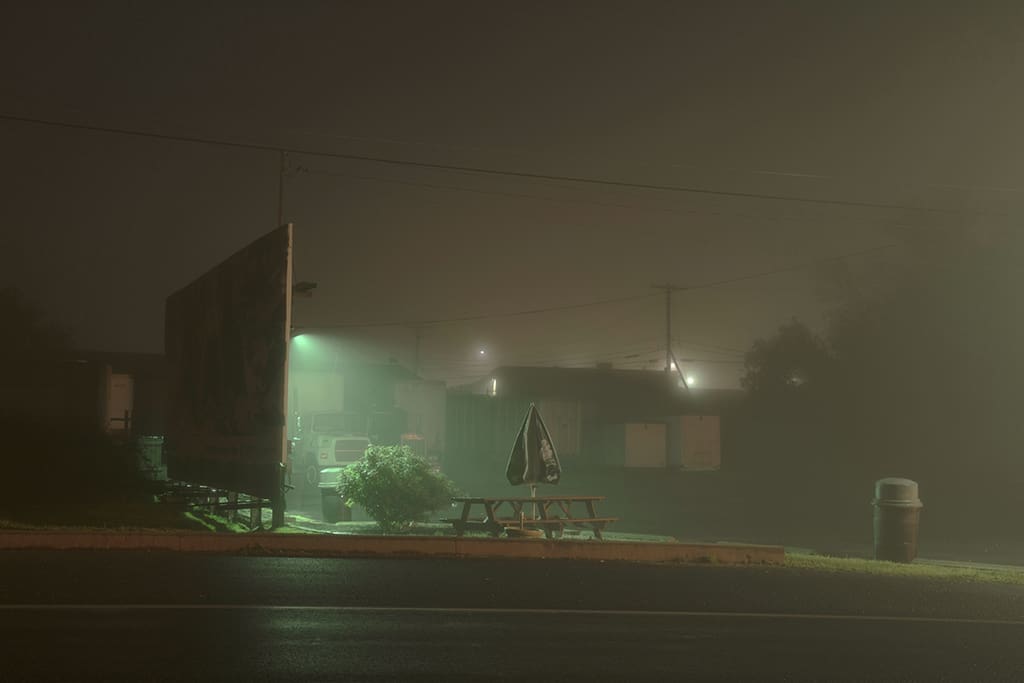
Initiated in 2015, Easton Nights stands as the defining body of work in Peter Ydeen’s photographic practice. Shot in and around Easton, Pennsylvania, the series transforms familiar suburban and post-industrial scenes into atmospheres of quiet intensity. Inspired in part by George Tice’s night photography, Ydeen initially worked in black and white before embracing color, drawn to the complex palette produced by artificial light.
© Peter Ydeen. Courtesy of the artist.
Unpeopled streets, parked cars, refuse bins, storefronts, and modest houses become protagonists within these images. Under streetlights and sodium vapor lamps, the everyday acquires an uncanny stillness. Geometry and perspective guide the viewer’s eye inward, while darkness opens space for projection and introspection. Rather than depicting urban life as alienating or desolate, Easton Nights reveals a sense of suspended intimacy, where the built environment seems to breathe in the absence of human figures.
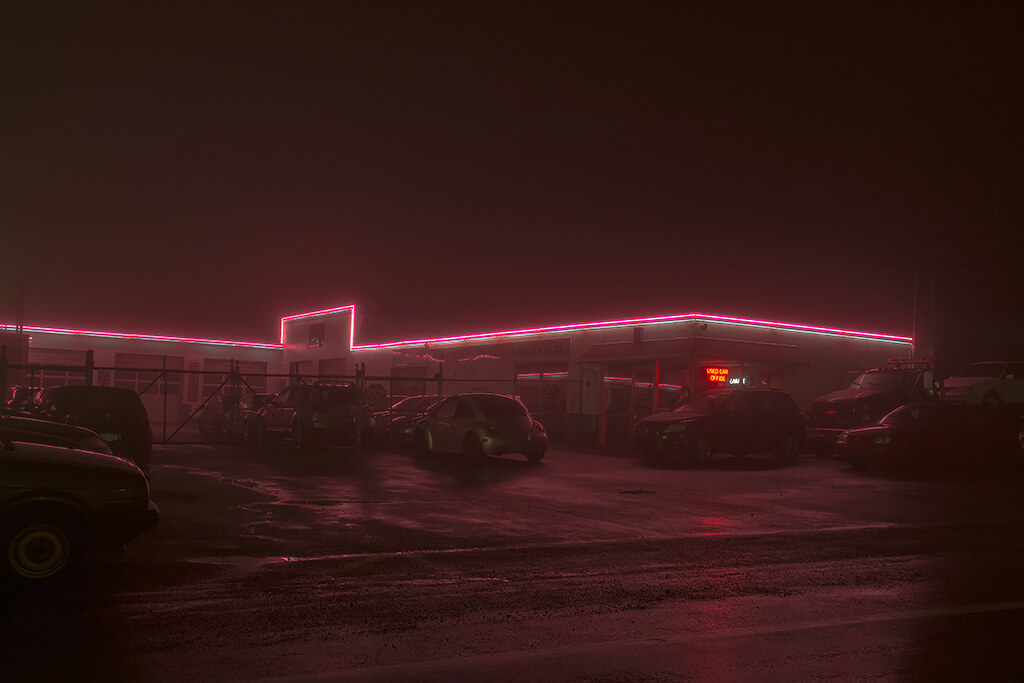
The series has been exhibited in the United States and Europe, including at AOC F58 – Galleria Bruno Lisi in Rome. Ydeen has described the work as a form of visual mimesis – an echo of daily life revealed most clearly when emptied of activity. Over time, his processing approach evolved toward greater clarity, allowing architectural form and shadow to coexist without sacrificing mood.
BETWEEN OBJECTIVITY AND ROMANCE: A PHOTOGRAPHIC ETHOS
Ydeen’s work is often discussed in relation to the New Topographics tradition, particularly its attention to human-altered landscapes. Yet where that movement emphasized neutrality and distance, Ydeen introduces a subtle romantic inflection. His images are not ironic or detached; they are attentive, empathetic, and quietly lyrical.
Drawing conceptually from sources as varied as Marcel Duchamp’s readymades, American Precisionism, and Romantic literature, Ydeen treats ordinary objects and spaces as carriers of latent meaning. Night functions not as a symbol of fear but as an alternative perceptual condition, one governed by its own chromatic logic and emotional tempo.
His background in sculpture remains evident in the three-dimensionality of his compositions, while his experience in exhibition design often extends into the physical presentation of his photographs, including hand-built frames that reinforce material presence.
MOTION, TIME, AND DAYLIGHT: EXPANDING THE FIELD
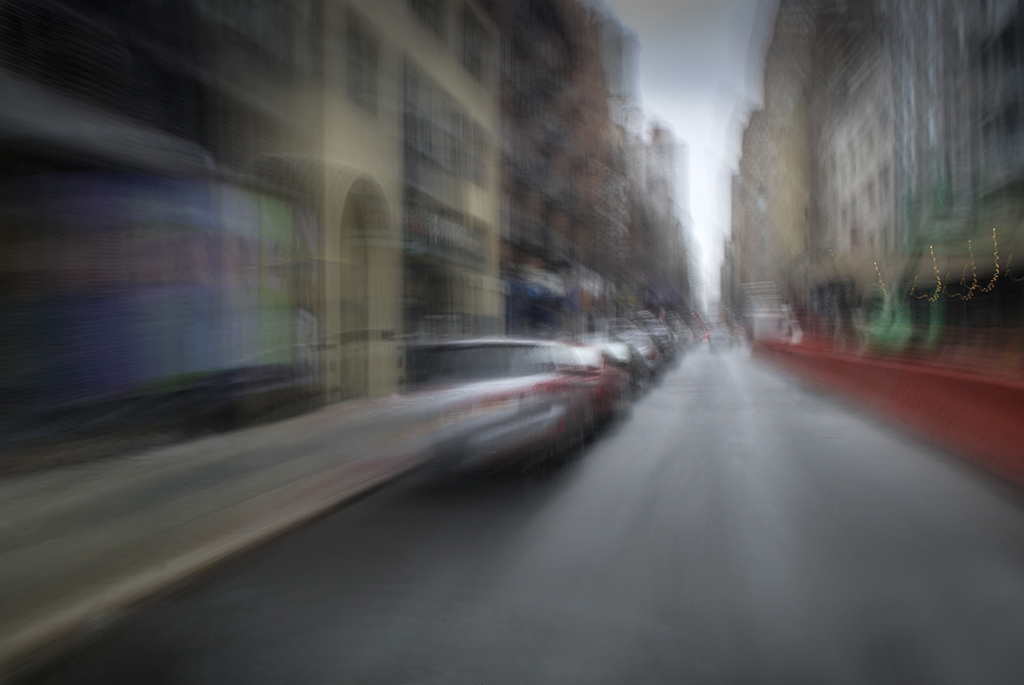
Subsequent series such as Commuter Motions and Black White and Gray extend Ydeen’s inquiry into time and movement. Commuter Motions, produced during his regular commute between Easton and New York City, incorporates time-lapse strategies to visualize flux and transition, adding temporality as a critical dimension of landscape perception.
Black White and Gray, photographed along Interstate 78, returns to monochrome while embracing motion blur and abstraction. Industrial forms dissolve into rhythmic structures, suggesting a landscape shaped as much by passage as by construction.

In contrast, Valley Days explores the Lehigh Valley in daylight, revealing a quieter, contemplative register. Its circular sub-series, Valley Days Rondels, concentrates the viewer’s gaze, evoking meditative forms that echo mandalas and architectural oculi.
WAITING FOR PALMS: SEEING ACROSS CULTURAL DISTANCE
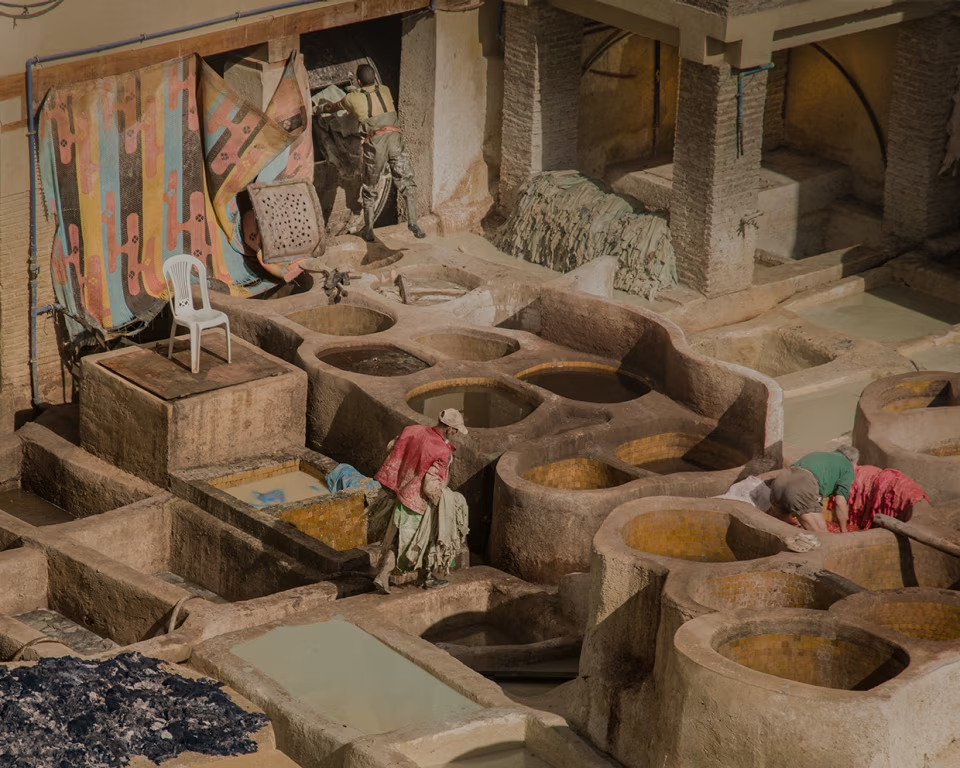
Waiting for Palms represents a significant geographical and conceptual expansion of Ydeen’s practice. Developed from travels in Morocco and Egypt beginning in 2016, the series traces urban and peri-urban landscapes from Cairo to Aswan and Luxor, and from Essaouira across the Atlas Mountains to Fez and Marrakech.
Shot without a tripod and often revisited from multiple vantage points, the images possess a looseness and softness distinct from Easton Nights. Human figures appear more frequently—not as subjects of portraiture but as elements within the spatial field. Walls, courtyards, trees, and fabrics articulate thresholds between public and private life.


Rather than reinforcing exoticized or Orientalist narratives, Waiting for Palms reflects critically on the act of looking itself. Ydeen positions himself as an outsider, attentive to the ethical implications of representation. The work emphasizes proximity without appropriation, intimacy without intrusion.
Curator Camilla Boemio has described the series as a practice of “careful wandering,” where observation becomes a form of negotiation between photographer, place, and cultural distance.