
Now Reading: Modern House in a Baroque Garden: A Contemporary Sanctuary by Jan Žaloudek
- 01
Modern House in a Baroque Garden: A Contemporary Sanctuary by Jan Žaloudek


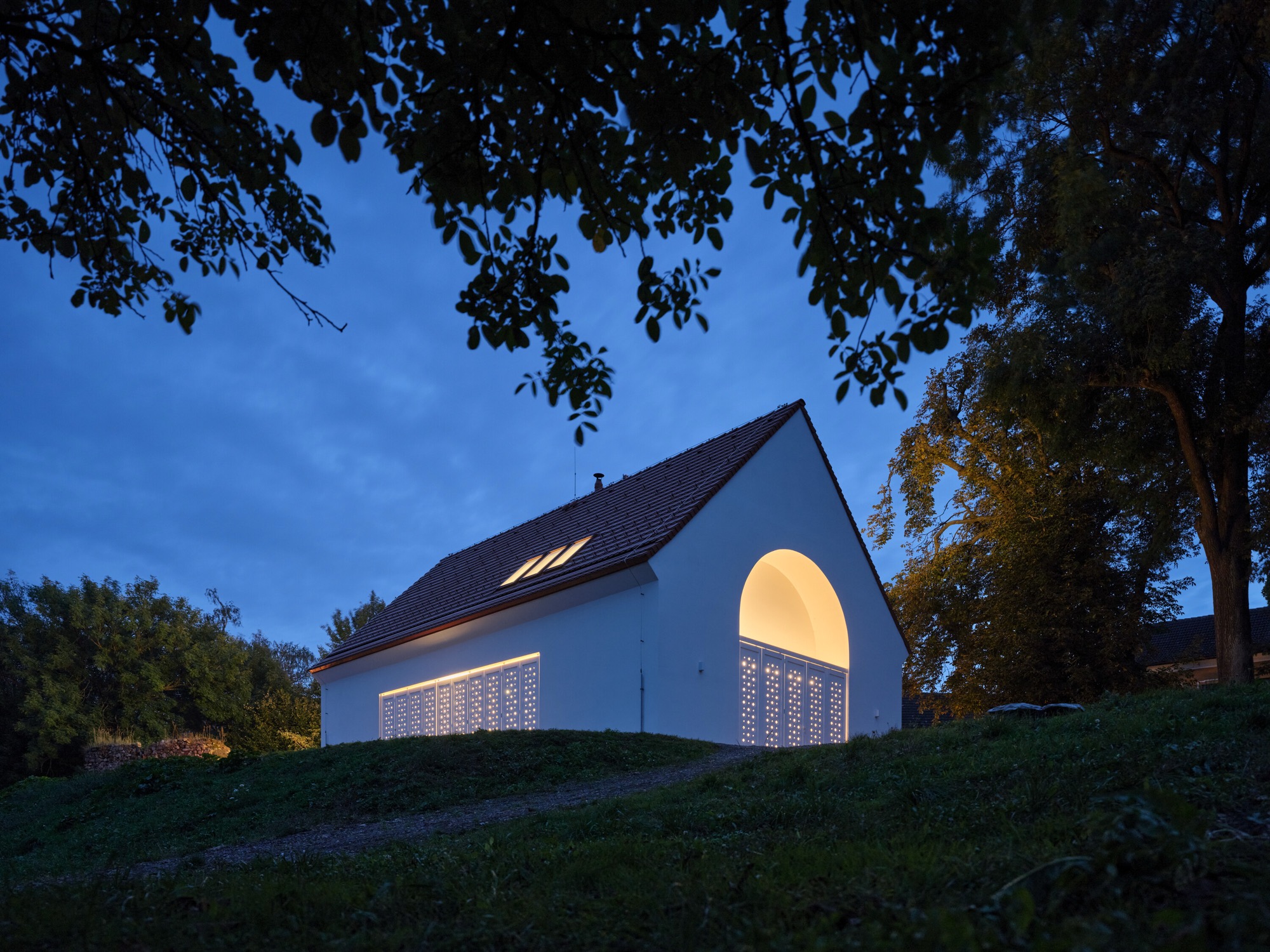
Set within a historic garden once belonging to the neighbouring château in the South Bohemian village of Kamenná Lhota, House Oskar is shaped by a landscape steeped in memory. Mature trees, the remains of a Baroque barn and a centuries-old stone wall define the setting, creating a rare architectural dialogue between contemporary living and heritage. Architect Jan Žaloudek responds to this genius loci with a house that is both grounded in place and quietly transformative, offering a contemplative retreat embedded in the rhythms of nature.

ARCHITECTURE FOR CONTEMPLATION AND DAILY RITUAL
Designed by Žaloudek for himself and his family, the house is conceived as a microcosm dedicated to contemplation, inspiration and recreation. Together with his wife, art historian and writer Jolanta Trojak, the architect sought a place capable of nurturing silence as well as creativity. Their vision was a home where the most ordinary routines become ritualised moments, framed by light, texture and shifting views of the garden.

Every detail contributes to this intent. From the sheltered loggias to the vaulted interior, the house stages a sequence of spatial experiences that move fluidly from intimacy to openness. Living, reading, resting and creating occur in a continuous exchange with the orchard, the sky and the historic fabric surrounding the property.

PERFECTION, IMPERFECTION AND THE SACRED
The design is shaped by its culturally protected context and by the natural topography of the site. Žaloudek approached these constraints as generative forces, ensuring the new volume would not dominate the château but instead complement its presence with a timeless, chapel-like calm. The house recalls the traditional elongated form of local agricultural buildings, with a gabled roof and masonry walls pierced by carefully calibrated openings.


Perforated brickwork on the southern gable evokes the ventilation patterns of historic barns, functioning as a solar screen while anchoring the house in rural typologies. Wooden shading panels echo the rhythm of these apertures, giving the façades a tactile, crafted quality. Each elevation is carved with niches that soften the compact massing, creating transitional spaces that blur boundaries between interior and exterior. These recesses reference Baroque morphology as well as the expressive massing of ecclesiastical architecture, allowing the house to alternately open toward the landscape or close into a meditative shell.


Material choices reinforce this continuity with the region. Insulated ceramic masonry, reinforced concrete elements and a white stucco façade align the house with its vernacular context. The roof is tiled with fired ceramic, while shading panels in whitewashed Czech fir and spruce bring warmth and material honesty.
NATURAL CYCLES AND THE CHOREOGRAPHY OF LIGHT
Life inside House Oskar is oriented toward the movement of sun and moon. The main living area unfolds toward the orchard, capturing the sunrise, while the perforated southern façade frames views of the courtyard and the ruins of the Baroque barn. Generous glazing connects rooms to terraces, greenery and the surrounding stone walls, ensuring every space participates in the seasonal and diurnal cycles of the site.

Light is treated as a material. The white wooden shading panels allow the interior to be modulated throughout the day, transforming bright rooms into spaces where patterns of filtered light drift across stucco surfaces. At dusk the effect reverses, and the house glows through its niches like a lantern in the landscape. The palette of lighting blends minimalist white fixtures, washi paper lanterns and the soft flicker of a wood-burning stove to create an atmosphere that oscillates between the sacred and the domestic.


A SACRED INTERIOR OF CURVES AND CRAFT
Contrasting with its crisp white exterior, the interior is warm, sculptural and unexpectedly vaulted. The main living space rises to seven meters under a sweeping curved ceiling, amplifying its chapel-like character. White stucco walls, large aluminium-framed windows and a two-metre circular oculus in the southern gable imbue the room with an ethereal clarity.


At the centre stands a curved wooden kitchen with a granite island carved from Indian Shivakashi stone, conceived as a domestic altar anchoring daily life. A dining area furnished with an oak table and chairs is overseen by a nineteenth-century Madonna sculpture, while a long sofa offers simultaneous views to the landscape and courtyard. The seating is framed by a tapestry woven from undyed sheep’s wool, reinforcing the home’s tactile, crafted sensibility.


The ground floor includes a bedroom, bathroom and utility rooms, all furnished with custom wooden and stone elements designed by Žaloudek. The upper floor forms a distinct emotional world, conceived as a cocooned retreat with a bedroom, bathroom and studio space bathed in soft daylight from small roof windows. Arched niches and compact volumes create an intimate environment suited for reading, writing and artistic reflection.

A LIVING GESAMTKUNSTWERK
Art permeates the house as a natural extension of the family’s life. Works spanning Czech Modernism to contemporary sculpture appear throughout, creating a living dialogue with the architecture. A nineteenth-century panneau japonais hangs in the bedroom alongside a painting by Antonie Stanová. Sculptural works by Michal Janiga and stone pieces by Vanda Hvízdalová inhabit the rooms like subtle companions. The attic displays stone sculptures on travertine plinths, while the main hall welcomes visitors with a ceremonial mask from Gabon. Noguchi’s Akari lamps glow softly in several rooms, accompanied by handcrafted ceramics and a vast library of art books.
Named after the composer Oskar Nedbal, who composed his operetta Polish Blood at the neighbouring château, the house is imagined not merely as a private residence but as a living Gesamtkunstwerk. Žaloudek and Trojak intend to share the space through short-term stays, artist residencies, workshops and cultural events. In doing so, they hope to cultivate a community of people drawn to creativity, contemplation and the slow intelligence of the landscape.
Project Credit
Studio: Jan Žaloudek Architekt
Location: Kamenná Lhota, Czech Republic
Completion: 2025
Photographer: BoysPlayNice
More Photos