Now Reading: Herzog & de Meuron and the Architecture of Perception
- 01
Herzog & de Meuron and the Architecture of Perception

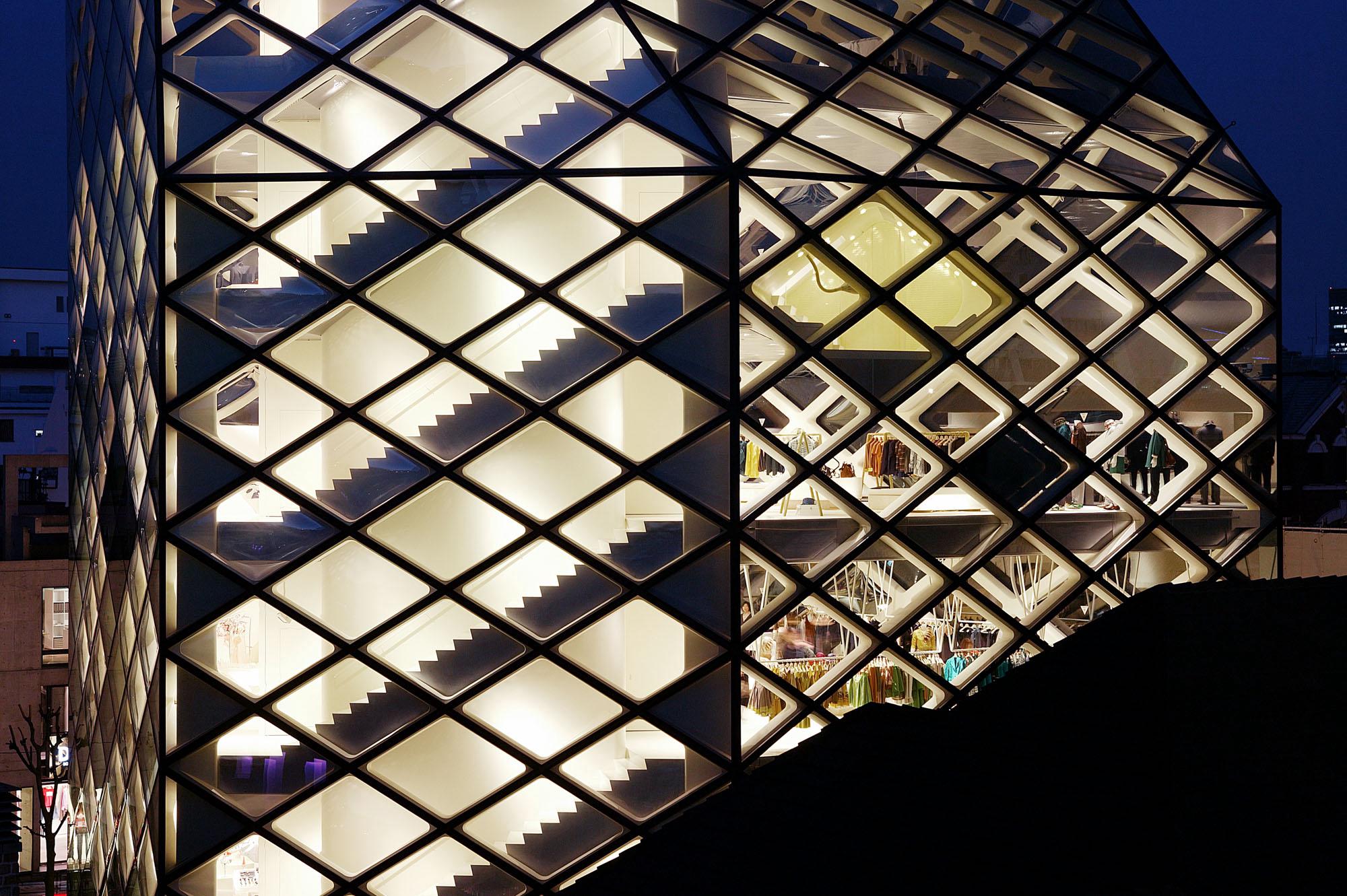

In Tokyo’s Aoyama district, where density is both physical and psychological, a crystalline volume rises with measured precision. Completed in 2003, the Prada Aoyama Epicenter does not assert itself through mass. Instead, it refracts the city. Its faceted glass envelope, composed of flat, convex and concave panes set within a steel diagrid, bends reflections into shifting images of sky, traffic and passing figures. In the morning it appears light and porous. At night it captures and multiplies the glow of Omotesando.

The building occupies a compact urban plot of roughly 330 to 370 square metres. Rather than saturating the site, the architects compressed the volume vertically and carved out an open forecourt. In central Tokyo, where commercial land is intensely valued, this gesture is not decorative but urban. It establishes distance, frames entry and introduces public breathing space into a dense retail environment.

Founded in Basel in 1978 by Jacques Herzog and Pierre de Meuron, the practice has consistently resisted stylistic branding. Awarded the Pritzker Prize in 2001, they were recognised for their capacity to transform ordinary programmes into spatial experiences of uncommon clarity. Prada Aoyama marked a turning point in that trajectory. A retail commission became an experiment in perception and structure.

ARCHITECTURE AS THE ART OF FACTS
Jacques Herzog has described architecture as the art of facts. The phrase signals a refusal of ideology in favour of precision. Buildings must first function structurally, environmentally and socially. Form is not imposed but emerges from constraint.
At Prada Aoyama, the glass envelope works in concert with the steel diagrid that stabilises the structure and transfers loads to a reinforced concrete core. The façade operates simultaneously as structural frame and perceptual instrument. Its varied curvature modifies views from inside and outside, expanding spatial experience without increasing floor area. The building contains approximately 2800 square metres across multiple levels, yet its footprint remains compact and legible.
The project clarifies the studio’s nuanced position on iconic architecture. Recognisability is not rejected, but symbolism detached from context is. The Aoyama building derives its identity from reflection and distortion of its surroundings. It belongs to Tokyo because it continuously absorbs Tokyo.
This logic reappears in later works. The transformation of Tate Modern in London preserved the Turbine Hall as a civic interior of extraordinary scale. The 2016 extension introduced a new brick volume that complements rather than mimics the original structure. Continuity is achieved through material dialogue rather than formal repetition.

MATERIAL AS MEDIUM
Across the studio’s work, material is never passive. It carries structural, climatic and perceptual responsibility.
At Dominus Winery in Napa Valley, stone filled gabion cages filter light and regulate temperature, producing a building that feels at once archaic and exact. At the Beijing National Stadium, interwoven steel members generate both structural coherence and visual depth at monumental scale. The popular nickname simplifies the project, but the architecture itself is a disciplined interplay of mass and void.


In Hamburg’s Elbphilharmonie, a glass superstructure rises above a historic brick warehouse. The undulating roofline resonates with the harbour horizon while enclosing acoustically refined concert halls within. The contrast between heavy base and light crown becomes spatial narrative.

In each case, surface is inseparable from performance. Stone moderates climate. Steel distributes force. Glass refracts perception.

REPRESENTATION AND PROCESS
Herzog & de Meuron’s design method privileges investigation over prescription. Physical models and material prototypes are tools for testing behaviour rather than vehicles for image production. The façade of Prada Aoyama emerged from extensive experimentation with glass panels, analysing how curvature would distort reflection under varying light conditions.
Dialogue also shapes their projects. At Tate Modern, collaboration with curators informed circulation and programme. Drawings, photographs and fragments are often presented as layered archives rather than closed narratives. Architecture remains open to reinterpretation even after completion.
URBAN CONTINUITY
Although frequently associated with cultural landmarks, the studio consistently addresses the city at multiple scales. The Blavatnik School of Government organises academic life around a central atrium that encourages exchange. The M+ Museum in Hong Kong frames Victoria Harbour while maintaining accessible public terraces. The AstraZeneca Global Research and Development Centre in Cambridge arranges laboratories and offices to promote interaction.


Formal languages differ, yet contextual grounding and spatial clarity remain constant. The practice avoids repetition not by rejecting continuity, but by allowing each site to determine its own logic.
ENDURING RESONANCE
More than two decades after completion, Prada Aoyama remains responsive to its environment. Retail culture has evolved, yet the building continues to function as urban lens rather than static emblem. Its presence is defined by reflection, change and restraint.
Herzog and de Meuron’s consistency lies not in recognisable form but in disciplined attitude. Architecture, in their work, is sustained inquiry grounded in material intelligence and urban awareness. The crystalline tower in Aoyama demonstrates that precision and perception can coexist without spectacle.
Photo Cover
Facade of the Prada Aoyama Epicenter (2003) by Herzog & de Meuron in Tokyo, its crystalline diagrid glowing at night and revealing interior stairs and displays. Credit: Herzog & de Meuron / Johannes Marburg (via Divisare)