Now Reading: Brutal Echoes: Tuff, concrete and the politics of memory in the Post Soviet Caucasus
- 01
Brutal Echoes: Tuff, concrete and the politics of memory in the Post Soviet Caucasus

Brutal Echoes: Tuff, concrete and the politics of memory in the Post Soviet Caucasus

In the Caucasus, architecture rarely fades into background. It remains against the horizon, embedded in volcanic slopes, exposed to wind and seismic uncertainty. Soviet modernism arrived in Armenia and Georgia as an imported ideological language, yet it did not remain external. It encountered geology, craft traditions, and a cultural memory far older than the twentieth century.
To read Soviet architectural legacy in Armenia through style alone is reductive. Brutalism, modernism and socialist realism are taxonomies that flatten terrain. The more decisive question is material. Concrete was the structural instrument of the Soviet project. Armenia responded not by rejecting it, but by pairing it with tuff, the volcanic stone that has shaped Armenian construction for centuries.
Tuff is porous, workable and chromatically warm. It carries geological memory as well as architectural continuity. When Soviet planning systems were imposed, they were absorbed into a cityscape already defined by stone. What emerged was not a simple transplantation of ideology but a tectonic negotiation between imperial modernism and local material culture.
MONUMENT “PEACE”, NUKRIANI
Before turning fully to Armenia, the Monument “Peace” near Nukriani in Georgia provides a threshold. Attributed to sculptor Nugzar Manjaparashvili and generally dated to the 1970s, the monument stands in open terrain in the Kakheti region.
The structure consists of a monumental female figure elevated above three vertical supports. Its arms extend outward in a gesture that suggests address rather than triumph. The figure is sometimes described as winged in popular accounts, though the sculptural reading is more abstract than literal.

Detached from dense urban context, the monument operates as silhouette. Reinforced concrete mass and elevated human form place it firmly within late Soviet monumental vocabulary. Yet without the institutional script that once framed it, the monument now exists primarily as material presence. It has outlived its ideological narrative.
This condition, monument without script, anticipates the more complex negotiations visible in Armenia.
MOTHER ARMENIA, YEREVAN
Installed in 1967 in Victory Park overlooking Yerevan, Mother Armenia replaced a statue of Joseph Stalin that had occupied the same pedestal since 1950. The substitution marked a recalibration of Soviet imagery during the post Stalin period.

Sculptor Ara Harutyunyan produced a 22 metre hammered copper figure. Including the pedestal, the monument rises to approximately 51 metres. The pedestal itself had been designed earlier by architect Rafayel Israyelian.

Architecturally, the base is more than a plinth. Its mass is severe, yet its interior organization recalls Armenian ecclesiastical typologies through tripartite rhythm and vaulted spatial articulation. The monument therefore stands at an intersection between Soviet monumental scale and Armenian architectural lineage.
The sword is held horizontally across the body, signalling vigilance rather than aggression. Archival sources identify Yevgenia Muradyan, a schoolteacher, as the model for the statue’s face. This human reference tempers the abstraction typical of socialist realism.

After Armenia’s independence in 1991, Mother Armenia was neither dismantled nor radically reframed. It was absorbed into civic life. Commemorations continue to take place at the site. The pedestal houses a military museum. Its endurance illustrates how spatial and material integration can allow ideological monuments to transition into national symbols without erasure.
CASCADE COMPLEX, YEREVAN
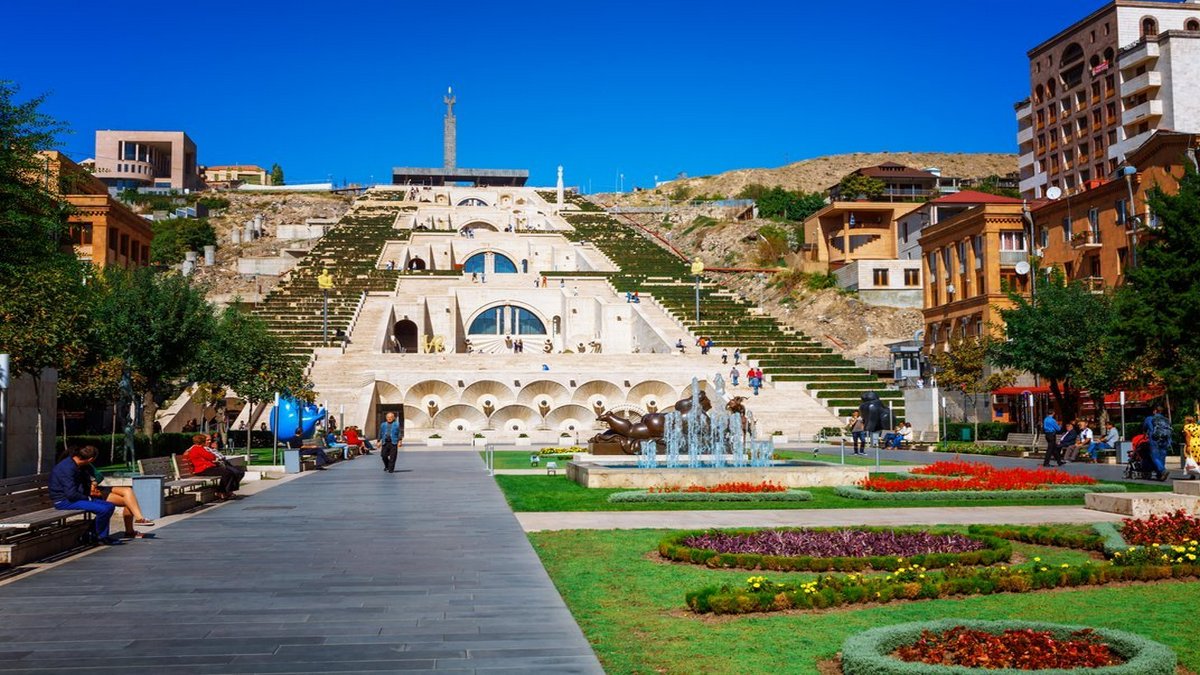
The Cascade Complex traces its conceptual origin to Alexander Tamanyan’s 1924 master plan for Yerevan. Construction of the monumental stairway began in the 1970s under architect Jim Torosyan.

Extending approximately 302 metres and comprising around 572 steps, the Cascade was conceived as a connective urban device linking the city centre with elevated northern districts. It is more infrastructure than monument. Terraces, fountains and landings choreograph civic movement across slope. Topography becomes public ritual.
Tuff is central to its architectural expression. Yerevan’s identity as the Pink City derives largely from local volcanic tuff. The Cascade participates in this chromatic continuity. The stone softens the reading of mass and allows for sculptural relief work that would feel alien in untreated concrete.

Construction was interrupted following the 1988 Spitak earthquake and the political rupture that followed the dissolution of the Soviet Union. For years the upper sections remained incomplete, exposing structural ambition without finished surface.
In the early 2000s, parts of the complex were revitalized through the establishment of the Cafesjian Center for the Arts. Contemporary sculpture now occupies terraces originally conceived within socialist planning logic. The Cascade endures because it is spatially useful. Its infrastructural function outlasted its ideological framing.
WRITERS’ RESORT, LAKE SEVAN
The Writers’ Resort at Lake Sevan stands among the most significant works of Armenian modernism. Associated with architects Gevorg Kochar and Mikael Mazmanyan and originating in the early 1930s, the complex was designed as a retreat for members of the Armenian Writers’ Union.
The most striking element is the lakeside lounge building projecting toward the water, supported by a central structural core. Its circular volume and panoramic glazing articulate early modernist experimentation within a dramatic landscape setting.

Reinforced concrete dominates here more than tuff, yet the building remains inseparable from its volcanic terrain and shoreline context. Landscape and structure operate in tension.

The political history of the site is layered. The architects’ careers intersected with repression during the Stalin era. The building therefore embodies both state patronage and personal vulnerability.
In recent years, conservation initiatives including participation in the Getty Foundation’s Keeping It Modern program have addressed structural assessment and preservation strategy. Early reinforced concrete in seismic zones presents long term challenges.
Today the resort functions as hospitality space while retaining architectural significance. Its continued use demonstrates adaptive continuity rather than static preservation.
TUFF AS MATERIAL COUNTER NARRATIVE
Tuff is central to Armenia’s negotiation with Soviet modernism. It is soft enough to carve yet durable enough to endure. Its color range from rose to ochre produces warmth that offsets concrete’s severity.
In Yerevan, tuff predates the Soviet period and continues after it. It anchors architectural continuity across regimes. When Soviet planners imposed new geometries, they did so in a city already materially encoded by volcanic stone.

This material continuity complicates narratives of rupture. Structures built with or alongside tuff appear less foreign. Through stone, imported ideology acquires local grounding.Material becomes political not through symbolism but through persistence.
From the plateau monument in Georgia to the layered civic landscapes of Armenia, Soviet era architecture in the Caucasus demonstrates resilience grounded in material. Concrete hardened ideology into form. Tuff embedded form into landscape. Together they produced structures that resist simple moral categorization. These buildings do not ask to be romanticized. They ask to be understood. Their endurance lies not in stylistic purity but in their capacity to absorb political rupture while remaining spatially relevant. In the volcanic stone of Yerevan and the cantilever over Lake Sevan, architecture becomes tectonic memory. Not propaganda preserved intact, but form reinterpreted through continuity of material and use.
Photo Cover
The Cascade Complex in Yerevan, a monumental stairway integrating Soviet modernism with local tuff stone and volcanic landscape. Credit: Photo via Art-A-Tsolum / The Bohemian Blog.