Now Reading: Concrete and Light Across Cultures: Tadao Ando’s French Odyssey
- 01
Concrete and Light Across Cultures: Tadao Ando’s French Odyssey


Over the past three decades, architectural discourse has shifted repeatedly, yet certain figures maintain a remarkable consistency. Tadao Ando is one of them. While architectural culture has oscillated between postmodern quotation, digital experimentation and expressive formalism, Ando has continued to refine an architecture grounded in mass, enclosure and light. His projects in France form a distinct chapter within this trajectory, revealing how a spatial language shaped in Japan engages with a country defined by historical density and luminous atmosphere.
France becomes, in Ando’s work, not a site of opposition but of calibration.

THE BEGINNING: MEDITATION SPACE AT UNESCO, 1995
Ando’s French presence begins with the Meditation Space at UNESCO headquarters in Paris, completed in 1995 for the organization’s fiftieth anniversary. The building occupies a discreet position within the modernist complex designed by Marcel Breuer, Bernard Zehrfuss and Pier Luigi Nervi, adjacent to the garden by Isamu Noguchi.
The structure is a cylinder of reinforced concrete measuring 6.3 metres in diameter and height. Access is through narrow openings cut into the perimeter wall. Inside, the volume is defined by exposed concrete and a continuous circular skylight set along the roof’s edge. Daylight descends along the curved surface, transforming the interior throughout the day.
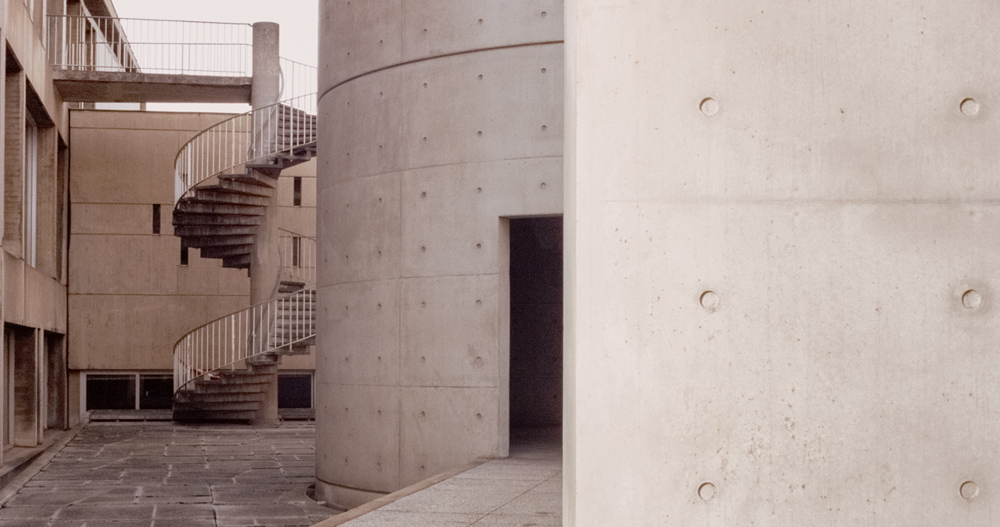
The spatial composition is elementary. Wall establishes enclosure. Light introduces variation. The void becomes the primary architectural medium.
The floor incorporates granite from Hiroshima that had been decontaminated after exposure to atomic radiation. The gesture links memory and reconciliation without overt symbolism. Within UNESCO’s international framework, the space functions as a non denominational sanctuary. Its scale is modest, yet its presence is intense.
Here Ando’s method is fully articulated. Thick concrete walls define limit. Light produces movement. Emptiness becomes structure.

PROVENCE: CHÂTEAU LA COSTE
Ando’s most extensive work in France unfolds in Provence at Château La Coste, a vineyard estate of approximately 500 acres near Aix en Provence. Beginning in 2008, Ando developed the masterplan and designed several key buildings completed between 2008 and 2011.
Four Cubes to Contemplate Our Environment, completed in 2011, introduces his presence on the site. A timber pavilion contains four glass volumes addressing environmental themes. The structure frames long views toward the Luberon landscape, situating reflection within direct engagement with terrain.

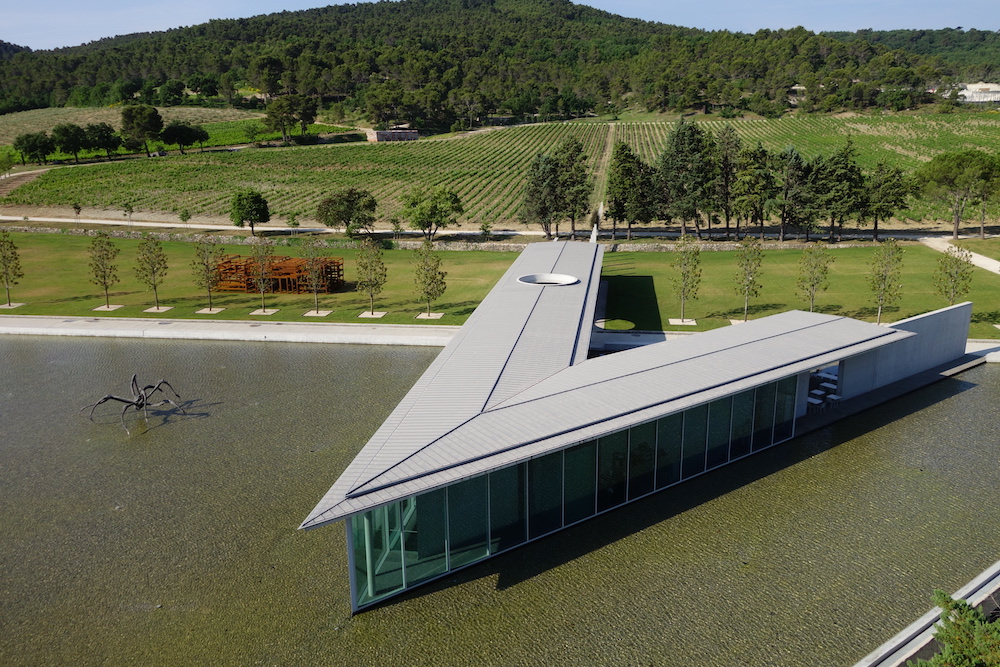
The Art Centre, also completed in 2011, establishes a primary architectural anchor. A V shaped concrete pavilion opens toward a reflecting pool that mirrors sky and vineyard. The fair faced concrete surfaces demonstrate Ando’s characteristic precision. Under the strong Provençal light, the walls register subtle tonal shifts, reinforcing the dialogue between built form and landscape.
The Chapel integrates the remains of a sixteenth century structure. Ando preserved the historic masonry while introducing glass and steel elements to establish continuity between old and new. A red glass cross by Jean Michel Othoniel stands within the restored volume. The intervention does not erase history. It clarifies it.

Across the estate, Ando’s architecture does not compete with the vineyard setting. Paths, water surfaces and controlled apertures guide perception. The light of southern France intensifies the contrast between mass and void, extending the spatial investigation first articulated in Paris.
PARIS REVISITED: BOURSE DE COMMERCE, 2021
In 2021, Ando completed the transformation of the Bourse de Commerce into the Pinault Collection museum. The eighteenth century rotunda and its monumental dome fresco were preserved intact.
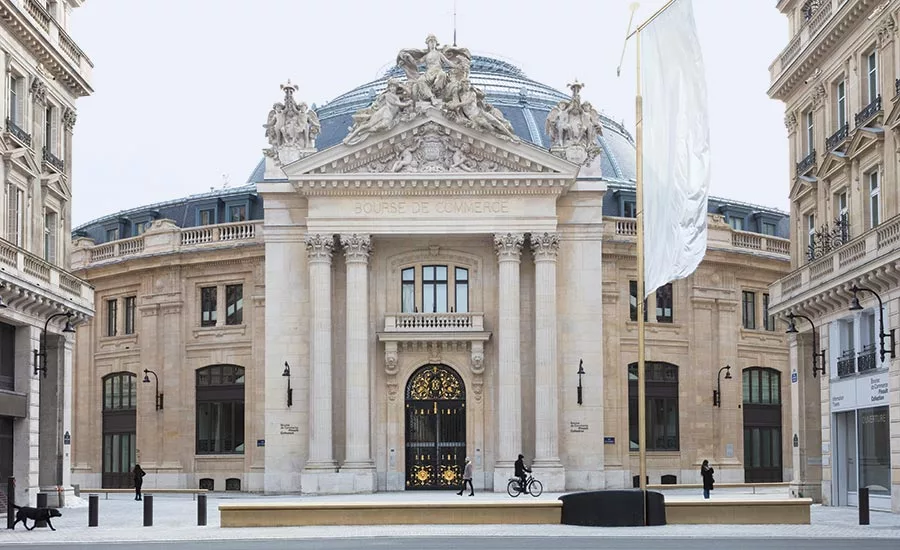
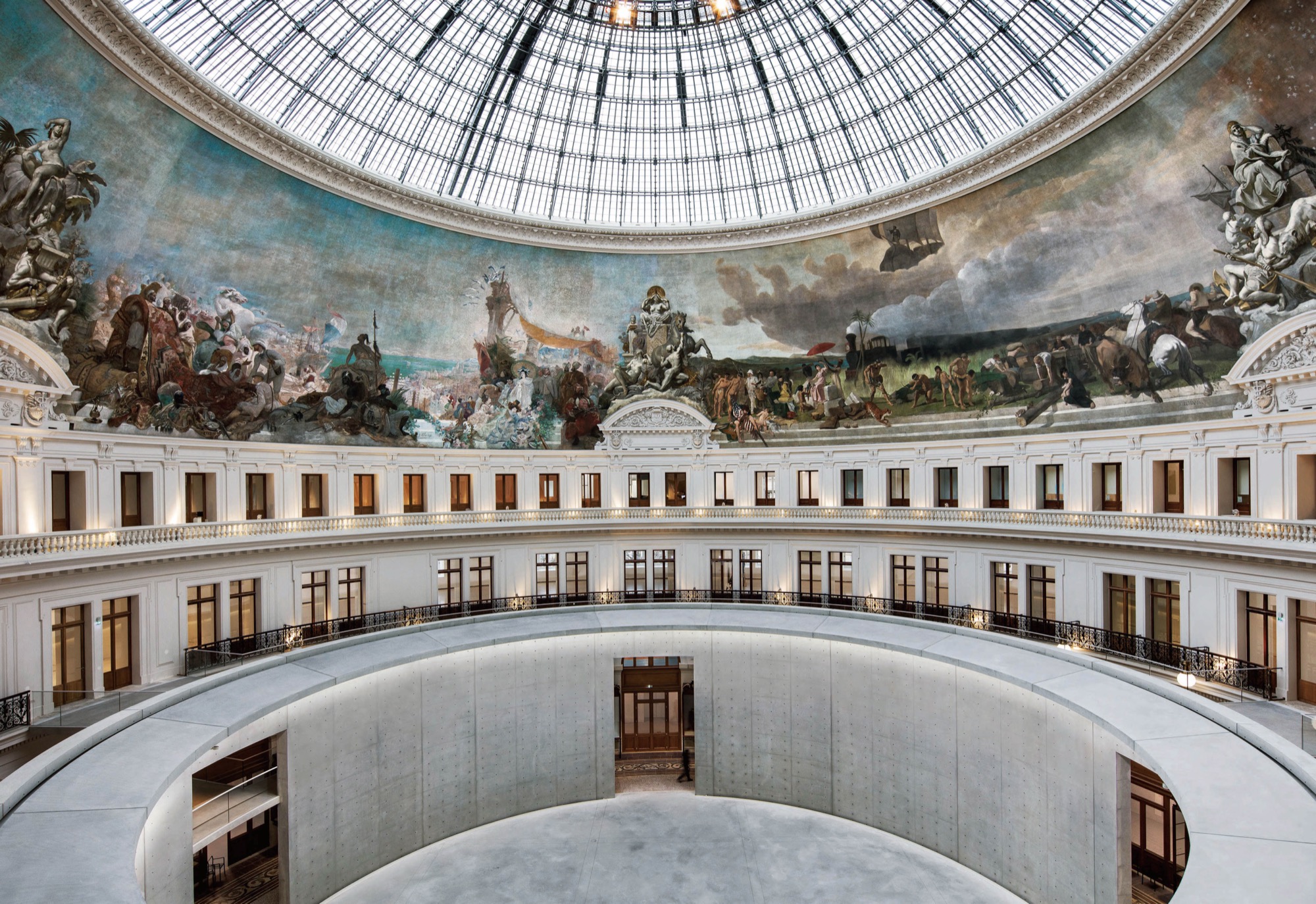
Within this historic envelope, Ando inserted a freestanding concrete cylinder 9 metres high and approximately 29 metres in diameter. A circular passage between the original wall and the new structure establishes a layered spatial sequence. Visitors experience the building as a dialogue between centuries rather than a replacement of one by another.
The project exemplifies Ando’s approach to intervention. The new element remains autonomous yet proportionally disciplined. Smooth concrete surfaces contrast with the ornate dome above, producing tension without aggression. History is neither concealed nor dramatized. It is staged with restraint.

ARLES: LEE UFAN FOUNDATION
In Arles, Ando renovated the seventeenth century Hôtel Vernon to create the Lee Ufan Foundation, opened in 2022. The project combines restored stone volumes with newly constructed subterranean concrete galleries.

The contrast between historic masonry and refined concrete planes establishes a quiet environment for Lee Ufan’s work. Terracotta floors, exposed timber beams and controlled light maintain continuity with regional construction traditions while introducing Ando’s spatial discipline.
As in his earlier French projects, architecture does not assert itself as spectacle. It frames experience.

A CONSISTENT POSITION
From the intimate cylinder at UNESCO to the monumental intervention at the Bourse de Commerce, Ando’s French works demonstrate continuity of principle rather than stylistic variation. Concrete remains central, yet it operates as mediator of light, scale and silence.
France, often described as the land of light, provides a distinct context for this exploration. In Provence, sunlight intensifies surface and shadow. In Paris, filtered light softens urban density. Across both settings, Ando resists theatricality. His buildings demand duration and attention.
Approaching his ninth decade, Ando’s work in France affirms a position rarely altered. Architecture is enclosure and void shaped by light. In a period marked by expressive excess, his restraint continues to generate resonance.
The result is not confrontation between cultures, but a measured exchange.
Photo Cover
The iconic concrete cylinder within the historic rotunda of Bourse de Commerce, exemplifying Ando’s fusion of modern minimalism and French heritage. Credit: Wallpaper Magazine.