
Now Reading: Earth valley theater: A land art theater where birds and humans share the same sky
- 01
Earth valley theater: A land art theater where birds and humans share the same sky

Earth valley theater: A land art theater where birds and humans share the same sky

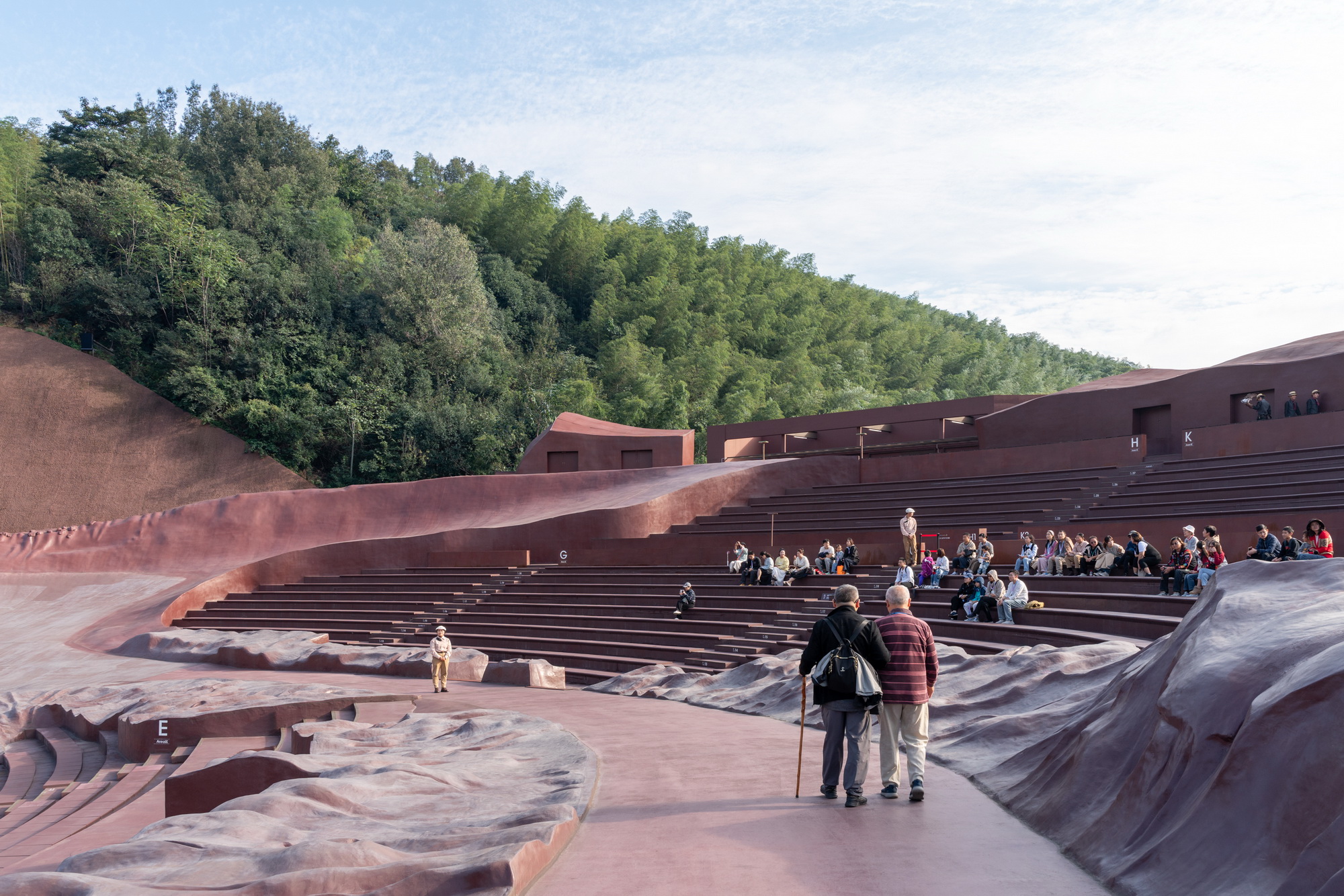
In the deep valley landscape of Yixing in Jiangsu Province, the Earth Valley Theater proposes a radical shift in the relationship between humans and non human species. Rather than the enclosure based logic of the modern aviary, the theater constructs an open ecological system: a place where birds and humans coexist, yet follow their own rhythms. The project forms part of the Sino French art initiative Dancing with the Birds and serves as a real world experiment in interspecies spatial design.

TOWARD A TOTAL ARTWORK
The architecture, interior, and landscape were conceived through an integrated design approach by GOA. Working closely with director Fan Yue, artists, animal behavior specialists, and engineers, the team pursued a vision akin to Richard Wagner’s idea of the total work of art. The theater is therefore not a neutral container but an artistic instrument where topography, performance, light, sound, and avian life are composed as one synchronized system.

In this collaboration, the birds become the true protagonists. Their movement, perception, and habitat requirements guided the spatial structure from the earliest sketches, prompting the architects to design simultaneously through human and avian viewpoints.
ARCHITECTURE AS LAND ART
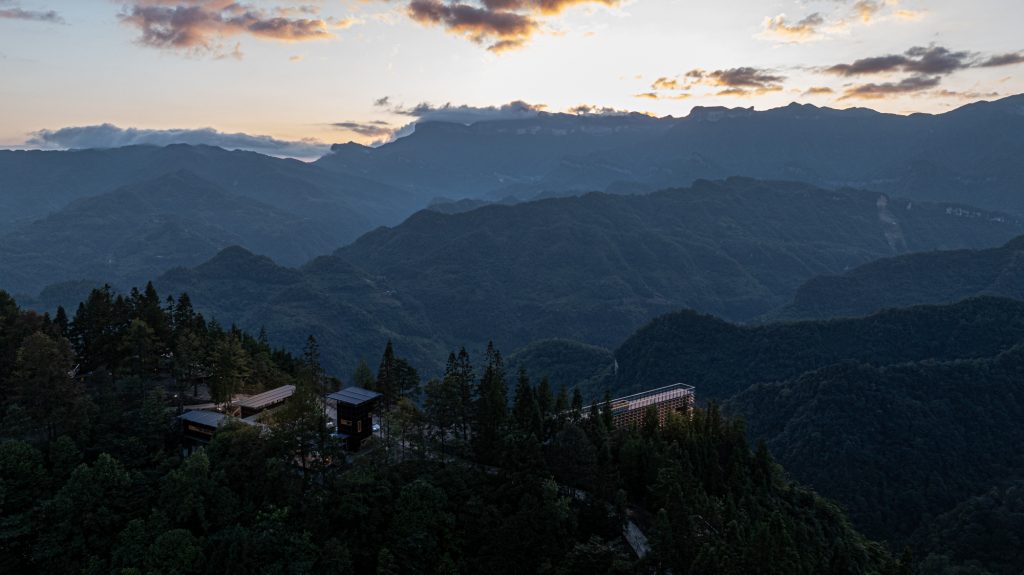
The commission began in twenty twenty one with a request from Yaohu Town to create an open air theater for an ecological narrative performance. The site is located at the untouched end of a valley that opens in several directions, a gentle landform that suggested a minimal intervention approach. Rather than elevating volumes above ground, GOA placed much of the theater beneath the existing terrain so that the architecture reads as part of the valley itself.

The building is organized at the two extremities of the site. One end forms a stepped plinth containing the public functions of the theater such as entrance and ticketing. The opposite end hosts the aviary zone where the birds dwell. Between them lies the two thousand seat auditorium, which follows the lines of the existing grade and slips into the natural contours of the valley. The surrounding hills frame the stage and become part of the performance once the show begins.

A secondary valley intersects the main one and extends toward a bamboo grove. This quieter corridor houses the aviaries, keeping them sheltered from human disturbance. Here, the terrain becomes an essential stage device. At the dramatic climax, flocks of white storks emerge from the narrow valley passage in synchrony with sound and light, transforming the landform into a three dimensional backdrop.


DESIGNING FOR BIRDS
The performance demands entirely new spatial typologies. Birds take off from the aviaries, land at bird boxes on top of the auditorium, and launch freely across the open sky. To support this choreography, the architects analyzed flight paths, vision angles, bodily dimensions, and species specific behavior.
The theater adopts a ring like configuration that orchestrates these movements. The slope of the seating is tuned with precise vertical offsets so that raptors sweep just above the audience without compromising safety. Interior surfaces are finished in thermally treated timber to avoid toxic finishes. Stickers on transparent glass prevent collisions. The ground gravel, mesh openings, and internal partitions of each aviary are adjusted according to species, acknowledging that birds inhabit space differently from humans.

Through these measures, the architecture becomes a landscape in which birds can act according to their own instincts. What visitors perceive as a theater is simultaneously a habitat calibrated for avian comfort and autonomy.


CLAY AND BAMBOO AS CULTURAL MATERIALS
Yixing’s deep tradition of pottery and its surrounding bamboo forests shaped the material language of the theater. GOA transformed these local motifs into durable forms capable of withstanding climate and time. Clay is expressed in raw earth, in malleable surfaces, and in terracotta like textures. The carved concrete of the plinth was first CNC shaped to control its geometry, then hand sculpted on site to retain the tactile presence of pottery.

Bamboo appears in the stage installation and the outer envelope of the aviaries. For durability, the design uses high density polyethylene engineered to resemble woven bamboo fibers. Panels in three tones create a subtle, shifting facade as light moves across the valley.
These materials act not as decoration but as containers of emotion, grounding the project in Yixing’s cultural memory while supporting a contemporary theatrical environment.

WHEN DESIGNERS BECOME BUILDERS
The integrated design model required the architects to engage deeply with construction processes. GOA’s team worked across disciplines, dissolving the traditional boundaries between conceptual design, technical detailing, and site management. This collaborative mode allowed the performance and the building to grow as one continuous entity.

The gentle topography hides an extensive drainage system. Rainwater is directed into concealed gutters that connect to the valley’s existing channels and to the landscape water system. The clay like landforms contain cavities where acoustic equipment is embedded to support the multimedia effects of Dancing with the Birds.


The aviaries employ a prefabricated light steel system using three standard wall panel types that combine external cladding and internal insulation. Precision assembly ensured that the structures met both the requirements of the birds and the dramatic needs of the director.
Through this process, the designers became builders, and the builders became collaborators in a complete artistic work. The Earth Valley Theater is not merely an architectural container. It is a living stage where performance, landscape, birds, and humans coexist in a shared environment.

A THEATER FOR BIRDS, HUMANS, AND THE IMAGINATION
With the completion of Dancing with the Birds, the Earth Valley Theater stands as a rare experiment in interspecies design. In this land art theater, architecture becomes a terrain rather than an object. Birds reclaim the sky above the audience. And visitors experience a momentary suspension of everyday boundaries, discovering a new proximity to nature and to themselves.
The Earth Valley Theater invites a question rather than offering an answer. What does it mean to design for the coexistence of species And how might architecture participate in re imagining the relationships between humans, landscapes, and other living beings.
Project Credit
Project Name: The Earth Valley Theater in Yaohu Village
Location: Wuxi, Jiangsu Province, China
Design/Completion: 2021 / 2025
Floor Area: 9,200 m2
Integrated Design (Architecture, Interior, Landscape): GOA / @goa_arch_design
Photographer: CHEN Xi Studio
More Photos