
Now Reading: A Lightweight Overwater Structure that Merges Digital Craft and Structural Intelligence
- 01
A Lightweight Overwater Structure that Merges Digital Craft and Structural Intelligence

A Lightweight Overwater Structure that Merges Digital Craft and Structural Intelligence

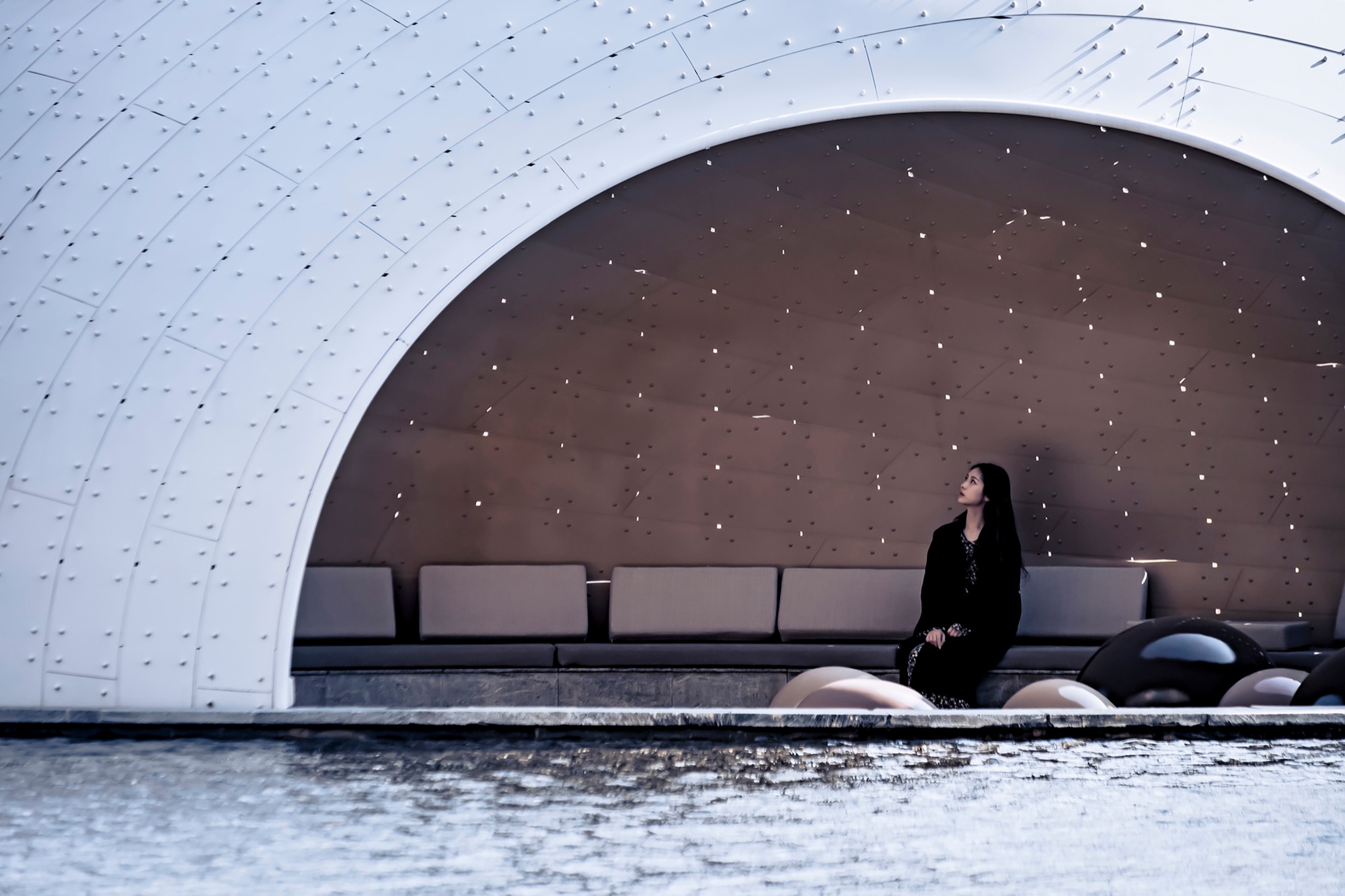
Suspended lightly above a reflective pool, the Thin Shell Metal Woven Pavilion offers a place of shade, stillness, and sensory immersion. Designed and built by XISUI Design, the project investigates how wide span, lightweight architecture can be achieved through computational design and an ultra thin structural skin. The result is an eleven meter overwater pavilion that combines scientific precision with a poetic spatial experience.

BIONIC INSPIRATIONS AND STRUCTURAL LOGIC
The pavilion’s form draws from two natural archetypes studied by the research team. The woven density of a bird’s nest suggested a structural language of segmentation and interlacing. The load distribution of an eggshell offered a model for how curved surfaces can transmit forces efficiently with minimal material. These references informed a centripetal dome and a seamless shell that serves simultaneously as enclosure and structure.

Although the pavilion spans eleven by eight meters, it requires no conventional supporting frame. Instead, the entire load is handled by a pair of two point five millimeter metal layers shaped into a doubly curved skin. Computational simulations of wind and gravity loads confirmed that this ultra light assembly can achieve a span thousands of times its thickness. The pavilion therefore relies on a structural principle shared with ancient vaults and natural eggshells, where curvature becomes the primary mechanism for stability.

DIGITAL FABRICATION FOR LIGHTWEIGHT CONSTRUCTION
A bespoke software tool guided the generation of the pavilion’s hyperbolic geometry. The surface was analysed, subdivided, and calibrated through curvature and deformation calculations. This process produced four hundred sixty nine metal segments, each individually shaped to fit into a continuous surface. Every component was designed to be fabricated directly through CNC machines, numbered, and assembled on site with precise interlocking accuracy.

Construction relied entirely on a welding free system. The segments were fixed together with predesigned bolts that established point to point alignment. This approach eliminated distortions associated with heat and removed the need for complex formwork or heavy keels. A small team of craftsmen could assemble the entire pavilion by following a digital map that ensured geometric fidelity.
The use of removable fasteners grants the pavilion a high degree of flexibility. Individual components can be replaced, adjusted, or reassembled. The entire structure can be relocated without damaging the shell. First erected in twenty twenty and later transported to its permanent site in twenty twenty three, the pavilion demonstrates how digitally guided modular construction can reduce waste, conserve resources, and extend the lifespan of architectural installations.


ASSEMBLY, ACCURACY, AND ADAPTABILITY
Each bolt in the assembly was digitally positioned and verified to ensure that the final geometry remained true to the original computational model. This prevented cumulative errors that often occur in manual fabrication. The system also avoids distortion in thin plates, a common issue during welding. By guaranteeing accuracy, the pavilion achieves a clarity of form where the surface reads as a smooth, continuous shell rather than a composite of smaller pieces.
The adaptability of the design gives the pavilion a long term sustainability dimension. The structure can migrate across sites, evolve, or be reinterpreted in future projects. The precision of the digital workflow ensures that reassembly maintains the same structural and aesthetic performance.


A JOURNEY BELOW THE WATER SURFACE
Visitors approach the pavilion through a sunken walkway that moves beneath the surface of the pool. This transitional route creates a moment of release as visitors shift from the city’s intensity to a quieter sensory environment. Light enters the interior through a constellation of small gaps between the woven segments. As sunlight shifts, these openings cast moving patterns across the dome, echoing the curvature and flow of the structural lines.
The pavilion’s exterior is finished in white, producing a tranquil reflection on the water below. The interior adopts a matte brown gold tone that softens glare and creates a cave like depth. The centripetal dome forms an intimate chamber that amplifies even small sounds, encouraging meditation and quiet conversation. Together, the surrounding water, the dome, and the filtered light establish a contemplative atmosphere reminiscent of a secluded landscape of mountains and sea.
The Thin Shell Metal Woven Pavilion concludes with an architectural paradox. It is both delicate and strong, both minimal and spatially rich. Above all, it offers an urban retreat where visitors can rediscover calm and enter a state of introspection.

PROJECT CREDIT
Official Project Name: Thin-Shell Metal Woven Pavilion
Location: Hefei City, Anhui Province, China
Size: 11.8 meters
Design & Build: XISUI Design / @xisui.design
First Completion Date: October 1, 2020
Relocation Completion Date: April 20, 2023
Photographer: Yihao Hu, Jia Liu, Fancy Images
More Photos


Founded in Shanghai in twenty eighteen, XISUI Design is a multidisciplinary practice composed of landscape architects, architects, installation artists, and digital and structural engineers. The studio specialises in landscape installations, playgrounds, spatial structures, and commercial environments, with a focus on advanced digital technologies and experimental materials. Guided by the values of Advance, Happiness, and Originality, the team seeks to create inclusive and emotionally resonant environments that reflect contemporary innovation while maintaining a connection to cultural and human experience.