Now Reading: FOIL Gallery: Contemporary art, industrial memory, and a multisensory civic space in Montreal
- 01
FOIL Gallery: Contemporary art, industrial memory, and a multisensory civic space in Montreal

FOIL Gallery: Contemporary art, industrial memory, and a multisensory civic space in Montreal

In Montreal’s dynamic Mile Ex district, FOIL Gallery emerges as a new cultural anchor where contemporary art intersects with everyday neighbourhood life. Designed by Atelier L’Abri, the conversion of two long vacant suites inside a century old industrial building reveals the site’s historical, cultural, and material depth while creating a hybrid space that unites exhibition, hospitality, and sensory experience.
Founded by artists Fvckrender (Frédéric Duquette) and Baeige (Jo Anie Charland), FOIL Gallery operates as both an art venue and a neighbourhood café. This dual identity reflects the founders’ commitment to accessible and community rooted creativity. Directly connected to the newly completed Parc des Gorilles, the gallery contributes to the transformation of a once neglected pocket of Mile Ex, demonstrating how adaptive reuse can preserve heritage while strengthening local cultural life.

A CENTURY OLD FACTORY REIMAGINED
The building that now houses FOIL Gallery was constructed in the nineteen tens for Canadian Explosives Limited, first serving as an ammunition factory during the First World War and later employing women in large numbers during the Second World War. It remains one of the few surviving industrial structures from the early development of the Marconi Alexandra sector, defined by its remarkable sawtooth roof supported by timber clerestory trusses and its heavy concrete framework.


After decades of abandonment and increasing development pressure, the structure was at risk of demolition. Its revitalisation began with the arrival of new creative businesses along its row of industrial suites, facing a short stretch of Waverly Street shaped by the former diagonal railway line. The same geometry informed the design of Parc des Gorilles, inaugurated in twenty twenty four after a grassroots movement succeeded in reclaiming the former urban wasteland as public green space. The FOIL project therefore participates in a wider effort to restore both the building and its surroundings as active components of the city.


ATELIER L’ABRI’S ARCHITECTURAL APPROACH
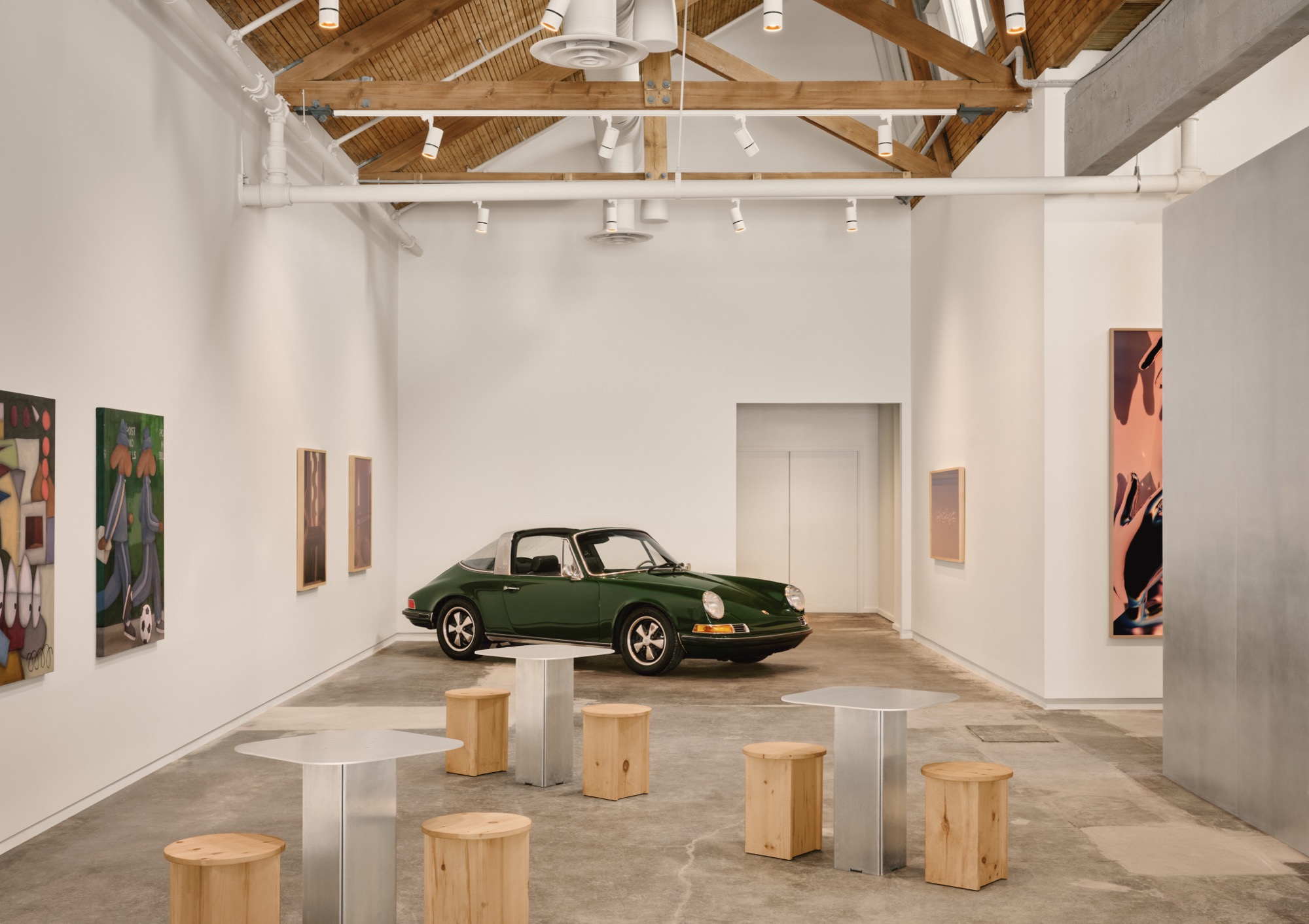
Atelier L’Abri’s intervention begins with a careful reading of the existing building. The architects chose to reveal rather than overwrite the raw industrial character of the factory. Layers of paint were removed from the wood plank ceilings, the massive timber trusses, and the concrete beams and columns through meticulous sandblasting, bringing back their natural tones and weathered textures. The concrete slab floor was stripped, cleaned, and sealed, allowing visitors to see the marks and patina accumulated across more than a century of use. New skylights reopen the potential of the sawtooth roof, filling the interiors with diffuse daylight.

At the core of the plan, the architects inserted a hand brushed metal cube that organizes the gallery’s public and private areas while retaining a clear reading of the original structural volume. White painted acoustic walls create flexible exhibition surfaces and form a crisp counterpoint to the preserved material palette. The overall strategy reflects L’Abri’s commitment to contextual coherence, material sobriety, and the revalorisation of heritage buildings as a sustainable response to contemporary urban challenges.


A CAFÉ AS THRESHOLD AND GATHERING SPACE
The gallery’s luminous café opens toward Parc des Gorilles through a full height glass garage door, offering a welcoming threshold between city and interior. The curved counter, finished in artisanal microcement, introduces a soft minimalism that complements the raw structure. Custom furnishings by Montreal designer Raymond Raymond bring a warm and understated functionalism that balances the rigour of the architecture. At the rear, a dedicated projection room creates an intimate environment for immersive and audiovisual works. The metal cube also accommodates a meeting room furnished with a large table by Essai Mobilier and Vipp chairs, articulating an aesthetic that bridges local craftsmanship with enduring design references.


A MULTISENSORY ART EXPERIENCE
FOIL Gallery presents an evolving program that spans digital installations, physical artworks, and cross disciplinary practices. The inaugural exhibition features creations by Fvckrender and Baeige alongside works by J3000, Vincent Tsang, Andrea Wilkin, Victor Mosquera, and Zoë Winters. At the heart of the space, a restored nineteen seventy Porsche Targa becomes a sculptural centrepiece, collapsing distinctions between art, design, engineering, and cultural memory.
Sound, scent, and taste form part of the curated experience. A soundscape by Olivier Lamontagne (The Holy), a signature fragrance developed by D S and Durga, coffee by ZAB Café, and pastries by Mélilot bring a multisensory dimension that extends the gallery’s immersive ethos.


A PLATFORM FOR COMMUNITY, CREATIVITY, AND URBAN CULTURE
More than a conventional gallery, FOIL functions as an evolving cultural platform. The space hosts launches, screenings, and monthly DJ sessions such as AM:PLIFIED, where music, coffee, and community converge in a relaxed atmosphere. It positions itself at the intersection of contemporary practice, conviviality, and experimentation, reaffirming the role of cultural spaces as catalysts within the urban fabric.


FOIL Gallery asserts itself as a confident new voice in Montreal’s cultural landscape. Its architecture celebrates industrial memory while projecting a contemporary vision of openness, creativity, and sensory depth. As a tribute to the finer objects in life, the project demonstrates how adaptive reuse can preserve heritage, support community, and produce architecture that resonates far beyond its physical boundaries.


Project Credit
Project: FOIL Gallery
Site: Montréal, QC, Canada
Area: 350 m2
Architecture: Atelier L’Abri / @atelierlabri
Completion: 2025
Photography: Alex Lesage
Atelier L’Abri is a Montreal based architecture practice recognised for its commitment to ecological, healthy, and human centred design. The studio received the twenty twenty five Emerging Architecture Prize from the Quebec Order of Architects, along with the twenty twenty four distinctions for Small Firm of the Year at the Architecture Master Prize and Best Young Firm at the A Plus Awards. L’Abri advocates for responsible architecture that respects its context, prioritises local sourcing, and contributes to environmental, social, and economic well being through long lasting, carefully crafted projects.