Now Reading: Drifting stones: Mirror pavilion and stone staircase
- 01
Drifting stones: Mirror pavilion and stone staircase

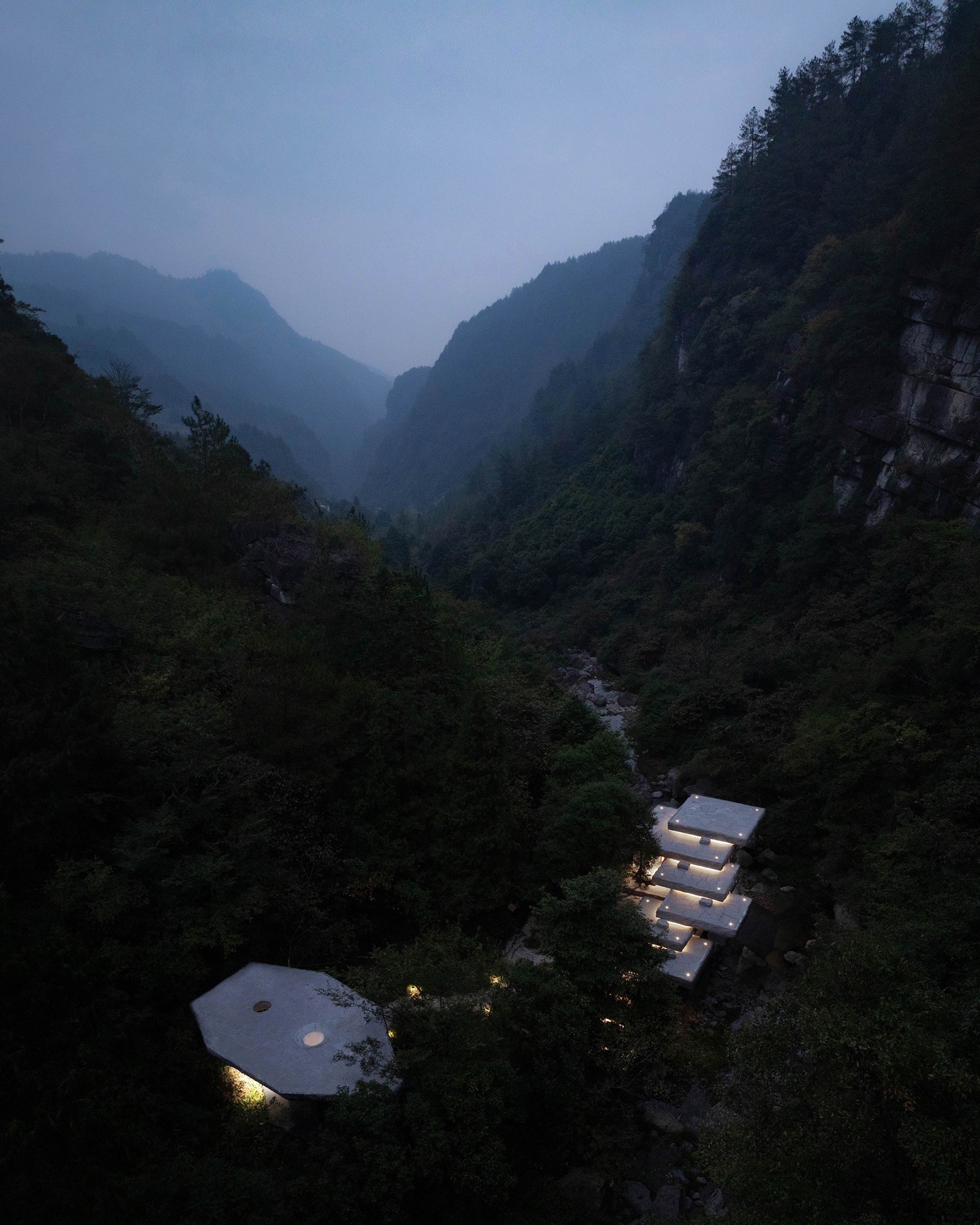

In the Nanchuan District of Chongqing, Drifting Stones frames a quiet encounter with the mountains. Set among evergreen trees, sheer cliffs and a narrow stream, the project is deliberately small in scale, yet precise in how it edits the landscape. It comprises two moves, a stone staircase that tracks the slope and a pavilion tucked into the hillside, creating a sequence that encourages visitors to slow down, look outward, and listen to water as a constant measure of place.


A LANDMARK FOUND BY CHANCE
The project began with an unexpected find. During an unrelated visit, a granite boulder stood out in the valley, remarkable for its flat top and almost theatrical presence. Positioned near the centre of the terrain, it read less like a fragment of geology and more like an artefact, the kind of object that triggers narrative before it triggers function. Feasibility studies followed, not simply to test construction, but to decide how close architecture could come to such a commanding element without reducing it to a backdrop.


The answer was not to compete with the stone, but to build a resting space that heightens its strangeness. The name Drifting Stones captures that mood, something ancient and immovable perceived through shifting light, moving cloud shadows and the continuous drift of sound from the stream.


DESIGNING CONTRAST TO DEEPEN IMMERSION
Rather than aiming for seamless disappearance, Drifting Stones operates through calibrated contrast. Textures and surfaces echo the roughness of the site, allowing the intervention to sit comfortably against the cliffs. At the same time, materials associated with precision and reflection introduce a second register. Steel, glass and mirror create moments that feel slightly unreal, as if the landscape has been re rendered through a different lens.


This duality is the project’s key device. It invites a closer relationship with nature by changing how nature is seen, sometimes through tactile contact with stone, sometimes through reflections that dissolve edges and scramble depth. The result is a dialogue between the ordinary and the uncanny, between geological weight and optical lightness.

At the centre of the experience is a stair sequence referred to as The Stacks. Ten stone slabs are arranged along the mountainside as a measured ascent, each step emphasising stability, balance and a deliberate pace. The route is not only a means of moving uphill, but a tactile instrument, shifting the visitor’s attention from distant views to the immediate contact of feet, hand and surface.

Where the steps cantilever near the boulder, the gap becomes an indoor reception area. Enclosed in frameless glass, it reads as a thin shelter inserted between mass and air, opening panoramic views while providing a moment of pause. The glass does not attempt to domesticate the site. It simply offers a clear threshold, a place to stand still while the landscape continues to move around you through wind, sound and reflection.

Nearby, a second element, The Hut, sits on the hillside and functions as a restroom. Reached by cobblestone paths, it is designed as a quiet surprise rather than a service building. Mirror surfaces pick up foliage and sky, reducing the object to a shifting outline that appears and disappears as one approaches.


Above it, a large boulder seems to float, intensifying the project’s interest in illusion and weight. A skylight draws daylight down into the interior, turning a pragmatic programme into an atmospheric room. Here, utility is not hidden, but transformed, treated as part of the same spatial narrative that begins at the stream and continues along the stair.

MAKING STONE WHERE STONE COULD NOT BE BUILT
Site constraints shaped the construction strategy. Rather than relying on heavy stone assembly, the project adopts an artificial stone method. A steel framework forms the structure, overlaid with cement mixed with local stone powder. Artisans then worked the surfaces by hand, building stone like textures into the façade so the intervention could hold its own against the cliffs without pretending to be geology.

This approach also amplifies the project’s material tension. Raw stone appears where the body touches, such as rugged handles set against glass doors, while stainless steel fixtures and polished edges introduce a controlled, contemporary precision. The language is consistent, not decorative. It is a way of making the visitor constantly aware of what is natural, what is made, and how the two conditions can coexist without merging into a single tone.
A SMALL INTERVENTION WITH A LASTING AFTERIMAGE
This is modest in footprint, but expansive in effect. It does not treat the landscape as scenery to be consumed from a distance. Instead, it builds a sequence of close range experiences where heaviness and reflection, enclosure and exposure, feel equally present. The boulder remains the anchor, the stream the soundtrack, and the architecture a device for noticing what is already there.


As cloud reflections drift across mirrored surfaces and tree shadows slide over the stone steps, the project offers a form of temporary stillness. It is less a destination than a pause in motion, a place where the mountain’s scale is not conquered, but quietly acknowledged.


Project Credit
Project name: The Drifting Stones
Location: China, Chongqing
Design firm: DoDesign / @dodesign_works
Completed: 2025
Photo: Arch-Exist