
Now Reading: Ciénaga de Mallorquín Ecopark turns a Colombian wetland into living public infrastructure
- 01
Ciénaga de Mallorquín Ecopark turns a Colombian wetland into living public infrastructure

Ciénaga de Mallorquín Ecopark turns a Colombian wetland into living public infrastructure

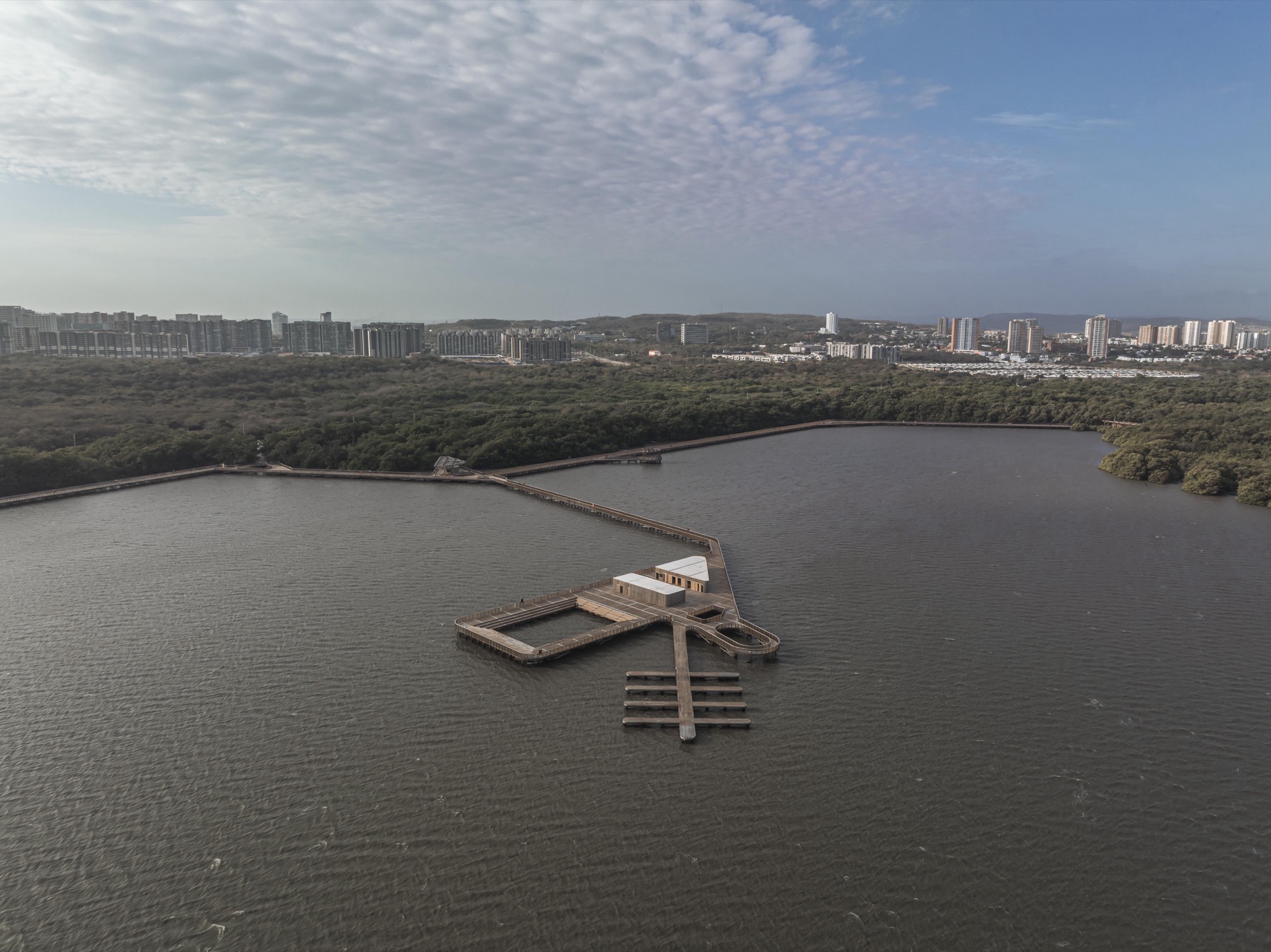
At the edge of Barranquilla, where the Magdalena River meets the Atlantic Ocean, Ciénaga de Mallorquín Ecopark reframes the relationship between urban life and one of the most significant wetland ecosystems of the Colombian Caribbean. Designed by DEB Architecture and El Equipo Mazzanti, the project transforms a degraded lagoon landscape into an accessible environmental infrastructure, where conservation, public space and civic education are understood as parts of the same system.

The Ciénaga de Mallorquín is a territory of exceptional ecological value. Its mangrove network supports more than 200 resident and migratory bird species, while its cultural identity remains closely linked to artisanal fishing and other local practices. Over the last century, however, large scale territorial changes, including the construction of Bocas de Ceniza and the expansion of urbanisation, altered the wetland’s natural dynamics and gradually separated it from the everyday life of the city.

Against this condition, the Ecopark does not approach landscape as scenery, nor does it impose a new architectural object on the site. Instead, it proposes a living edge between Barranquilla and the wetland. This edge operates as a protective, active and inhabitable threshold, allowing people to enter the ecosystem without interrupting its biological and hydrological processes.

Covering 61,834 square metres, the project is organised as a network of elevated walkways, observation platforms, resting areas and gathering spaces. These elements make it possible to experience the mangrove from within, while reducing direct occupation of the ground and preserving the continuity of the natural cycles that sustain the wetland.
The walkways introduce a new rhythm of movement through the landscape. Visitors are guided slowly across water, vegetation and open views, encountering the wetland not as a distant natural reserve, but as a living system that can be observed, understood and respected. Observation platforms become moments of pause within this sequence, supporting birdwatching, environmental interpretation, scientific activity and informal learning.


The design is developed through distinct areas that support different forms of public use. In its first phase, the project includes the Contemplation District and the Family District. The former is dedicated to biodiversity observation and environmental education, while the latter introduces spaces for recreation and social gathering. Together, they expand the idea of public space beyond leisure, turning it into a framework for ecological awareness and collective care.


One of the project’s most important gestures is its recognition of existing local practices. Artisanal fishing is not treated as a marginal activity to be displaced by environmental restoration, but as part of the cultural and economic life of the wetland. By incorporating these practices into the spatial logic of the Ecopark, the project seeks a more balanced coexistence between conservation, community use and local development.
Landscape strategies play a central role in this mediation. Vegetation, restored areas and public circulation are treated as continuous elements rather than separate layers. The result is a gradual transition between the built city and the lagoon ecosystem, where the boundary between urban space and natural habitat becomes more porous, more legible and more resilient.


The Ecopark is therefore conceived less as a finished architectural object than as an open and evolving system. Its value lies in the way it connects environmental regeneration with public access, and in the way it allows a fragile ecosystem to become part of the city’s civic imagination without being consumed by it.
By treating landscape as living infrastructure, Ciénaga de Mallorquín Ecopark offers a possible model for coastal territories facing similar pressures of urban growth, ecological degradation and social disconnection. Its approach demonstrates how architecture, urbanism and ecology can work together to restore strategic ecosystems while creating new spaces for education, encounter and collective responsibility.


The project has received several international recognitions, including the 2025 AIA International Honor Award for Urban Design, the 2025 AIA International Sustainable Future Award for Urban Design, the 2025 Dedalo Minosse OCCAM Under 40 Award and the Architizer A Plus Awards 2026 Winner. These awards reflect its contribution to contemporary debates on environmental regeneration, sustainable urbanism and the future of public space in vulnerable landscapes.


DEB Architecture and El Equipo Mazzanti are two architectural studios working together on high impact urban, social and environmental projects. Their approach combines territorial research, architectural design and urban regeneration strategies, with a particular focus on cultural and ecological value. Their work explores new relationships between city, landscape and community, using architecture, urbanism and sustainability as tools for transformation.
Project Credit
Project: Ciénaga de Mallorquín Ecopark
Location: Barranquilla, Colombia
Area: 61,834 square metres
Year: 2022
Design: DEB Architecture / @deb_architecture, El Equipo Mazzanti / @equipo_mazzanti
Photo: Alejandro Arango
More Photos