
Now Reading: Fala Atelier uses angled walls and colour to reorganise Porto apartment
- 01
Fala Atelier uses angled walls and colour to reorganise Porto apartment

Fala Atelier uses angled walls and colour to reorganise Porto apartment

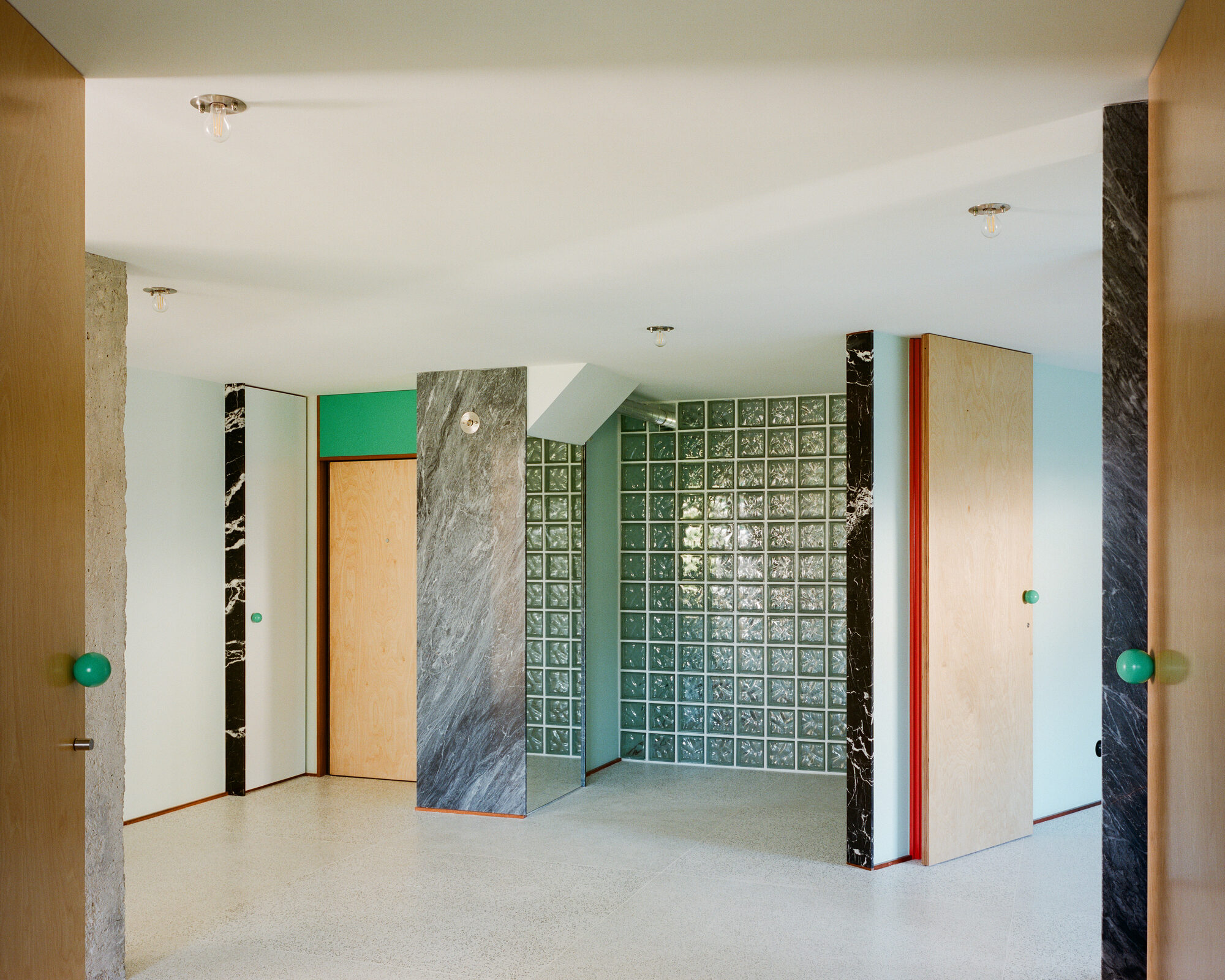
In the centre of the city, a large apartment has been transformed into a landscape of shifting geometries and uncertain boundaries. The original layout, fragmented and inefficient, was almost entirely erased, leaving behind only a handful of structural columns, technical risers, and the irregular outline of the existing perimeter. Rather than imposing a conventional orthogonal order onto this awkward footprint, the project embraces its inconsistencies, allowing the apartment to evolve through a series of skewed relationships between walls, rooms, and circulation.

The new interior unfolds as a continuous spatial field rather than a collection of discrete rooms. Walls are positioned at varying angles, responding to the peculiar geometry of the perimeter while generating a sequence of interconnected spaces. Rooms emerge less as enclosed entities than as temporary conditions within a fluid domestic landscape. Several are accessible through multiple doors, creating alternative routes through the apartment and encouraging a constantly shifting reading of the interior.

A proliferation of oversized plywood doors further reinforces this sense of movement. Connecting the angled walls, they act as spatial devices that periodically reveal, conceal, and reframe views across the apartment. Circulation becomes less a fixed path than a choreography of possibilities, where spaces remain visually and physically connected even when separated.


Materiality plays an equally important role in destabilising expectations. Rather than adopting the neutrality typically associated with contemporary interiors, the project introduces a palette of pale green and light blue surfaces that subtly differentiate one zone from another. Glass blocks and mint-coloured tiles catch and diffuse natural light, producing moments of softness within the otherwise precise geometry.


The existing structural columns, thick and slightly awkward in their original condition, are not concealed but deliberately highlighted. Clad in marble, mirror, or metal, they become points of reference within the shifting spatial composition. Against a continuous floor and ceiling that establish a calm visual framework, these interventions act as anchors within an otherwise restless interior.


Moments of vivid green and bright orange punctuate the apartment, introducing unexpected bursts of colour into the carefully controlled palette. At the centre of the plan, the kitchen appears almost as an autonomous object. Defined by a rounded semicircular form, it sits somewhere between furniture and architecture, closer to a sculptural installation than a conventional domestic element.


Throughout the apartment, order and instability coexist. Nothing appears accidental, yet nothing settles entirely into place. Walls, doors, colours, and objects continuously negotiate the constraints of the existing perimeter, producing an interior in which relationships remain deliberately unresolved.


Rather than imposing a singular logic, fala 215 embraces complexity and contradiction. The result is a domestic environment where rooms never fully agree with one another, and where everyday life unfolds within a carefully orchestrated state of spatial tension.
Project credit
Project name: fala 215 – apartment of skewed relations
Location: Porto, Portugal
Area: 150m2
Year: 2025-2026
Design Firm: fala / @fala.atelier