Now Reading: Glass House – Stone House: A contemporary dialogue with Northern Portugal’s granite vernacular
- 01
Glass House – Stone House: A contemporary dialogue with Northern Portugal’s granite vernacular

Glass House – Stone House: A contemporary dialogue with Northern Portugal’s granite vernacular

In northern Portugal, a short distance from the Atlantic, Glass House – Stone House reframes a familiar rural typology through a precise contemporary lens. The project is composed as a pair: a reconstructed granite farmhouse that carries the weight of local monolithic tradition, and a light, transparent glass pavilion that reads as both counterpoint and extension of the landscape. Together, they operate less as a contrast for its own sake than as a calibrated conversation between permanence and permeability, enclosure and exposure.

The stone house is rebuilt with dry laid granite walls set directly on the ground, without mortar, reinforcing an almost geological continuity between building and terrain. In a region shaped by humidity and coastal air, this choice foregrounds material behaviour rather than concealing it behind layered assemblies. The farmhouse’s original seven room footprint is retained, but reinterpreted: three rooms become enclosed, heated interiors, while four are intentionally left open to the elements. The decision turns absence into a tool. Exterior becomes part of the plan, and the line between inside and landscape is made porous by design, offering a flexible framework that can accommodate future uses, additions, or seasonal shifts without fixing the house into a single, finished state.


Instead of relying on complex insulation packages of membranes, synthetic layers, or cavity walls, the project introduces an active insulation strategy integrated into the mass of the stone itself. Copper pipes embedded within the exterior granite walls deliver radiant heat during colder months, regulating indoor comfort while interrupting capillary action. The approach keeps the construction logic materially direct, aligning thermal performance with the building’s elemental character and the region’s building culture.


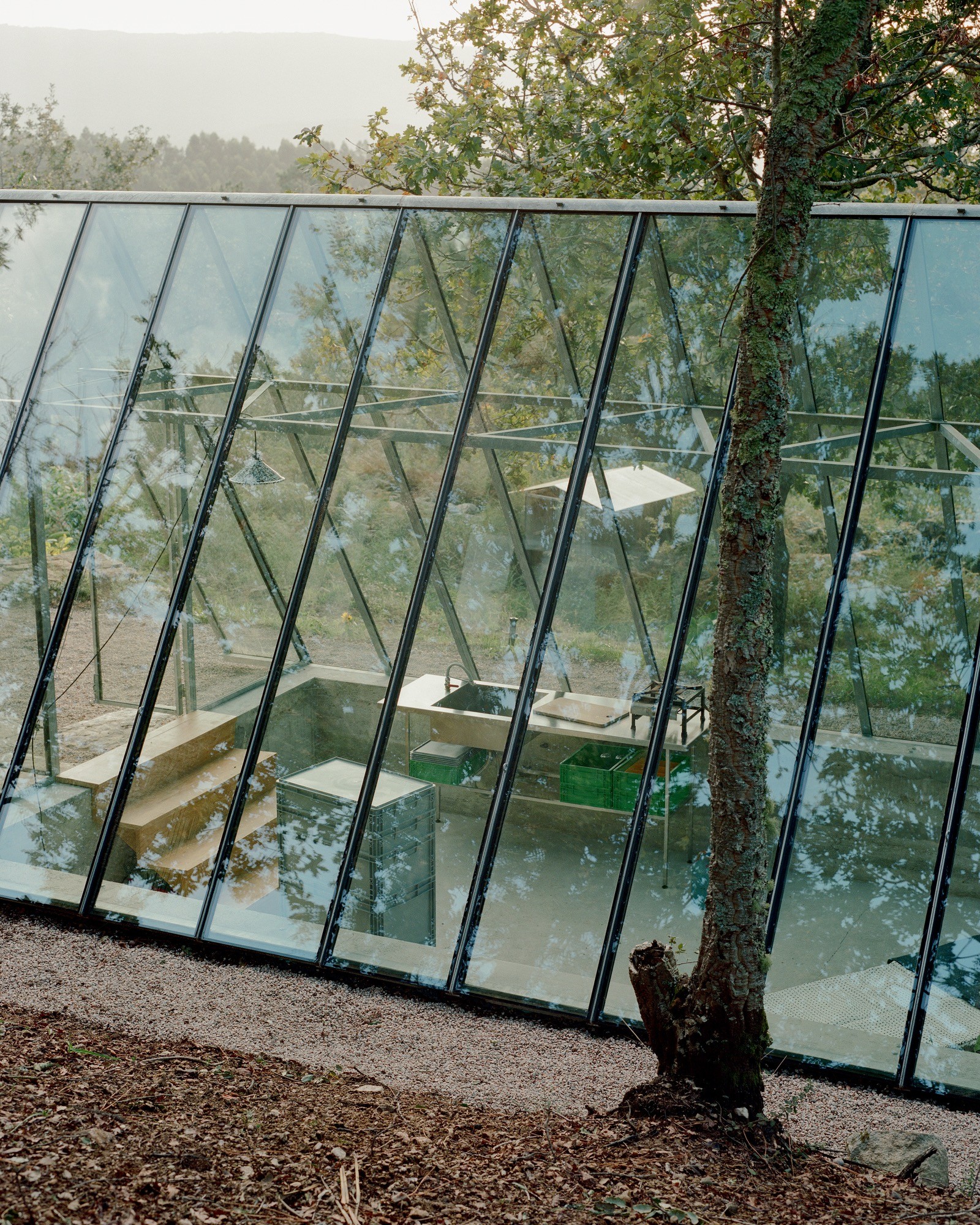
Completed first, the glass house sits lightly beneath a canopy of trees, a refined volume that feels more like a sheltered atmosphere than a sealed room. Two slender glass façades incline toward each other to form a triangular roof, protecting a sunken floor plane below. Informed by the conservatory, it offers warmth and transparency at once, acting as an inhabitable threshold between domestic life and the surrounding terrain. Where the stone house anchors the project in time and tradition, the glass pavilion opens it outward, extending the architecture into weather, light, and landscape.


Project Credit
Project name: Glass House – Stone House
Location: Portugal, Porto
Design: Dyvik Kahlen Architects / @dyvikkahlen
Complete: 2021
Photo: Francisco Ascensao