Now Reading: Blue door with built-in bench revives Tokyo garage bar without full renovation
- 01
Blue door with built-in bench revives Tokyo garage bar without full renovation


“In our youth, we were inspired by Ruskin…” wrote Le Corbusier in The Decorative Arts of Today, acknowledging both the necessity and the limits of nineteenth century craft reform. That tension between decoration and modernity frames the Blue Door at Ogikubo Bar, a modest yet pointed intervention in a residential neighbourhood of Tokyo.

Ogikubo Bar began in 2015 as an improvised garage set up with a camping table and folding chairs. Over a decade it became a local institution, despite lacking even a proper entrance. To mark its tenth anniversary, the owner chose not to renovate the space entirely but to install a single door, wary that drastic change might unsettle regulars who value its continuity.


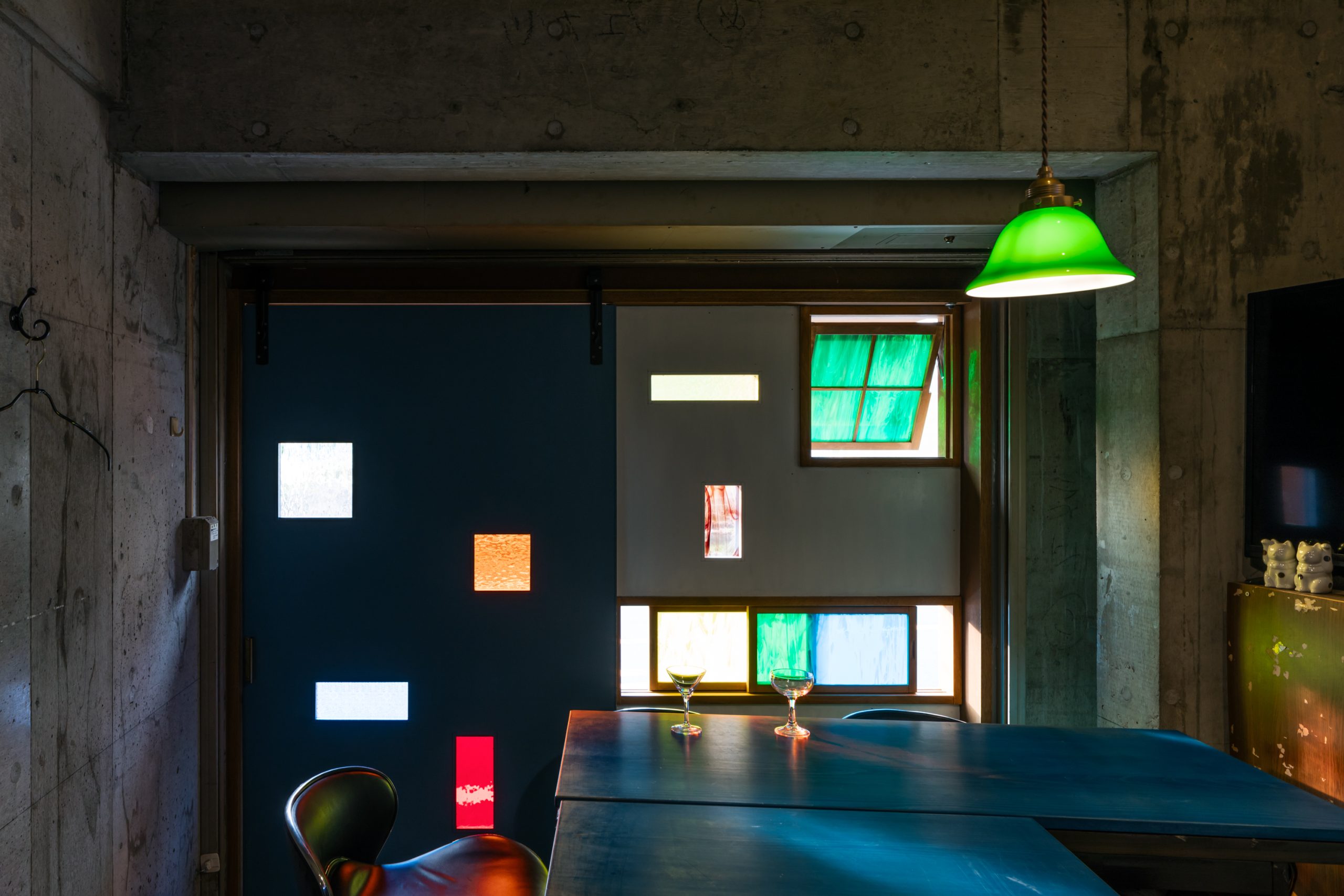
The design response embraces constraint. Rather than overhaul the bar, architect Mumu Tashiro treats the door as an autonomous architectural object. The project begins with colour. Blue, deeply embedded in Japanese material culture through indigo and navy dyes, possesses a particular resonance in low light. Tested through various mixtures, the final decision was a ready made, saturated blue applied directly. Under daylight it appears vivid; under streetlights it softens, absorbing the reddish grain of its lauan base. Against the concrete façade, it becomes a concentrated field, carving out a microcosm within the street.

Ten distinct panes of glass are embedded across the surface. Sourced from Japan, the United States, France and Germany, each differs in colour, texture and translucency. Rather than forming a uniform pattern, they are dispersed at varying heights and dimensions. From dusk to midnight, shifting light animates them, revealing silhouettes of customers inside. The small window becomes a device of social recognition. One does not need a fully open façade to connect; a narrow aperture and a glow of light suffice.
The door extends beyond threshold. A fold out bench is integrated into its structure, allowing it to function as furniture. Children play on it, guests wait, neighbours pause. In these unscripted uses, the door exceeds its typology. Decoration here is not ornament but agency, generating behaviours beyond its prescribed function.


Historically, bars flourished during the Industrial Revolution as public houses, spaces where workers gathered and identities intersected. Ogikubo Bar retains that semi public character. Its future renovation is planned in phases, allowing visitors to witness and inhabit the process. Architecture becomes incremental rather than definitive.


A door is conventionally a flat boundary. The Blue Door proposes instead a surface with depth, an object with autonomy and presence. Small in scale yet conceptually precise, it demonstrates how a single calibrated gesture can recalibrate atmosphere, craft and social life within the contemporary city.

Project Credit
Location: Tokyo, Japan
Design firm: Ateliers Mumu Tashiro / @mumutashiro
Photo: SOBAJIMA, Toshihiro / @sobajima_toshihiro