
Now Reading: David Chipperfield: the architect of quiet doubt, how imposter syndrome forged a legacy of restraint and sustainability
- 01
David Chipperfield: the architect of quiet doubt, how imposter syndrome forged a legacy of restraint and sustainability

David Chipperfield: the architect of quiet doubt, how imposter syndrome forged a legacy of restraint and sustainability

In the rolling fields of a Devon farm, where a young David Chipperfield once imagined a life mending animals as a veterinarian, the foundations of a disciplined temperament took root. Removed from the urban theatre he would later be asked to reshape, that pastoral beginning suggested a mode of endurance: work done with care, repeated until it holds. When Sir David Alan Chipperfield received the Pritzker Architecture Prize in March 2023, he responded not with triumphal rhetoric but with a candour that felt almost anomalous within the profession’s mythology. In a Dezeen interview republished from a 2020 podcast with the late Marcus Fairs, he admitted, “I don’t believe I’m that talented, I feel like a bit of a fake,” contrasting his “cobbled together” studio with what he described as Renzo Piano’s “grown-up office.” Achievement, he suggested, came less from innate brilliance than from persistence, with determination and commitment acting as substitutes for talent.
It would be reductive to treat that confession as a master key to an entire body of work. Yet it illuminates a persistent quality in Chipperfield’s architecture: a refusal to treat confidence as proof, and a reluctance to convert authorship into spectacle. In a discipline often seduced by visual assertion, where buildings declare themselves as signatures, his work proceeds differently. It seeks authority through calibration rather than dominance, through attention rather than announcement. His buildings do not attempt to eclipse their surroundings. They attempt to hold them, to render the existing city more legible. They operate at a low register, not out of modesty, but out of conviction that architecture gains durability when it resists instant legibility. That is a demanding position. It requires the architect to accept that impact can be cumulative, not instantaneous.

This disposition clarifies a question that often shadows his practice. Is Chipperfield driven by intuition or by strategy? The evidence consistently favours the latter. In conversation, he speaks less of revelation than of purpose, less of invention than of deliberate positioning. Critics have described him as possessing a “disciplined heart,” with intuition present but bound by method. His career has rarely chased novelty. It has cultivated coherence. In the present moment, that coherence carries ethical weight. Sustainability, in Chipperfield’s terms, is not an aesthetic of minimal means, nor a checklist of environmental technologies. It is a question of sufficiency, of making buildings that last, that can change, and that do not depend on constant replacement to remain relevant. The argument is not merely ecological. It is cultural. It asks what we consider “progress” to look like when building less becomes a form of intelligence.
Born in London in 1953 and raised partly in Devon, Chipperfield’s path toward architecture unfolded gradually. He studied at Kingston School of Art, graduating in 1976, and later at the Architectural Association in 1980, an environment defined by critique, intensity, and performative confidence. Chipperfield has recalled that Zaha Hadid played a crucial role in helping him pass his diploma. “If it hadn’t been for her, I would have failed,” he said, an anecdote that captures both the culture of the AA and his instinct to puncture heroic self-narratives. Apprenticeships at the practices of Norman Foster and Richard Rogers introduced him to the rigour of large-scale modernism, yet he did not inherit its appetite for exposed mechanics. He once described encountering the Centre Pompidou mid-construction as “the sexiest building I’d ever seen,” but his own work would follow a more tempered modernism, contemporary without being performative. When he founded David Chipperfield Architects in 1985, early commissions, including retail interiors for Issey Miyake, became a laboratory for restraint, where proportion and material clarity carried meaning without recourse to spectacle. This was not minimalism as pose. It was minimalism as discipline, learnt in the hard grammar of making.

This is where the notion of “radical restraint” becomes productive, provided it is understood as an active position rather than a stylistic absence. Chipperfield repeatedly returns to architectural fundamentals, durability, utility, beauty, and under ecological pressure these fundamentals acquire sharper stakes. The Pritzker jury praised his work for treating sustainability as “pertinence,” a refusal of the superfluous in favour of resilience. The position is not nostalgic, nor merely technical. It is political. Chipperfield has been openly critical of architecture’s commodification, in which buildings function as instruments of global influence at significant environmental cost. In a 2023 conversation with The Grand Tourist, he argued that addressing consumption requires confronting aspiration, desire, and happiness themselves. Sustainability, in this framing, cannot be solved through optimisation alone. It demands a shift in what architecture promises and in what societies are taught to value. His response has been systemic rather than cosmetic: prioritising reuse, supporting circular thinking, and insisting that existing structures represent not a constraint but an ethical starting point. Put bluntly, the “green” question becomes inseparable from a moral one: what is enough, and who decides?
An early project that quietly demonstrates this position is the River and Rowing Museum in Henley-on-Thames, completed in 1997. Set along the Thames, the building draws on the unassuming intelligence of local barns and boathouses through pitched roof forms and timber cladding, without sliding into imitation. The museum behaves as if it belongs to its landscape. Galleries unfold in a sequence that feels inevitable rather than orchestrated. Daylight and material are handled with restraint. Civic presence is achieved without monumentality. Inside, timber structure and carefully placed rooflights temper the galleries, producing a soft, even light that feels closer to a working boathouse than to a theatrical museum. Even without explicit ecological rhetoric, the project anticipates Chipperfield’s later commitments: low-impact decisions embedded in form, section, and material choice, producing longevity through legibility and care. The building’s calm is not passive. It is engineered.

That logic reaches its most consequential articulation in Berlin’s Neues Museum, realised between 1997 and 2009. Severely damaged during World War II and left exposed for decades, the building posed a fundamental question: how to restore without erasing, how to intervene without aestheticising ruin. Chipperfield rejected both extremes, neither pristine reconstruction nor romantic decay. Instead, traces of damage remain legible as historical evidence, while new elements are inserted with measured clarity. Contemporary additions do not mimic the old, yet neither do they compete with it. The result is a composed palimpsest in which different temporalities coexist without collapsing into a single image. New brickwork, plaster, and concrete are deployed as quiet counterparts, their edges and junctions making the act of repair readable without turning it into a display. The museum’s critical reception, including the Mies van der Rohe Award in 2011, confirmed that moderation can be radical when anchored in discipline. Here sustainability is cultural as much as material: conserving fabric reduces waste, but it also preserves memory. Constraint becomes a source of architectural force.

If one insists on reading this body of work through the lens of doubt, the mechanism becomes clearer. Self-questioning does not produce restraint. It sharpens it. Rather than asserting mastery, Chipperfield builds credibility through measured choices and through a willingness to allow what already exists to remain present. Where others might resolve history into a singular gesture, he allows it to remain unresolved, supported, framed, and made usable. The result is not ambiguity for its own sake, but ethical clarity: an acceptance that repair can be more responsible than replacement. There is also something else at stake. Repair is slower. It invites scrutiny. It asks the architect to relinquish the fantasy of authorship as total control.
In Milan, the Museo delle Culture (MUDeC), opened in 2015, extends this ethic through adaptive reuse. Occupying the former Ansaldo factory, the museum treats the industrial shell not as a relic but as infrastructure. Its luminous atrium acts as a spatial hinge, drawing visitors through a sequence that connects old and new without melodrama. The double-curved glazed atrium reads like a controlled distortion of the old factory volume, gathering daylight and throwing it back into the retained industrial fabric. In a city that often rewards architectural bravura, MUDeC proposes a quieter form of urban renewal: reuse rather than replacement, daylight rather than spectacle, continuity rather than rupture. The building does not perform cosmopolitanism; it hosts it.

The same temperament informs Seoul’s Amorepacific Headquarters, completed in 2018. Externally composed and restrained, the building is internally structured around generous atriums that function as urban interiors, gardens, shared rooms, and voids that distribute light and social life across the workplace. Sustainability here is not announced but embedded: durable materials, spatial adaptability, and an atmosphere shaped by daylight rather than by image. The large internal voids act as climatic moderators as much as social condensers, turning the corporate block into a porous interior landscape rather than a sealed object. Corporate architecture becomes, if not civic, then at least less extractive. It becomes more negotiable, more humane. Less certain of itself, perhaps, and therefore more careful.

Venice’s Procuratie Vecchie, reopened in 2022, further refines the relationship between restraint and public value. Revitalising a 16th-century building on Piazza San Marco that had long been inaccessible, the project reintroduced it to civic life through workspaces, exhibitions, and public programmes. The intervention avoids restoration-as-theatre. New routes and repaired surfaces allow the building’s historical authority to remain architectural rather than scenographic. Services and circulation are integrated with an almost surgical discretion, allowing the rooms to read as rooms again, not as heritage set-pieces. In a city under climatic stress, the project’s implicit sustainability lies in extending usefulness, with heritage treated not as a fragile artifact, but as active civic infrastructure. The building returns to the city not as image, but as use.

Restraint, however, is not immune to misinterpretation. Understatement can become a code of exclusivity. Durability can be romanticised or instrumentalised. The strongest readings of Chipperfield’s work resist these pitfalls by tying restraint to accountability: public access, reuse, and the capacity for care over time. The question is not whether architecture can be quiet, but whether quietness remains answerable to the city. In other words, restraint is only credible when it carries consequences beyond taste.
That accountability is tested most visibly in Milan’s Arena Santa Giulia, developed with Arup for the Winter Olympics scheduled for February 2026. Conceived as a 16,000-capacity venue that will later operate as a multi-purpose arena, the project frames sustainability as future adaptability. Like many Olympic projects, its success will be judged less by its opening moment than by how convincingly it can be absorbed into everyday civic life afterward. Recent coverage has suggested construction pressure and scheduling challenges, familiar conditions of mega-event architecture, where deadlines threaten to eclipse long-term value. The arena’s ultimate measure will not lie in its Olympic performance but in its capacity to function as durable civic infrastructure in the decades that follow. This is where the ethic of “enough” meets the politics of “on time.”

Beyond these headline projects, Chipperfield’s ongoing work continues to articulate architecture as careful addition rather than heroic replacement. In Athens, the proposed extension of the National Archaeological Museum introduces subterranean expansion and landscape strategies that preserve the neoclassical presence while increasing public capacity. In Edinburgh, the Dunard Centre advances another form of civic ambition: a concert hall conceived not as an icon but as a long-term cultural instrument. Across these projects, the same logic persists, architecture as calibration, repair, and continuity. They are not loud projects. They are patient ones. They assume the city will still be there, and that architecture must answer for its own endurance.

Chipperfield’s working method reflects this stance. Ideas are cultivated with rigour and consequence. Design is not presented as a sequence of epiphanies. Time becomes a material, time as memory, time as maintenance, time as public use. His position on sustainability follows naturally. In a culture oriented toward novelty, the most radical architectural act may be to build less, to build better, and to make change possible without erasure. Through initiatives such as Fundación RIA in Galicia, he has extended this responsibility beyond buildings to territory, ecology, and modes of living. Not as branding. As an insistence that architecture cannot be separated from the conditions that sustain life.

In an era of accelerated fashion, Chipperfield’s persistent scepticism has produced an architecture of continuity. His buildings negotiate between eras and environments, nature and metropolis, not through spectacle but through measured decisions that preserve value while accommodating necessity. As ecological pressures intensify, his work proposes not a style but a discipline: endure, question, repair, and build for posterity. Perseverance, he suggests, does not merely compensate for talent. Under present conditions, it may be the only credible way to practise.
Photo Cover
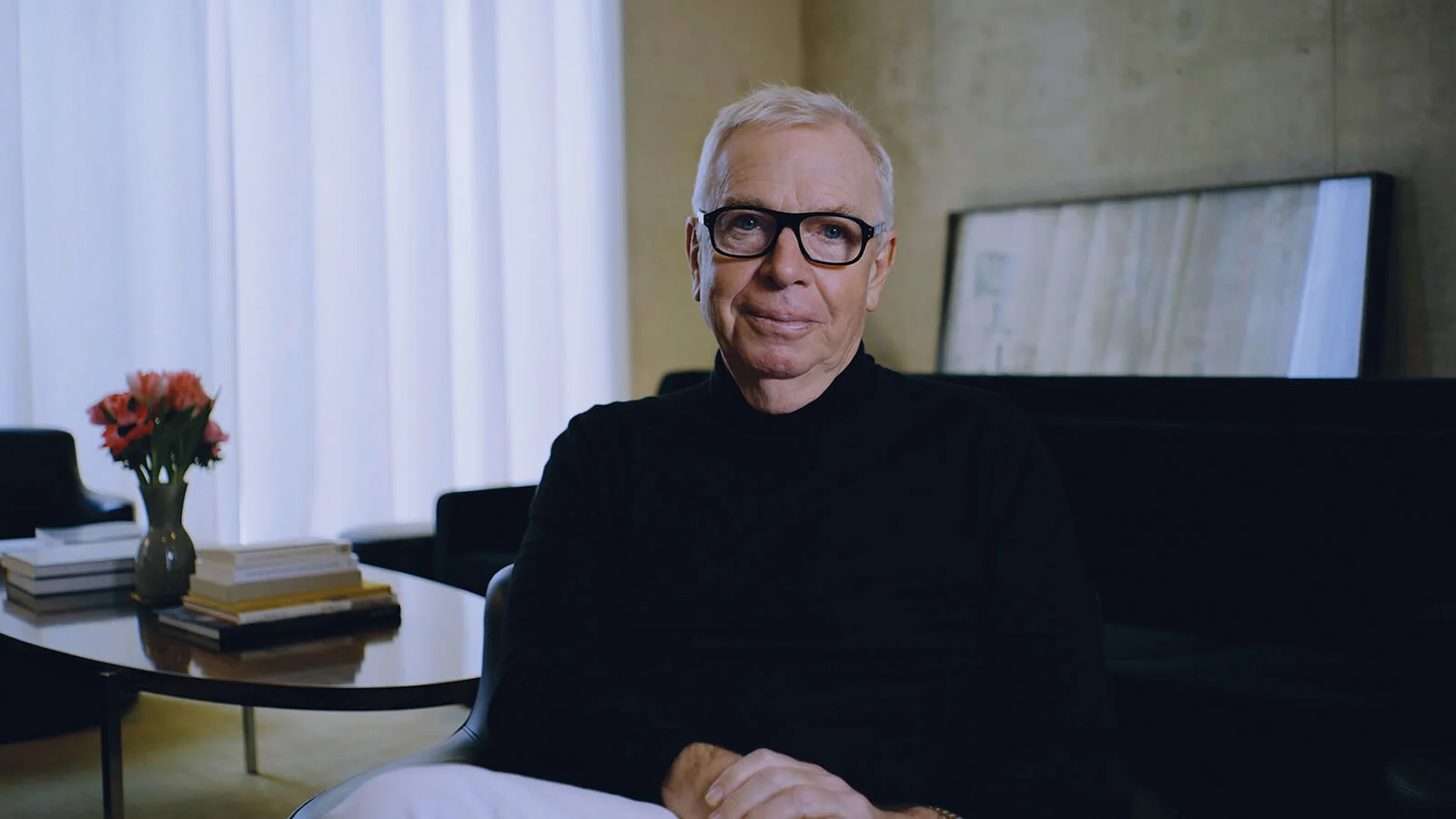
David Chipperfield in his Berlin studio – deliberate and understated working environment
Credit: David Chipperfield Architects / Simon Menges