
Now Reading: House in a Garden in Melbourne blurs indoor and outdoor living with layered landscape design
- 01
House in a Garden in Melbourne blurs indoor and outdoor living with layered landscape design

House in a Garden in Melbourne blurs indoor and outdoor living with layered landscape design

There is a quiet familiarity in the forested paintings of Grant Nimmo, where dense vegetation, filtered light, and layered depth evoke the sensation of being immersed in nature. These works do not simply depict landscapes but capture atmosphere, time, and presence. House in a Garden operates within a similar register, translating this sensibility into built form.


Set above the landscaped floodplain of the Birrarung, the house is conceived as a dwelling within foliage rather than beside it. Its spaces unfold as if embedded in a thickly planted terrain, where architecture and landscape are inseparable. The project reflects a condition that feels almost archival, recording an environment that is still accessible, yet increasingly fragile.

The plan is direct yet spatially rich. Two distinct wings organise the house into complementary modes of inhabitation. One is open and fluid, accommodating collective life, while the other is enclosed and quiet, offering retreat. This duality establishes a rhythm between connection and privacy, articulated through smoothly curved timber walls that soften transitions and introduce warmth.


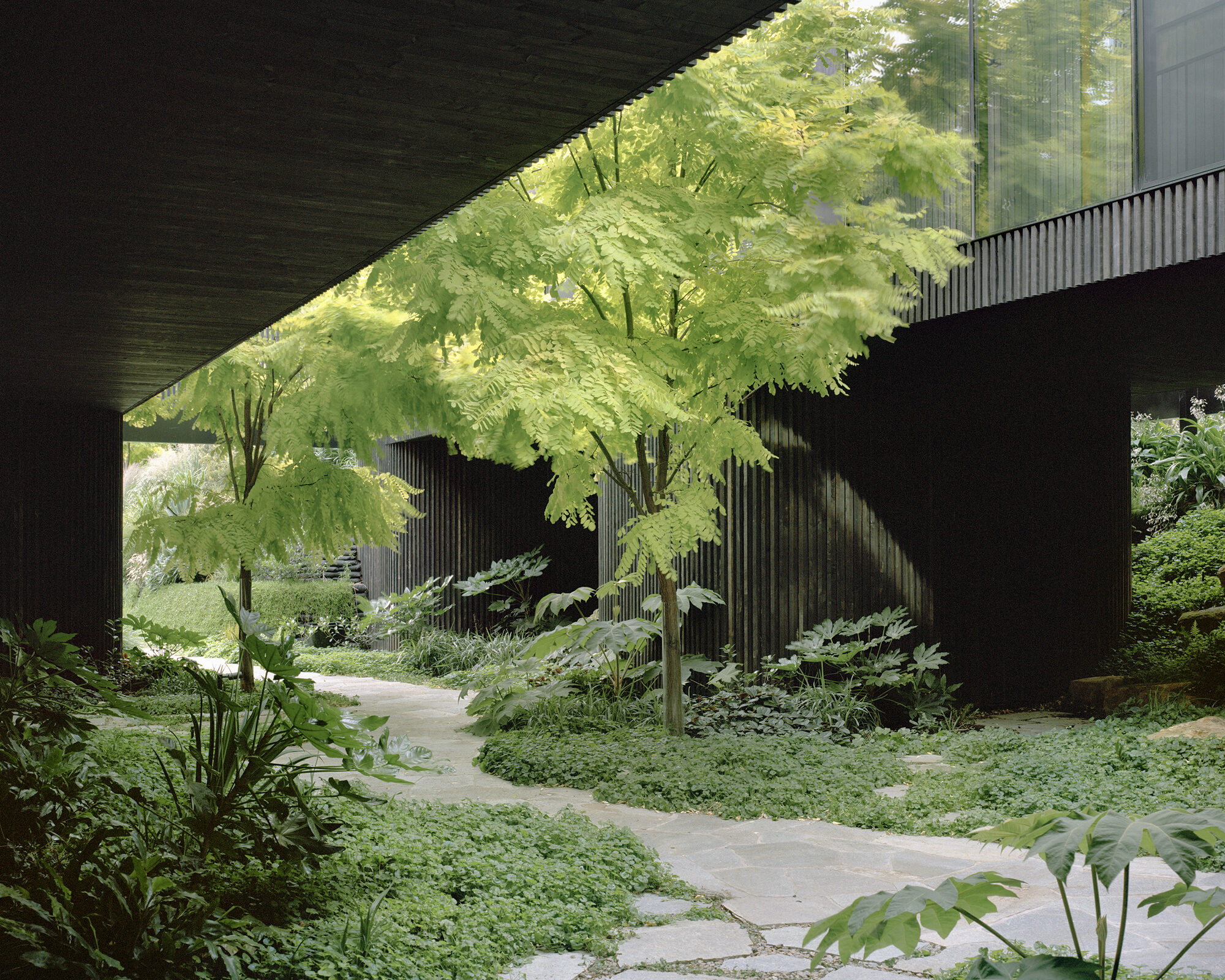
Elevated above the ground, the main living level sits lightly within the canopy. Below, a series of structural supports define pockets within the landscape, shaping spaces that range from open clearings to compressed, shaded zones. Some extend upward to allow trees to pass through, while others form sheltered areas dense with undergrowth, reinforcing a continuous dialogue between built form and natural growth.


Foliage surrounds every room, mediating views and shaping perception. Rather than expansive panoramas, the house offers curated glimpses outward, filtered through slender timber batten screens. This calibrated threshold condition defines the project’s character. From certain angles, the house appears solid and contained, while from others it dissolves into translucency, its edges softened by light and vegetation.

At ground level, permeability becomes more pronounced. The building opens to a pathway that guides movement through the site, encouraging a gradual, immersive approach. The experience of arrival is slow and deliberate, aligned with the rhythms of the landscape.

While conceived from the inside out, the project maintains a strong formal clarity. The plan reads as precise and graphic, yet internally it unfolds as a layered and nuanced environment. Spaces are defined less by enclosure than by atmosphere, softened through the presence of objects, planting, and carefully shaped niches.
This dual condition is central to the project’s identity. Externally, the house appears composed and defined. Internally, it is fluid and adaptable, balancing openness with intimacy. Volumes expand and contract, allowing spaces to feel both generous and personal.


The project replaces a former 1980s Mediterranean Revival house, whose visual weight dominated the site. In contrast, House in a Garden seeks a quieter presence, re-establishing a relationship between dwelling and landscape. This shift has been realised through close collaboration with Eckersley Garden Architecture, alongside Comb Construction and Canterbury Landscapes.
Environmental systems further reinforce this connection. Solar panels, heat pump hydronic heating and cooling, and domestic hot water systems operate alongside passive strategies such as cross-ventilation through voids. Together, they allow the house to engage with its environment both technologically and naturally.
Though conceived independently, the house and Nimmo’s paintings share a conceptual alignment. Each explores the experience of inhabiting a forest, where light, colour, and depth are constantly shifting. One exists as image, the other as space, yet both articulate a similar ambition: to capture the sensation of moving through, and living within, the layered richness of the natural world.
Project Credit
Project name: House in a Garden
Design firm: Edition Office / @editionoffice
Year of completion: 2026
Location: Melbourne, Australia
Photo: Maxime Delvaux