
Now Reading: Historic spinning mill in Kežmarok converted into distillery and museum
- 01
Historic spinning mill in Kežmarok converted into distillery and museum

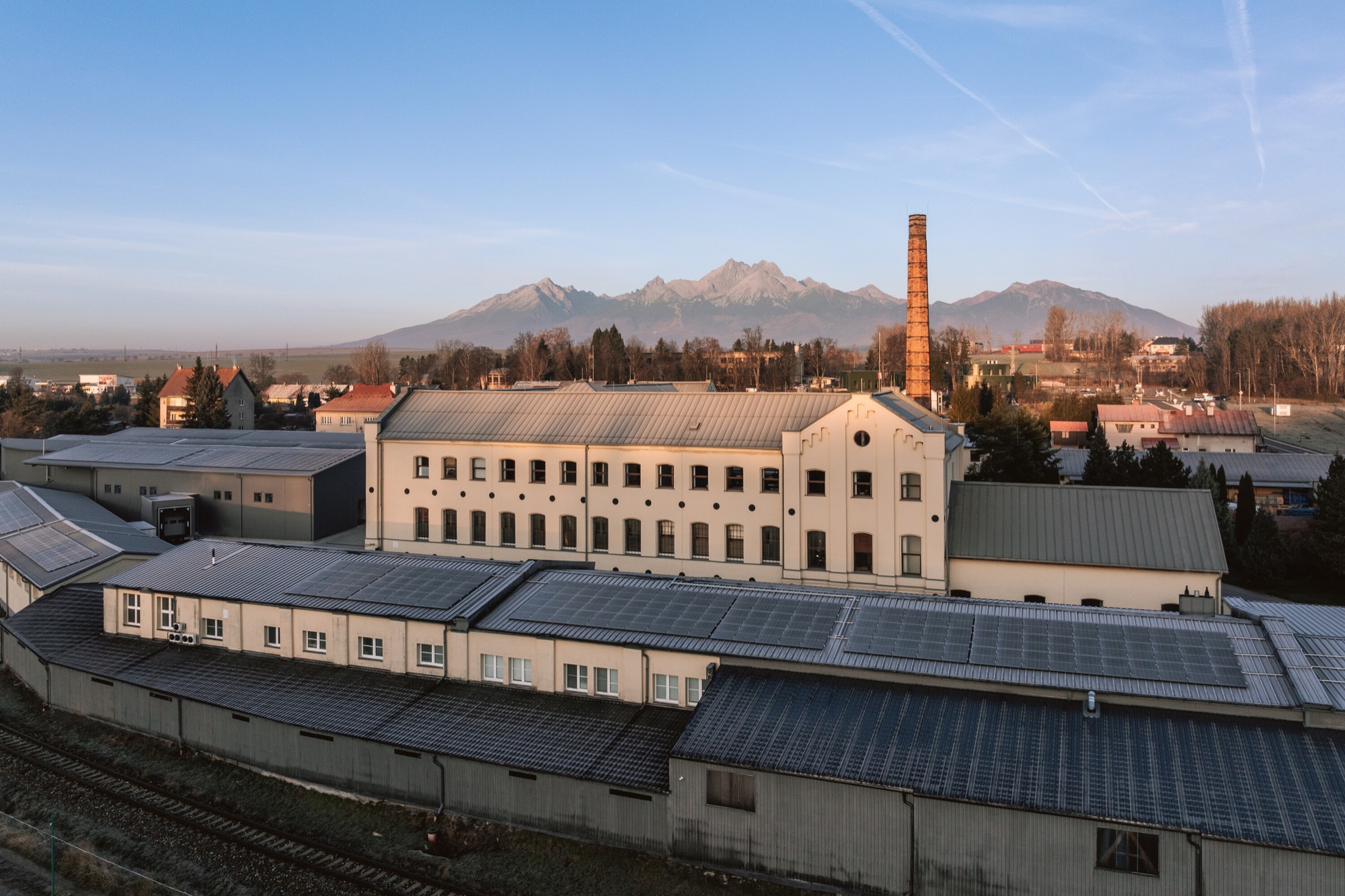

Founded in 1860 by Karol Wein, the spinning mill complex in Kežmarok once ranked among the most advanced textile factories of the Austro Hungarian Empire. Located in the foothills of the High Tatras, the facility emerged during a period when textile production flourished across the region, contributing significantly to the industrial landscape of northern Slovakia.
Production continued uninterrupted until 1946, when the original owners were forced to leave the country following political upheavals. The factory later operated under the name Tatraľan, functioning as a mechanical flax spinning and weaving mill that at its peak employed nearly 2,500 workers. For decades, the complex served as an important economic engine for the surrounding community.


After the economic transformation of former Czechoslovakia following 1989, industrial production gradually ceased. The once thriving factory fell into decline, yet the complex endured. Recognizing its architectural and historical significance, the main production building was eventually declared a National Cultural Monument.


When the property passed into the hands of its current investor, the structure was already in a severely deteriorated state. A stream flows directly beneath the building, while parts of the foundations rest on wooden piles that had begun to decay. Persistent moisture and repeated flooding had weakened the masonry and damaged floors and ceilings, making extensive conservation and structural rehabilitation unavoidable.

ARCHITECTURE BETWEEN HERITAGE AND RENEWAL
In 2019, the new owner launched an architectural competition seeking to transform the site into a contemporary production and administrative facility for a renowned spirits manufacturer while preserving the historic industrial structure. The winning proposal approached the project as a dialogue between heritage and contemporary architecture, integrating new layers while respecting the building’s original character.
Although the spinning mill stands on the outskirts of Kežmarok within an industrial district, the redevelopment sees the complex as a potential urban anchor. The architectural strategy introduces a public realm that reconnects the formerly closed industrial compound with the city, inviting both residents and visitors to rediscover the site.


The new programme proposes a balanced mix of production, culture, recreation and social life. On the ground floor of the extension, a café, company store and a museum dedicated to flax processing open the complex to the public and narrate the history of the region’s textile craft. The first phase of redevelopment, now completed, focused primarily on the restoration and adaptive reuse of the historic building itself. Today it accommodates production spaces, administrative offices, tasting rooms and guest apartments.

As the structure holds the status of a listed monument, the project was developed in close cooperation with the Heritage Office. Particular attention was given to preserving authentic elements of the industrial architecture. Cast iron reinforcements decorated with delicate flax flower motifs were carefully restored, while the original brick chimney will soon be transformed into a panoramic observation tower offering views toward the High Tatras.


RECONNECTING THE HISTORICAL FABRIC
Respect for the historical layer formed the foundation of the architectural approach. The design team treated the building’s industrial character not as a constraint but as the central identity of the project. Later additions that had disrupted the proportions and silhouette of the original structure were removed, including a boiler house that had altered the massing of the complex.
One smaller extension was retained for operational reasons, accommodating staff facilities. However, it was visually separated from the main building to preserve the clarity of the historic composition.

Material choices reinforce the dialogue between past and present. The exposed cast iron structure of the original mill remains the defining element of the interior, complemented by terracotta flooring and light toned plaster surfaces. New interventions are deliberately restrained, allowing the patina of the historic materials to remain the primary spatial expression.


INTERIOR STRUCTURE AND TECHNICAL STRATEGY
Inside the building, the renovation reveals the rational clarity of nineteenth century industrial construction. Rows of cast iron columns support brick vaults and semi vaulted ceilings, elements that were meticulously preserved during the restoration process.


Historic surfaces were cleaned and consolidated while maintaining their natural texture. Newly introduced elements such as floors, railings and lighting are designed with a quiet architectural language that complements the existing structure rather than competing with it.

One of the most complex technical challenges involved ensuring fire safety due to the presence of alcohol production and storage. The technical interventions were carefully integrated into the architecture so that contemporary safety requirements could be met without compromising the visual integrity of the historic spaces.


A NEW URBAN CHAPTER FOR THE MILL
The greatest achievement of the Kežmarok spinning mill redevelopment lies in its ability to introduce a new function while preserving the spirit of the original building. Rather than transforming the site into a museum of the past, the project allows the historic structure to continue evolving within contemporary life.


Beyond the renovation itself, the redevelopment introduces an important new public space within an area that previously lacked urban gathering places. By reopening the complex to the city, the project reconnects Kežmarok with a significant part of its industrial heritage.

In this way, the former spinning mill becomes more than a restored monument. It emerges as a living place where the memory of industrial production meets the rhythms of contemporary urban culture.
Project Credit
Studio: BEEF ARCHITEKTI / @beefarchitekti
Location: Pradiareň, Kežmarok, Slovakia
Completion year: 2024 (1st phase)
Usable floor area: 4.622 m²
Photo: Jakub Čaprnka
More Photos