Now Reading: UrbanNest Design Studio designs cave-like black interior for Asterix Café
-
01
UrbanNest Design Studio designs cave-like black interior for Asterix Café

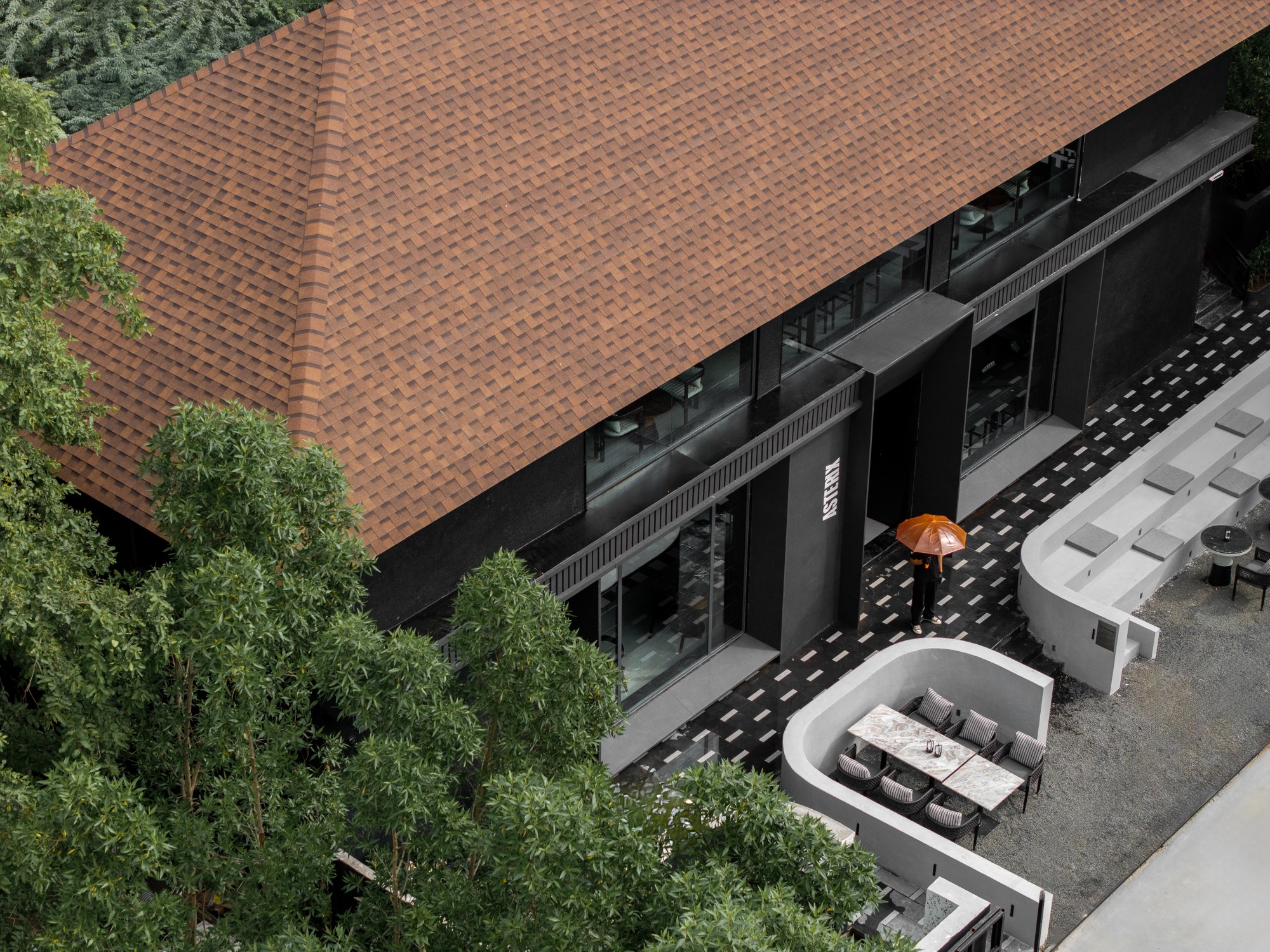

Asterix Café rethinks the familiar language of contemporary coffee spaces. While many cafés lean on light palettes and soft atmospheres, this project deliberately turns toward darkness as its primary design medium. Conceived by UrbanNest Design Studio, the café proposes a spatial experience built around depth, shadow and texture, transforming black into an expressive architectural element rather than a purely aesthetic choice.

The project positions itself as more than a conventional coffee venue. It is envisioned as a flagship destination where community activities, cultural programming and coffee culture intersect within a bold spatial framework. Layers of black surfaces, raw material finishes and sculpted forms create an immersive environment that unfolds gradually as visitors move through the building.

At ground level, the design establishes a strong visual anchor through the barista counter, finished in white terrazzo plaster. The counter stands in deliberate contrast to the surrounding pine wood panels coated in matte black, creating a composition where light and darkness articulate the spatial hierarchy. Merchandise and specialty coffee equipment are displayed almost as curated objects, illuminated by carefully positioned lighting that highlights the natural grain of the wood and the mineral texture of the terrazzo surface.


The interior is conceived as a continuous sequence of spatial atmospheres rather than a collection of separate rooms. Subtle shifts in light, material and scale guide movement through the café while maintaining a sense of visual cohesion. Darkness, rather than enclosing the space, becomes a background against which material textures emerge with greater clarity.


The project extends beyond the interior to create an active social threshold. An outdoor amphitheatre links the café with adjacent pickleball courts, allowing visitors to engage with both sport and social life while occupying the same spatial field. The gesture transforms the café into a place of gathering rather than a purely commercial venue.


Inside, the ground floor is designed for everyday coffee culture, offering a setting that feels intimate yet energetic. Above it, the first floor functions as a flexible cultural platform capable of hosting stand up performances, film screenings, exhibitions and coffee related events. A double height void connects the two levels, allowing sound, movement and light to circulate between them while reinforcing the sense of a shared interior landscape.

Furniture arrangements remain adaptable, enabling the space to shift between café use and cultural programming with minimal intervention. An integrated stage and modular seating elements ensure that the spatial character of the café remains dynamic throughout the day.
The design narrative takes inspiration from the idea of a cave. Rather than relying on strict orthogonal geometry, the interior surfaces are shaped through sculptural gestures that evoke erosion and subtraction. Curved edges, recesses and textured planes generate a spatial language that feels both primitive and contemporary.

This approach becomes most evident in the first floor “cave corner,” where a communal table carved from live edge timber sits beneath pendant lights fashioned from tree logs. The space evokes a gathering point that feels simultaneously raw and refined, suggesting an architectural interpretation of shelter rooted in nature.


Materiality forms the core of the project’s visual identity. The palette remains deliberately monochromatic, dominated by black and grey tones, yet the variety of textures prevents the interior from feeling uniform. Surfaces range from beaten metal sheets and brushed bronze details to micro concrete, matte finished pine panels, terrazzo plaster and raw stone.
These materials respond differently to both natural and artificial light, producing subtle variations in tone and reflection. The resulting interplay between light and shadow introduces a sense of depth that parallels the layered complexity often associated with specialty coffee itself.


From the exterior, Asterix Café presents itself as a distinct black volume. The façade is clad in aluminum panels, paired with Kadapa stone flooring and a sloping brown roofline that softens the building’s silhouette. Together these elements establish a strong visual identity that allows the café to stand out within its urban context.

The building operates simultaneously as shelter and symbol. Its dark geometry becomes part of the brand’s visual language, reinforcing the café’s identity through architecture as much as through graphic design.
Project Credit
Location: Adalaj, Gujarat, India
Site Area: 10,000 sq.ft.
Building Area: 3,000 sq.ft.
Designed by: UrbanNest Design Studio / @urbannest_designstudio
Year: 2025
Photo: Umang Shah Photography / @umangshahphotography
Styling: Studio Kanan Shah