
Now Reading: Where spatial energy becomes everyday action
- 01
Where spatial energy becomes everyday action

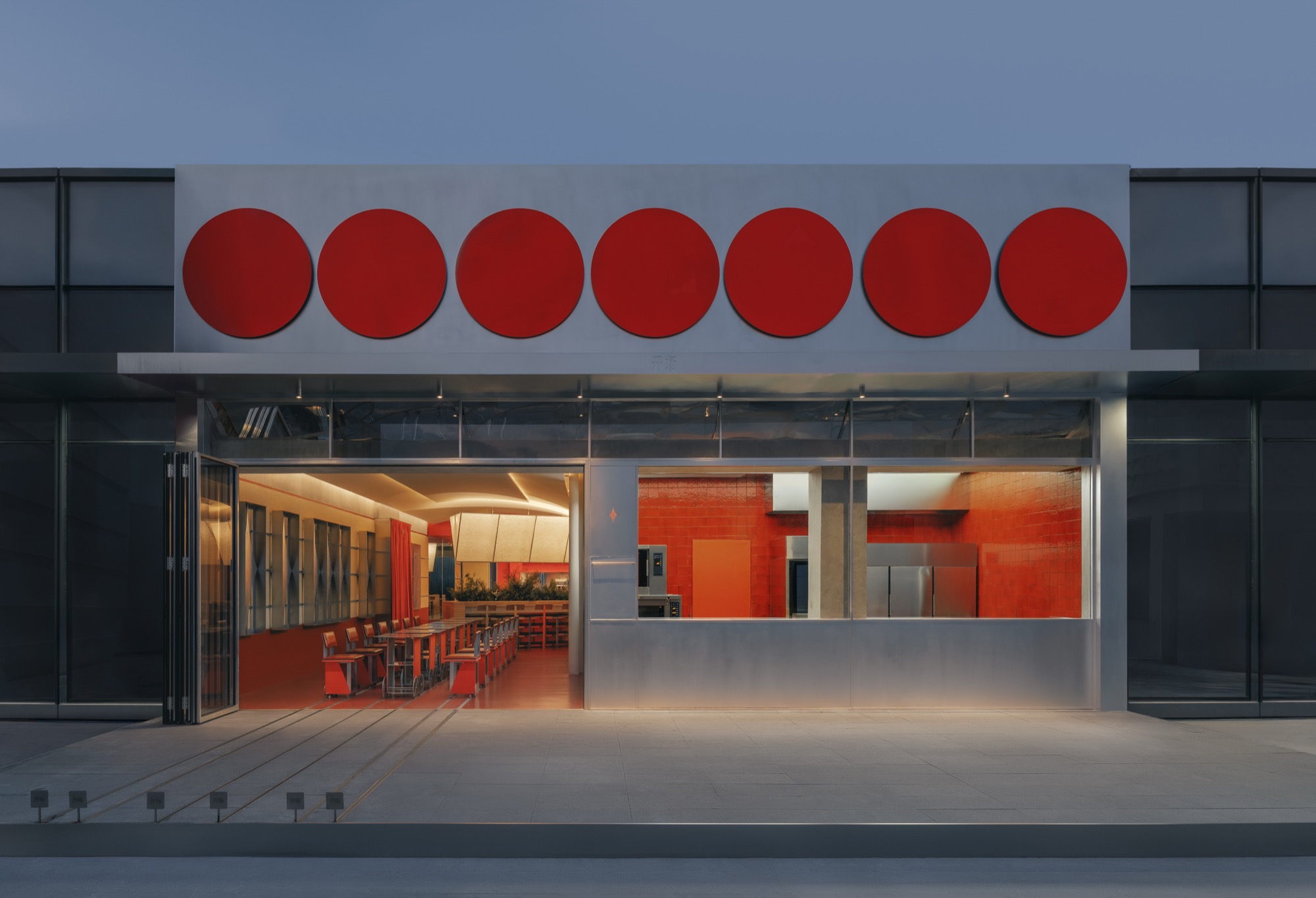

In a small town in Zhejiang, China, Café On Site, also known as 开场 Kai Chang, is conceived not simply as a place to drink coffee, but as a spatial field where energy gathers, circulates, and transforms everyday encounters. Rooted in local culture and daily rituals, the project positions the café as an active social condenser, where movement, interaction, and atmosphere shape the experience as much as taste and aroma.

The project was developed as a holistic system, encompassing brand strategy, naming, visual identity, and interior architecture. Rather than treating branding and space as separate layers, both were conceived simultaneously, allowing graphic language, spatial form, and daily operation to evolve from a shared conceptual core.


The name 开场 Kai Chang carries multiple meanings embedded in Chinese language and local context. It refers to an opening moment, like the beginning of a performance when attention gathers and anticipation builds. It also evokes the notion of place and atmosphere, with 场 describing not only a physical site but the invisible energy that defines it. At the same time, its phonetic resonance with 厂, meaning factory, subtly references Wenzhou’s entrepreneurial culture and its long association with small scale manufacturing and making. The English name On Site reinforces this idea of presence, anchoring the café firmly in its immediate context and everyday life.


A central design question was how to translate the abstract idea of spatial energy into tangible architectural and mechanical elements, while meeting the practical demands of a working café. The answer lies in a choreography of movement, rotation, and interaction embedded directly into the plan and furnishings.


Within the interior, the linearity of the original space is deliberately disrupted. Major functional zones are rotated at subtle angles, while four formally distinct columns act as spatial anchors that guide movement and frame views. This strategy breaks visual monotony and produces alternating moments of openness and intimacy. As visitors move through the café, they are intuitively drawn toward either expansive communal areas or more sheltered corners, allowing spatial energy to be felt rather than explained.


This sense of motion is further amplified through a series of kinetic mechanisms integrated into daily operations. A curved entrance door slides into a recessed circular track, setting the tone upon arrival. Behind the counter, baristas secure fittings into grooves to pass drinks through a takeaway window. Guests seated around a planter table draw a red curtain to frame informal photo moments. Seasonal pastries are displayed on a four point star shaped rack that can be rolled toward newly arrived customers. On pleasant days, tables glide along embedded tracks, extending the café outward and allowing coffee rituals to spill into sunlight.


Through these repeated gestures, spatial energy becomes part of everyday action. What begins as an abstract concept is absorbed into routine movements, turning branding into lived experience and architecture into an active participant in social exchange.


Located within a dense commercial district, the café confronts a complex urban condition that demands different responses at its front and rear. Each facade is treated as a distinct interface, negotiating visibility, protection, and openness in contrasting ways.
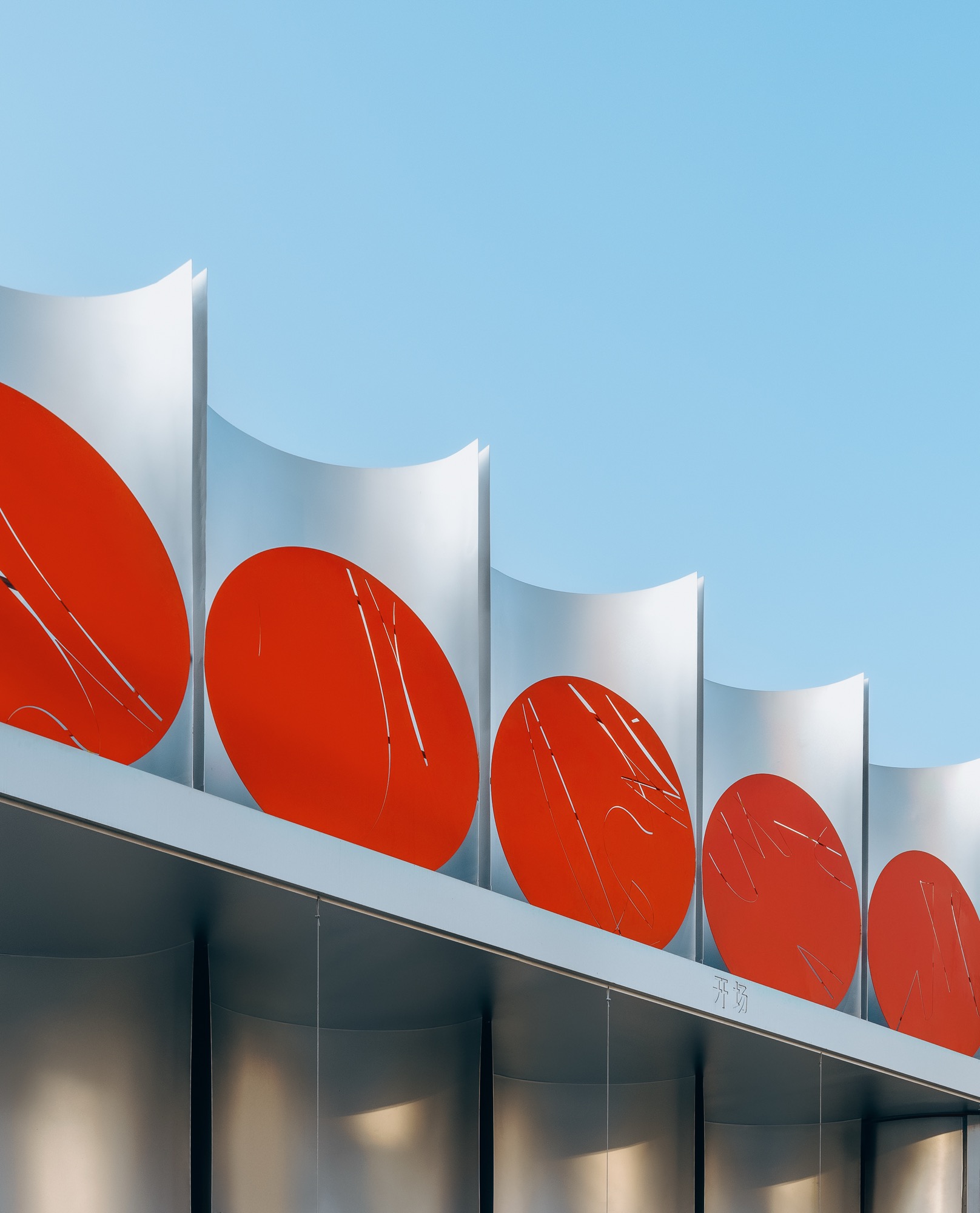
The front facade faces a neighboring barbecue restaurant, animated but visually and acoustically challenging. Rather than relying on transparent glazing or oversized signage, the design introduces a semi enclosed architectural screen composed of five hollow semi cylindrical volumes. Drawn from the brand’s visual language, these elements establish a rhythmic presence on the street while buffering smoke, noise, and visual clutter.


At close range, horizontal planes embedded at varying heights within the cylinders invite informal occupation, allowing people to lean or sit along the facade. At night, warm interior light filters through the curved gaps, offering fleeting glimpses of activity inside and transforming the facade into a quiet urban signal.
In contrast, the rear facade opens completely toward an adjacent park lawn. Here, boundaries dissolve as interior tracks extend outdoors, allowing furniture to slide seamlessly into the landscape. With a gentle push, the café expands into public space, merging daily rituals of coffee with the rhythms of the park.


Throughout the project, a strong geometric continuity links visual identity and architecture. Dynamic curves, circular metal components, four point star display structures, and inverted triangular linear lights recur across facade and interior, shifting scale and function while maintaining formal coherence. Each element originates in the graphic system and finds spatial expression through material, structure, and use.


Rather than functioning as decoration, these geometries operate as a shared language that binds brand, space, and movement together. In Café On Site, architecture does not simply house activity. It stages it, allowing energy to remain visible, mobile, and deeply connected to everyday life.
Project Credit
Project name: Café On-Site(开场Kai-Chang)
Location: Wenzhou, Zhejiang, China
Design firm: aptdotapt / @aptdotapt
Area: 140 m2
Completed: December 2025
Photo: Yumeng Zhu / @yumeng_zhu_coppakstudio
More Photos