Now Reading: Zimoun Sound Architectures: Mechanical Repetition and Emergent Systems
- 01
Zimoun Sound Architectures: Mechanical Repetition and Emergent Systems

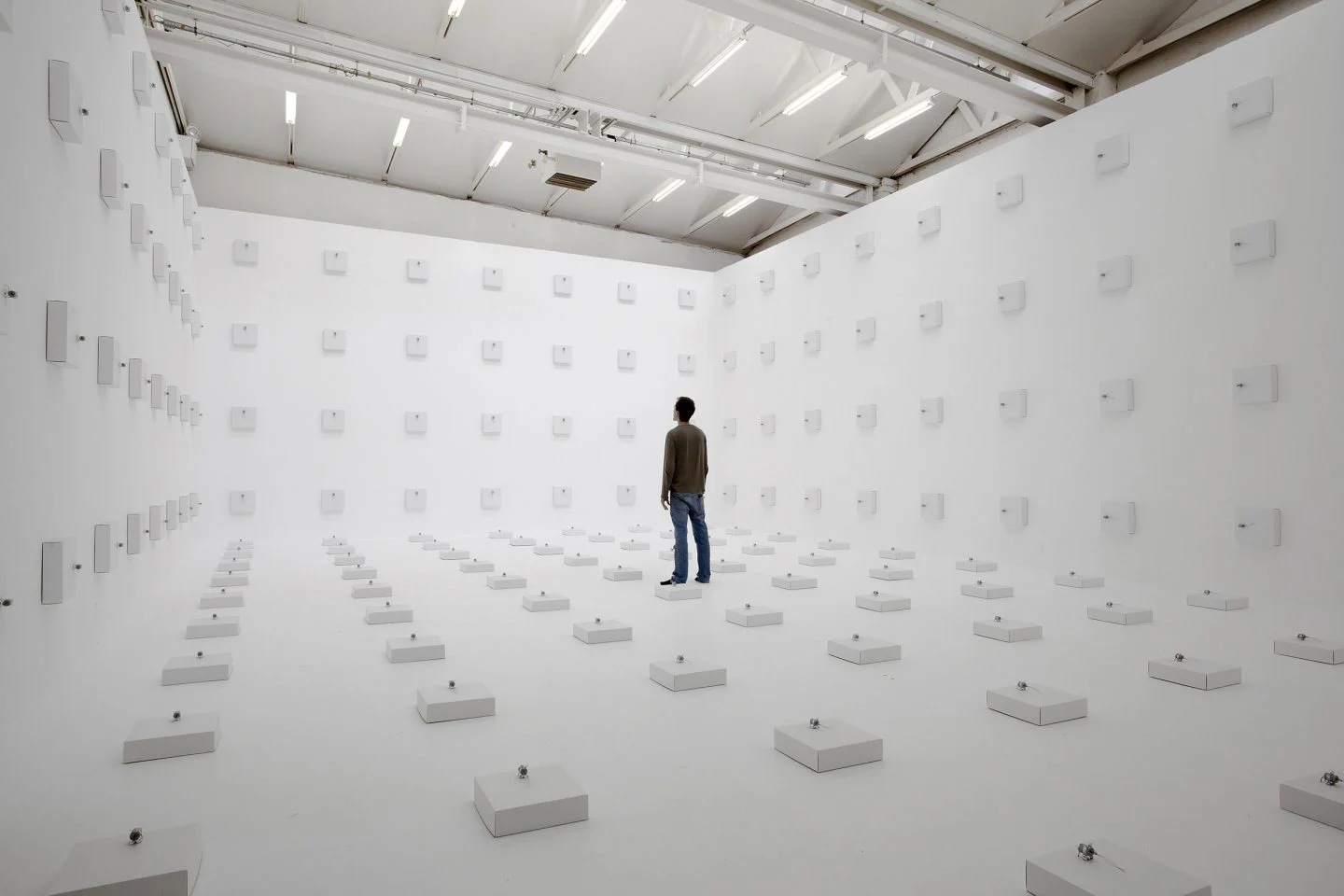

In the summer of 2017, the vast industrial halls of Le Centquatre Paris were transformed into a field of vibration. Swiss artist Zimoun presented Mécaniques remontées, at the time his most expansive exhibition in France. Visitors entering the former municipal funeral home and public baths encountered accumulations rather than objects: grids of cardboard boxes, suspended clusters of mechanical components, shipping containers converted into resonant chambers. Hundreds of small dc motors activated cotton balls, wires, ropes and paper bags. The building did not merely house the work. It began to resonate with it.
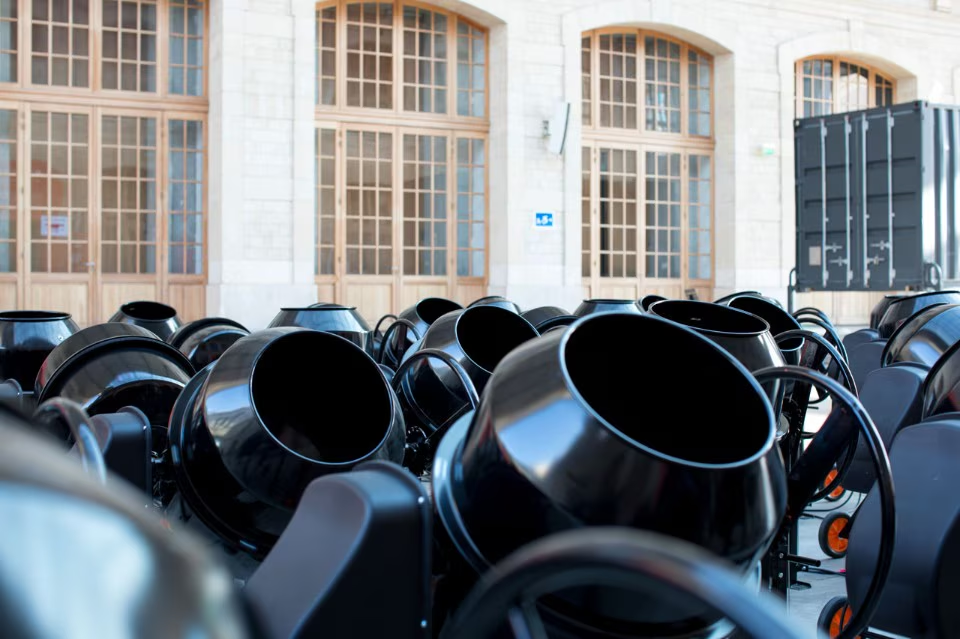
The resulting sound was neither composition nor chaos. It emerged from repetition structured with precision. As viewers moved through the installation, acoustic textures shifted subtly. Rhythms thickened and thinned depending on position, proximity and duration of listening. Architecture functioned not as backdrop but as co producer. The exhibition remains a defining example of Zimoun’s mature methodology: the generation of immersive complexity through disciplined mechanical simplicity.

Born in 1977 in Bern, Switzerland, Zimoun continues to live and work in the city of his birth. Entirely self taught, he developed his practice through sustained experimentation with sound, mechanical systems and spatial perception. His early interests included music, drawing and experimental construction. Rather than pursuing academic training, he refined a consistent inquiry into how simple materials behave when activated within structured environments.
During the mid 2000s, he shifted away from electronic composition toward direct physical sound production. Motors replaced speakers. Acoustic events were generated in real time by mechanical contact. This transition marked the formation of what he later described as sound architecture: installations in which sound is inseparable from spatial structure.
Across interviews and exhibition texts, Zimoun articulates a clear principle. Simplicity is not aesthetic reduction. It is a methodological strategy. By limiting materials and defining strict systems, he allows small irregularities to accumulate into emergent complexity.
REPETITION AND MICRO VARIATION
Many of Zimoun’s works are titled as inventories. The number of motors and the materials involved are listed with factual clarity. The titles resist metaphor and foreground construction.
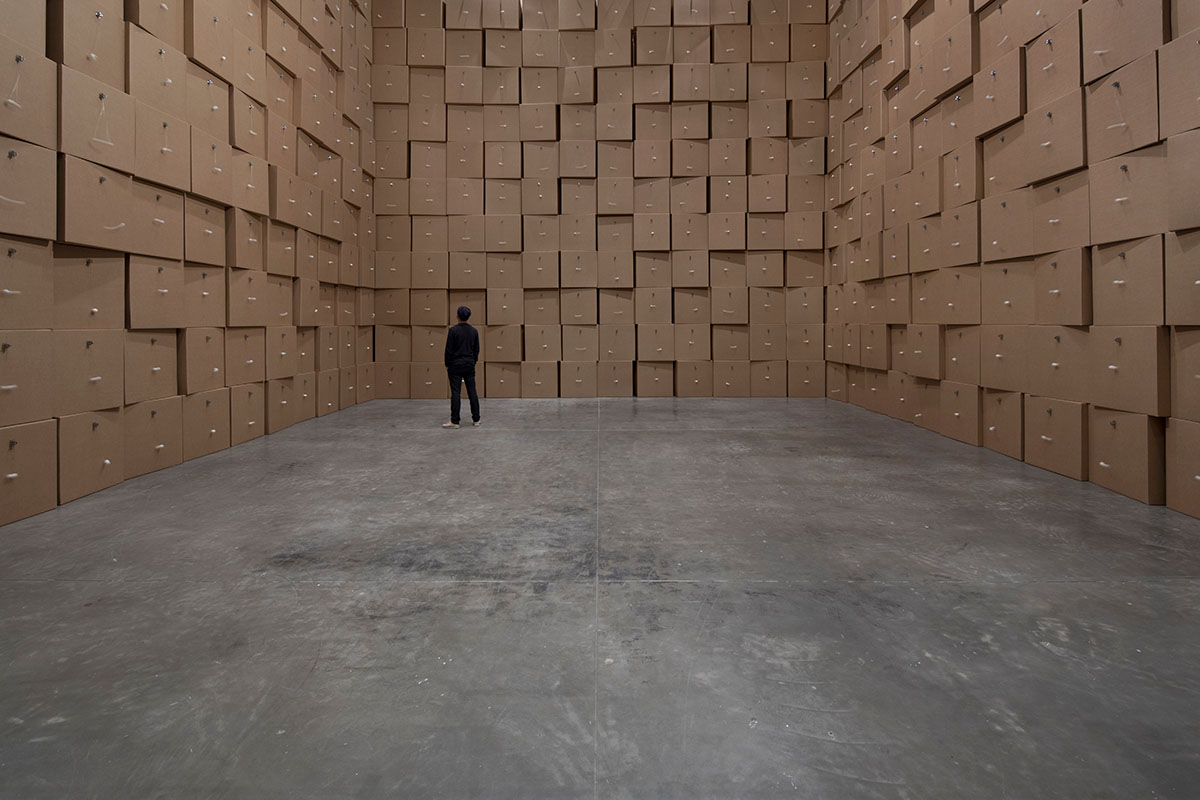
In one of the principal installations at Mécaniques remontées, hundreds of uniform cardboard cubes contained motor driven cotton balls tapping against interior surfaces. Individually, each unit produced a modest percussive sound. Collectively, they formed a dense acoustic field that never repeated exactly.

Mechanical variance, material fatigue, atmospheric conditions and architectural reflection ensured continual difference. The system remained structurally stable while acoustically fluid. Order and instability coexisted.
There is no narrative sequence. Visitors may enter and leave at any moment. The work unfolds in durational time rather than dramatic progression. Listening becomes a temporal decision rather than a linear experience.
MATERIAL AS STRUCTURE
Zimoun’s material vocabulary is deliberately modest. Cardboard, cotton, rope, paper bags, wooden sticks, metal wire and industrial motors remain recognisable. There is no attempt to transform or disguise their origin.
This clarity is essential. The acoustic properties of each material determine its role. Cardboard resonates with dryness and volume. Paper produces frictional rustle. Rope transmits vibration under tension. Motors contribute an audible hum that anchors the sound field.
The studio practice reflects similar discipline. Components are reused across projects. Materials circulate through multiple installations rather than being discarded. The logic of reuse parallels the internal structure of the artworks, where repetition and redistribution produce new acoustic outcomes.
Zimoun’s installations depend on architectural context. The scale and surfaces of Le Centquatre Paris were integral to the 2017 exhibition. High ceilings extended reverberation. Concrete amplified low frequencies. Sound traveled across rooms and blended between installations.
In one configuration, a shipping container functioned simultaneously as enclosure and resonant body. In others, suspended arrays created vertical acoustic zones through which visitors moved. Sound occupied volume and responded to structural conditions.


Movement through space altered perception. The work required physical presence. Listening became spatial navigation.

MECHANICAL CLARITY IN A DIGITAL CONDITION
In a culture saturated by digital interfaces, Zimoun’s analogue systems carry particular weight. The relationship between cause and effect remains visible. Each sound corresponds to a mechanical action.
Over time, attention shifts from individual taps or vibrations to collective pattern. The installations reward patience. The density of repetition produces immersion without spectacle. The sensation can feel organic, yet its mechanical origin remains evident.
This oscillation between industrial mechanism and organic perception sustains the work’s tension. Complexity arises not from hidden software but from cumulative variation within simple rules.
POSITION WITHIN CONTEMPORARY SOUND PRACTICE
Zimoun operates within a broader lineage of spatial sound art that includes figures such as Max Neuhaus and Christina Kubisch, artists who expanded listening into architectural environments. Yet his practice distinguishes itself through strict modular repetition and material neutrality.
The installations do not propose explicit narratives or symbolic messages. They construct operational systems. Behaviour becomes content. Meaning emerges through direct sensory engagement rather than interpretive framing.
Across international exhibitions, the core methodology remains consistent. Scale may vary, but the discipline of repetition and emergence persists.

The 2017 exhibition demonstrated how accumulation transforms modest elements into immersive environments. Rather than overwhelming the industrial architecture, the installations activated it. Acoustic territories overlapped. Sound migrated across structural boundaries. The building functioned as a continuous resonant field.
The exhibition clarified the maturity of Zimoun’s language. Mechanical repetition achieved architectural presence. Simplicity, multiplied, generated complexity.

At the center of Zimoun’s practice lies a sustained investigation into the relationship between order and instability. Distribution is measured. Components are evenly structured. Yet deviation inevitably appears. The system is predetermined. The outcome remains open. Over time, micro differences accumulate into shifting acoustic fields. The absence of narrative directs attention toward perception itself. Visitors become aware of fluctuation within apparent uniformity. Complexity reveals itself gradually, through sustained listening.

Nearly two decades into his mature practice, Zimoun continues to refine rather than reinvent his vocabulary. The constraint is deliberate. By limiting material and mechanical parameters, he deepens perceptual experience.

The installations do not demand interpretation. They require attention. Within grids of cardboard and arrays of motors, mechanical action produces environments that exceed their components.
Listening becomes architectural. Architecture becomes instrument. Systems become environments.
Simplicity, structured with precision, proves inexhaustible.

Photo Cover
Immersive cardboard wall enclosure, Zimoun 2017 exhibition view. Credit: © Zimoun