
Now Reading: Tracing the slope: A contemporary canopy in the Alpine landscape
- 01
Tracing the slope: A contemporary canopy in the Alpine landscape


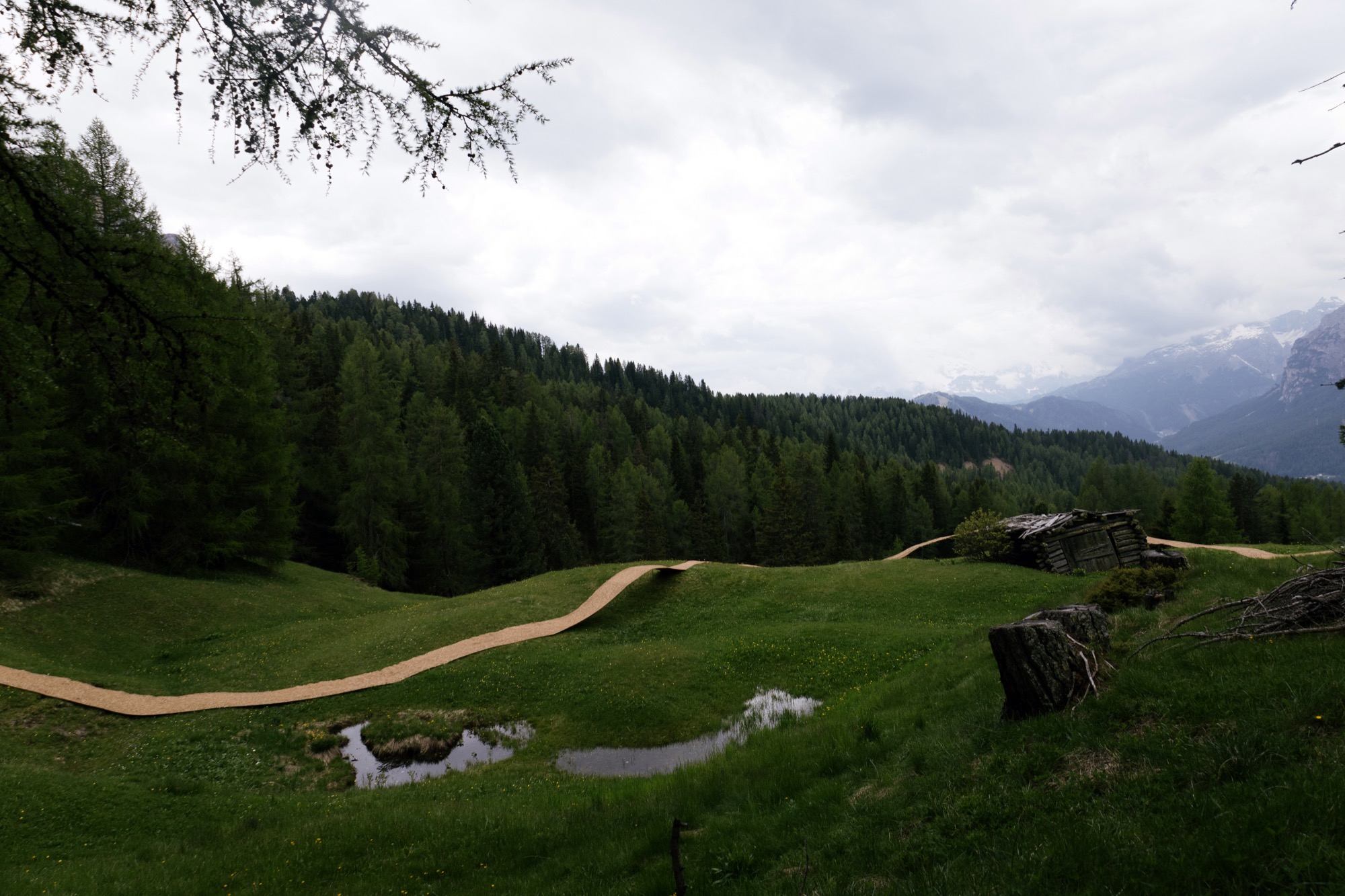
Selected for SMACH 2025, the open-air art biennale in the Italian Dolomites, ELSE’s installation Trace of Land imagines a single, round hay bale traversing the slopes of Armentara – rolling upward, sliding down, leaping across ridges and leaving behind a drifting path of dry grass. This imagined movement becomes a spatial gesture in the landscape, unfolding as a meandering canopy that follows the terrain and invites visitors to reflect on labor, landscape, and cycles of renewal.

A FAMILIAR LANDSCAPE RECAST
In the alpine pastures of Val Badia, the project reveals a transformed topography: a continuous ribbon of unfurled hay that drifts across the meadow, echoing the mountain trails carved into the Dolomites over generations. From afar, the straw line reads like a drawn contour – rising, dipping, bending, and tracing the profile of the distant peaks. The hay bale, displaced from its agricultural purpose, becomes a sculptural intervention. Once a compressed object of labor, it now takes on a new role as a material narrative on how humans work with, shape, and read the land.

Hay bales are often perceived as poetic remnants of agrarian life, yet they are products of mechanized processes – cut, bundled, and transported with industrial precision. Their presence aligns closely with this year’s SMACH theme, la cu – the Ladin word for “whetstone,” a tool that sharpens harvesting blades. Both tools and bales embody the reciprocal relationship between effort and terrain. Unbound from their cylindrical form, the hay strands unfurl to follow the meadow’s curves, rest directly on the earth, or rise lightly into an elevated canopy. Their undulating geometry blurs distinctions between what is natural and what is shaped by human hands.


As the canopy lifts from the ground, it enters into conversation with the surrounding wooden “tablà,” the traditional barns of the Ladin valleys. What begins as a poetic line becomes a form of landscape architecture, projecting a quiet rhythm that resonates with the region’s agricultural heritage. The hovering structure neither dominates nor mimics its context; instead, it articulates a soft continuity between the work of farmers, the patterns of haymaking, and the broad spatial scale of the Dolomites.

The construction remains deliberately simple. Vertical rebars are anchored directly into the soil and tied together with horizontal steel rods. A layer of wire mesh supports the hay, while grass ropes bind the fibers into place. This restrained system allows the canopy to extend across varying slopes and lengths, creating minimal disturbance to the pasture. Up close, the hay reveals a porous, tactile surface: a layered texture that filters light, shifting from dense opacity to warm translucence as the sun moves across the valley.

A LANDSCAPE INSTALLATION ROOTED IN CYCLES
Trace of Land occupies the Dolomites with extraordinary restraint. Both intervention and disappearance are built into its logic. As a gesture, the project links memory, material, and labor, reminding visitors that landscape architecture can emerge from the simplest of elements. The installation renews the pastoral setting not through permanence, but through a fleeting, tactile line—one that moves with the land, and eventually, returns to it.


Project Credit
Firm: ELSE / @design_by_else
Project Year: 2025
Location: South Tyrol, Italy
Photo: Gustav Willeit, Elisa Cappellari
More Photos