Now Reading: Tia-Thuy Nguyen: Energy does not disappear, it transforms
- 01
Tia-Thuy Nguyen: Energy does not disappear, it transforms

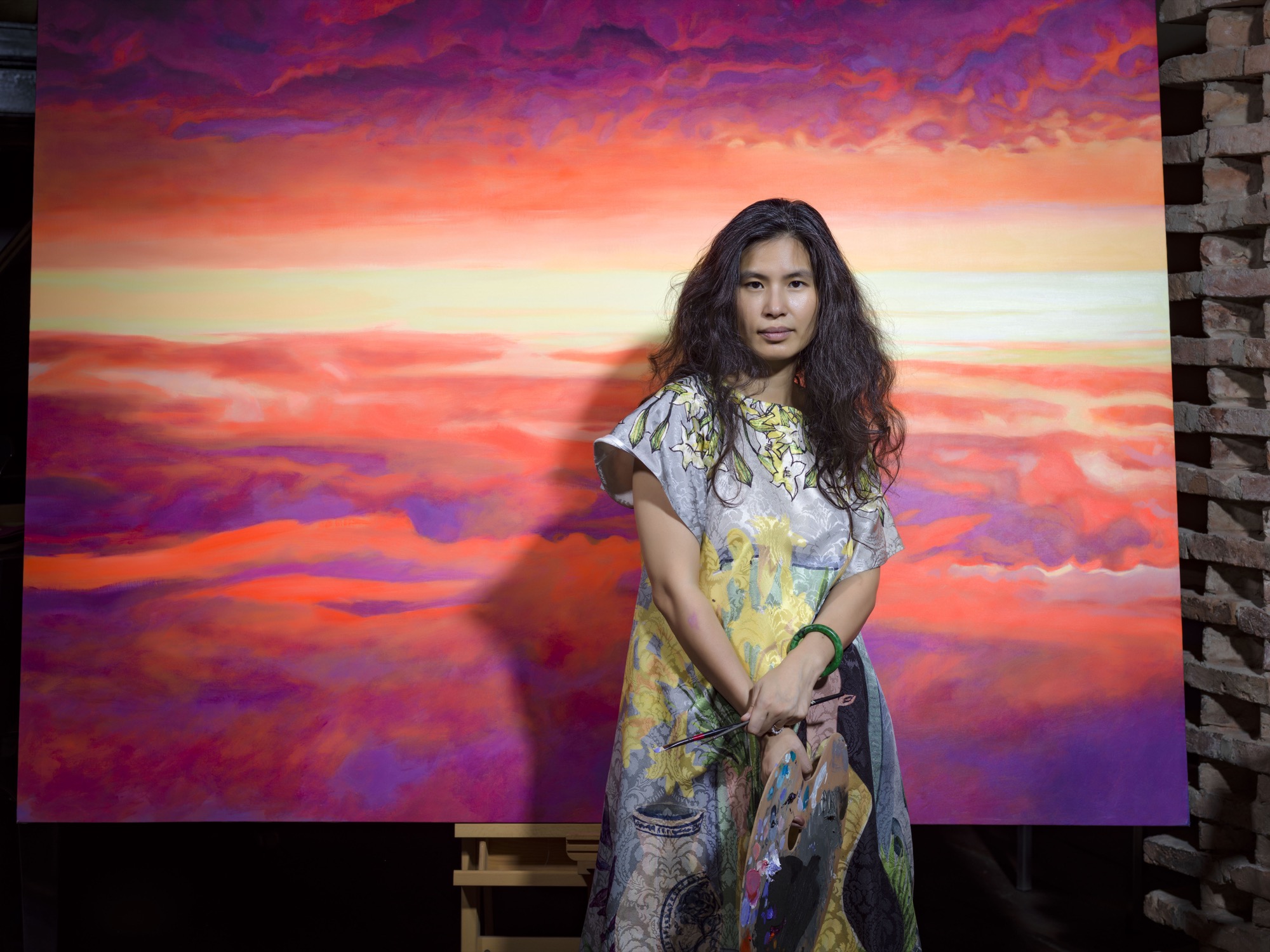

At a moment when public sculpture across Southeast Asia often oscillates between decorative spectacle and state monumentality, Tia-Thuy Nguyen’s installations propose a different trajectory. Her works do not assert permanence through mass. Instead, they construct permeability. Rather than anchoring memory in fixed form, they stage its ongoing circulation.
In Hanoi, where density, humidity, light, and historical sediment coexist in compressed layers, Tia’s large scale projects operate less as objects and more as atmospheric systems. Stainless steel becomes a reflective membrane that destabilises solidity. Quartz absorbs and refracts light as if holding residual breath. Glass produces spectral dispersion that shifts with the hour. What might initially read as monument resolves instead into a structure dependent on weather, encounter, and time.
Her practice sits at an unusual intersection. It engages deeply with Vietnamese craft traditions without romanticising them. It mobilises industrial material without surrendering to cold minimalism. It invokes collective history without lapsing into didactic symbolism. The result is an aesthetic language grounded in transformation rather than nostalgia.
In conversation below, Tia-Thuy Nguyen speaks about energy, grief, resistance, and collaboration. What emerges is a philosophy in which material is never inert and loss is never final.

What core philosophical principles guide your multidisciplinary artistic practice, particularly in harmonising nature, memory, and contemporary Vietnamese culture?
I do not approach things with the intention of conquering or owning them. My philosophy is to nurture, to grant them a new life and a different perspective. I do not struggle or resist. Instead, I allow the work to become more radiant and meaningful through elements that are not myself.
I play hide and seek with Mother Nature through materials that can transform under her hand. I empower what lies beyond me to become the force that completes the work. It is not only about awakening vision, but about bringing life and transformation into the work itself.
Vietnamese culture has shaped who I am. From layers of history and collective upheavals to the energy of the land where I was born and raised, I have inherited many stories, from family to society. It is not only a material sense of self, but one grounded in understanding and pride. I find beauty in scars, in ruins, and in the most ordinary aspects of daily life.

How did growing up in Hanoi and studying fine art influence the recurring themes of resilience and transformation in your installations?
The place where I was born and raised carries colour, scent, and the burning intensity of many generations. It is a place where the sky can hold four seasons in a single day, where sun, wind, and winter arrive unpredictably.
Before the École des Beaux Arts de l’Indochine was established, Vietnamese art largely belonged to anonymous craftsmen and was mainly applied to traditional handicrafts. With the formation of formal art education, artistic expression became more clearly defined and artists gained recognition. Studying fine art gave me a foundation to express my inner world through a work. That environment gave me colleagues, friends, knowledge, and a space shaped by history.

How did the fall of the seventy year old Nacre tree shape the conceptual vision of Resurrection?
In my creative practice, I always hope to let go. Rationally, I understand that death and loss are not things we should cling to. Yet somewhere within me, as a human being, I cannot fully release them. Seeing the seventy year old tree collapse, along with tens of thousands of other fallen trees, felt like losing a historical witness. I did not want that loss to happen, and somewhere within me I still wanted to hold on. I wanted to bandage that wound through contemporary art. Through Resurrection, I also embraced a deeply personal grief.
Inspired by the law of conservation of energy, that energy is neither created nor destroyed but only transformed, I sought to continue the life of that tree. To give it a new form, a new possibility, a new existence. In my eyes, the death of the tree marked the beginning of another chapter. Its energy could not disappear, nor could its life simply end.


Why did you choose hand hammered stainless steel and quartz flowers?
Steel carries a strong masculine quality. It is rigid and forged through force. Yet through shaping and labour, it becomes shimmering, soft, and patient, embodying a feminine presence. I chose quartz for its healing energy. When sunlight touches the surface, steel reflects while stone absorbs and glows. The xà cừ tree seems to breathe again. By placing artificial material such as stainless steel alongside natural quartz, I wanted to create a dialogue.

How did the image of Vietnam’s primeval forests shape the circular structure of Unity?
In Vietnamese consciousness, the forest is a place of shelter and resistance. The circular structure creates a safe zone within a dense and noisy urban environment. A circle has no beginning and no end. It symbolises solidarity and togetherness. The ring of trees resonates with light and colour, recalling the continuous circulation of universal energy.


Why did you choose an immersive structure of eighteen stainless steel trees rather than a traditional monument?
Large sculptures often demand to be viewed from afar. I wanted Unity to embrace its visitors. When you step among the eighteen steel trees, you become part of the work’s embrace.
I do not want to impose a fixed viewpoint. Viewers are free to climb, lie down, move left or right, inside or outside. When standing within the circle, your image reflects on the steel surfaces, merging with others and with the surrounding landscape. Individual boundaries dissolve, leaving only unity. The colours, patterns, and joyful light bring positive energy to the community.


Across both projects, Tia-Thuy Nguyen’s practice advances a proposition: that energy is not an abstraction but a structural principle. Material is animated through labour. History persists through transformation. Public space can host intimacy without relinquishing scale. In a rapidly modernising Hanoi, where development often displaces memory, her works do not fix the past in bronze or stone. They allow it to circulate. Light completes the form. Weather edits the surface. Viewers enter and exit, leaving traces only in reflection.
Energy does not disappear. It transforms.
Article Credit
Text: Rafael Cunha
Photo Credit: Images courtesy of the artist.