
Now Reading: Taberna Convento revives the social rituals of a Sevillian village
- 01
Taberna Convento revives the social rituals of a Sevillian village

Taberna Convento revives the social rituals of a Sevillian village

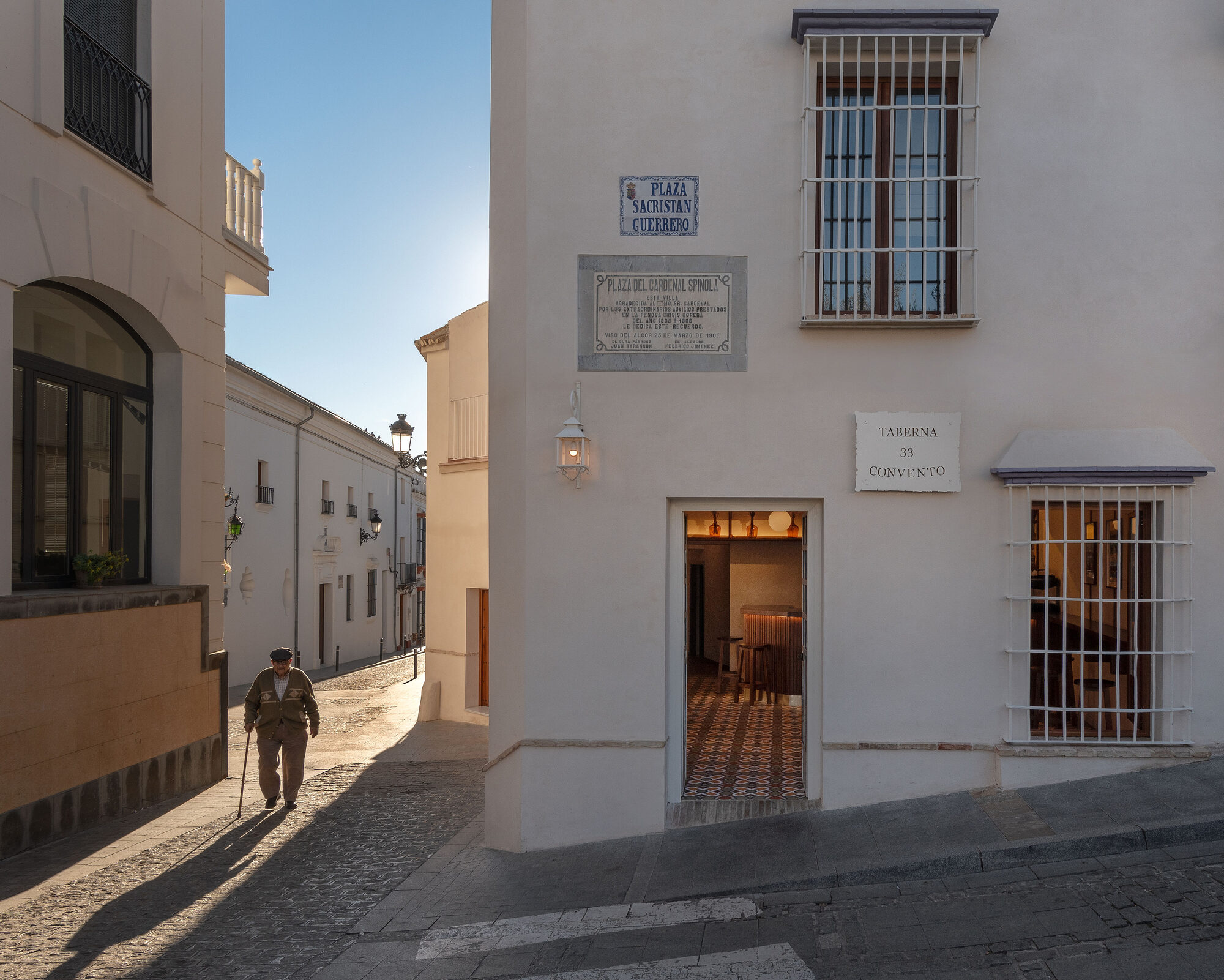
In the historic center of El Viso del Alcor, Taberna Convento reopens as more than a neighborhood bar. Positioned directly opposite the town’s convent and surrounded by the rhythms of daily life, the project by Alejandro Cateto restores a deeply rooted social space where local traditions continue to unfold naturally through architecture, material, and atmosphere.


For generations, the tavern has occupied a central role within the town’s collective memory. Women pass by on their way to church, children stop at the counter after school, and neighbors gather during long summer evenings beneath the glow of streetlights and orange blossoms. Rather than transforming the space into a stylized reinterpretation of Andalusian culture, the project preserves the familiar character of the village tavern while refining it through a quieter and more contemporary spatial language.
The renovation carries a personal dimension for Cateto, who grew up in the area and describes the commission as an emotional return to one of the town’s most symbolic gathering places. Located along the route of Holy Week processions, the tavern remains closely tied to the ceremonial and social life of the community, balancing the sacred atmosphere of the convent with the informal rituals of everyday encounters.


The design draws directly from the material vocabulary of traditional Sevillian tabernas. Lime mortar walls, hydraulic tiles, timber surfaces, and glass demijohns reappear throughout the interior, restoring textures and details that have gradually disappeared from many contemporary hospitality spaces.


Earth-toned finishes establish a warm and grounded atmosphere, while subtle purple accents reference the neighboring religious brotherhoods and the visual identity of Semana Santa. The palette moves carefully between domestic familiarity and spiritual resonance, creating interiors that feel both intimate and ceremonial.


Historic taverns across Seville are often filled with devotional imagery arranged without hierarchy or order. Here, the designers reinterpret that tradition through a more restrained composition. Religious photographs and framed images remain present, though curated with greater rhythm and spatial clarity, allowing memory and ornament to coexist without overwhelming the space.


Throughout the tavern, lighting plays a central role in shaping mood and perception. Candles appear repeatedly across the interiors, reinforcing a sense of stillness that echoes the surrounding religious architecture. Their soft illumination transforms the rooms into spaces that feel suspended between the sacred and the everyday.


This restrained atmosphere is heightened by the careful preservation of scale and proportion. Openings toward the street maintain a direct relationship with public life outside, while the interiors retain the intimacy associated with traditional village bars. Warm timber tones and muted plaster surfaces absorb light gently, allowing the space to shift gradually from daytime sociability to evening calm.


Rather than creating a nostalgic reconstruction, Taberna Convento proposes a contemporary reading of local identity through subtle architectural gestures. The project demonstrates how small hospitality spaces can preserve collective memory without becoming theatrical, allowing ordinary rituals to remain at the center of the experience.


In many small towns across southern Spain, neighborhood taverns continue to function as informal civic rooms where generations overlap throughout the day. Taberna Convento embraces this condition fully. Children still enter to ask for water after school, neighbors still gather spontaneously around the bar, and religious processions still pass directly outside its doors.
The project’s strength lies precisely in this continuity. Instead of imposing a new image onto the town, the renovation amplifies qualities already embedded within the place: familiarity, warmth, ritual, and collective presence. Through careful material restoration and a measured contemporary sensibility, the tavern becomes both a preservation of memory and an active part of everyday village life.
Project Credit
Project Name: Taberna Convento
Location: El Viso del Alcor, Seville, Spain
Design Firm: Cateto Cateto / @cateto.cateto / @alejandrocateto
Photo: Loveladrillo / @loveladrillo