Now Reading: Ground as method: Syn Architects in AlUla
- 01
Ground as method: Syn Architects in AlUla

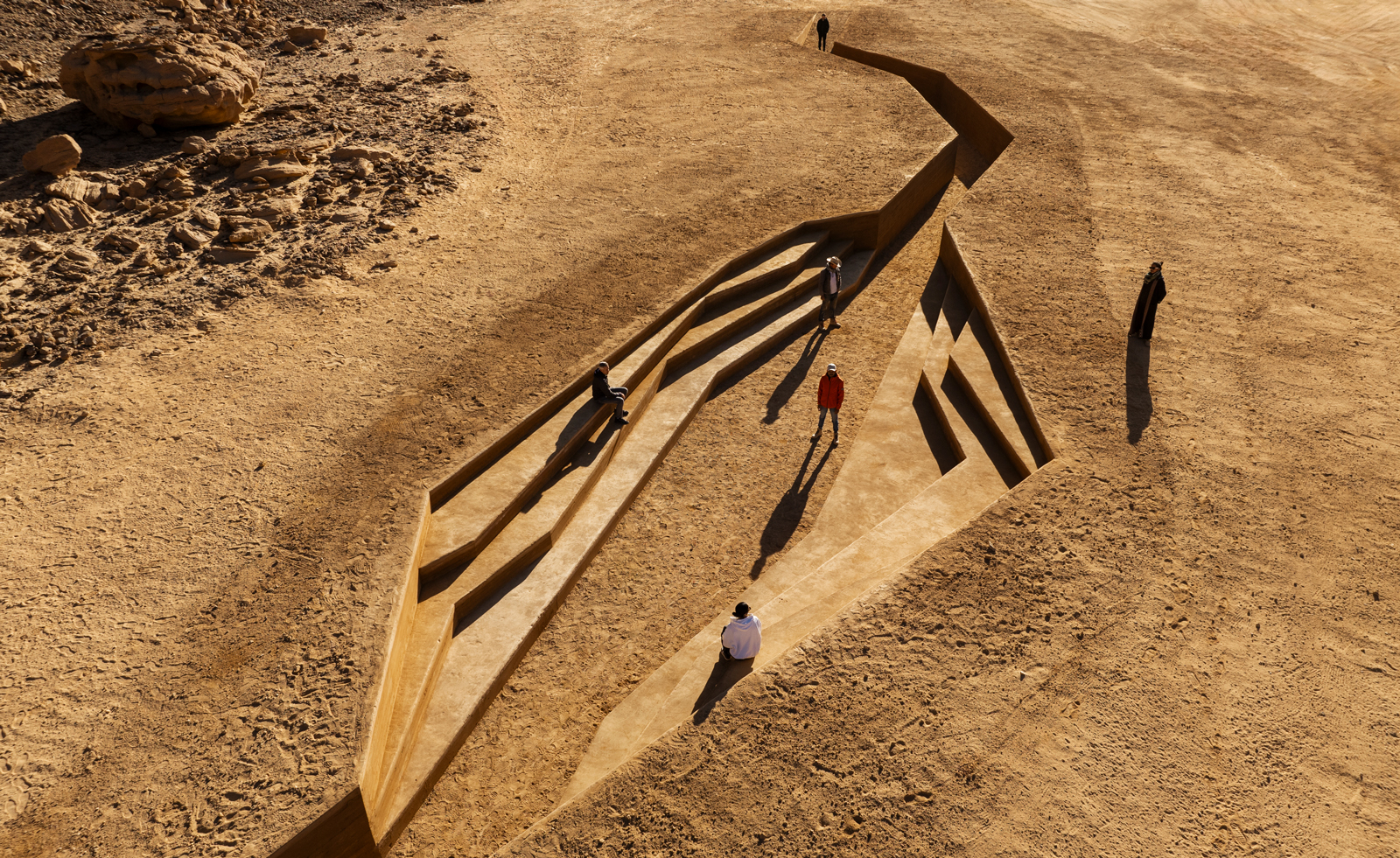

“Invisible Possibilities: When the Earth Began to Look at Itself” does not present itself in AlUla as a sculptural object placed upon the desert. It operates as a cut into the ground. Conceived for Desert X AlUla 2024 by Sara Alissa and Nojoud Alsudairi of Syn Architects, the installation shifts attention from horizon to terrain. Rather than asserting presence through elevation, it defines space through excavation. Visitors descend into a zigzagging passage formed from rammed earth produced using material sourced directly from the site. The desert is not framed as backdrop. It becomes structure, surface, and participant.

The work’s material logic is immediate. Compacted earthen walls register the physical act of compression. Layers remain visible, linking construction to geology. Spatial experience unfolds through movement. There is no single vantage point from which the installation resolves into image. Instead, perception is calibrated through walking, turning, and adjusting to shifting alignments of wall and sky. Scale is measured against the body. Monumentality is replaced by proximity.


Desert X positioned the project within a broader exploration of human and non human entanglement, and the artists have referred to Rosi Braidotti’s concept of the nomadic subject to describe a relational stance within ecological systems. In AlUla, this reference is embedded in the spatial sequence itself. The descent into earth repositions the visitor within geological duration. The installation does not dramatise crisis or stage spectacle. It produces attentiveness through material restraint.


This clarity of method offers insight into the wider practice of Syn Architects. Based in Riyadh and established in the late 2010s, the studio operates across architecture, research, and cultural documentation. Syn describes its work as ecologically sensitive, deriving aesthetic direction from contextual awareness and from the intrinsic qualities of materials found on site. This description is supported by consistent design decisions rather than rhetorical positioning.

Two parallel initiatives reinforce this framework. SaudiArchitecture.org, initiated in 2020, functions as an independent archive of modern and postwar architecture within the Kingdom. Through documentation and critical reflection, it records buildings that risk erasure amid rapid redevelopment. Um Slaim Collective, launched in 2021, investigates the transformation of neighbourhoods in Riyadh. Through exhibitions, workshops, and research programs, it examines how urban change reshapes both spatial fabric and social life. These initiatives situate architectural practice within a broader cultural and civic landscape.


Material selection remains central to the studio’s methodology. Rammed earth, limestone, and locally sourced aggregates are not aesthetic motifs. They are structural choices informed by climate and history. Rammed earth in particular embodies a synthesis of environmental logic and cultural continuity. As a technique with relatively low embodied energy and substantial thermal mass, it responds to arid conditions. At the same time, it recalls Najdi construction traditions in which earthen walls and courtyard typologies moderated light, heat, and airflow. Syn does not replicate vernacular forms directly. Instead, the studio reinterprets material intelligence within contemporary programs.


Heritage forms a second axis of the practice. Saudi Arabia is undergoing rapid urban transformation, and redevelopment frequently prioritises speed and scale. Within this context, preservation cannot rely solely on static conservation. Syn approaches heritage as adaptive continuity. The objective is not to freeze buildings in time but to sustain their relevance through use.
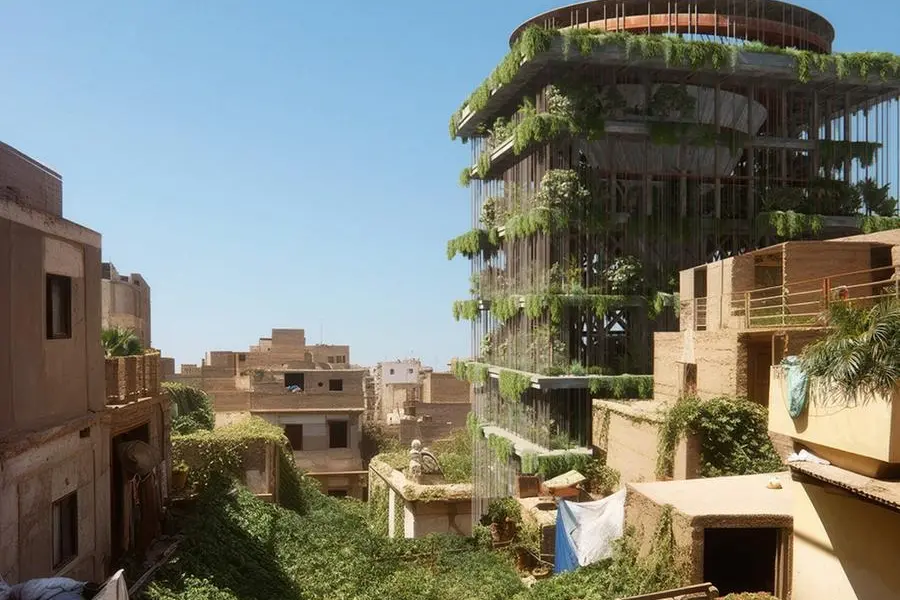
Shamalat Cultural Center exemplifies this approach. Completed in 2022, the project rehabilitates a mud structure and integrates new architectural elements within its existing footprint. The building now houses a library, studios, and a cafe. Existing earthen walls were stabilised and retained, while limestone additions establish continuity without mimicry. The intervention does not produce contrast for effect. It creates a layered interior in which past and present coexist through function. The project was shortlisted for the Aga Khan Award for Architecture 2025. In the same year, Alissa and Alsudairi received the AR Moira Gemmill Prize for Emerging Architecture.


Recognition situates the studio within international discourse, yet the coherence of the work lies in its internal consistency. Across installation, building, and research platform, a shared logic persists. Architecture is approached as connective tissue linking land, memory, and collective life.
Representation forms a third dimension of this approach. Syn does not limit architectural communication to finished buildings. Installations, workshops, and exhibitions are integral components of the practice. The Saudi National Pavilion at the Venice Architecture Biennale 2025, titled The Um Slaim School An Architecture of Connection, extended research into a public and pedagogical format. Archival materials, collaborative contributions, and spatial constructs were assembled to suggest that architectural knowledge is collective and evolving. The pavilion functioned as a platform for dialogue rather than a display of completed form.


This expanded definition of architecture aligns with the ethos evident in Invisible Possibilities. In AlUla, excavation becomes both physical act and conceptual position. The trench does not compete with surrounding sandstone formations. It remains materially aligned with the desert floor. Its presence is deliberate but not dominant. Through modest scale and grounded construction, the work proposes that architecture can operate through alignment rather than imposition.
Within contemporary Saudi Arabia, development is frequently measured by magnitude and visibility. New urban visions emphasise technological innovation and global recognition. Syn proposes a different measure of progress. Sustainability is treated as discipline and responsibility rather than branding. Heritage is approached as a living framework rather than an image. Research and documentation are understood as forms of architectural labour equal in importance to construction.
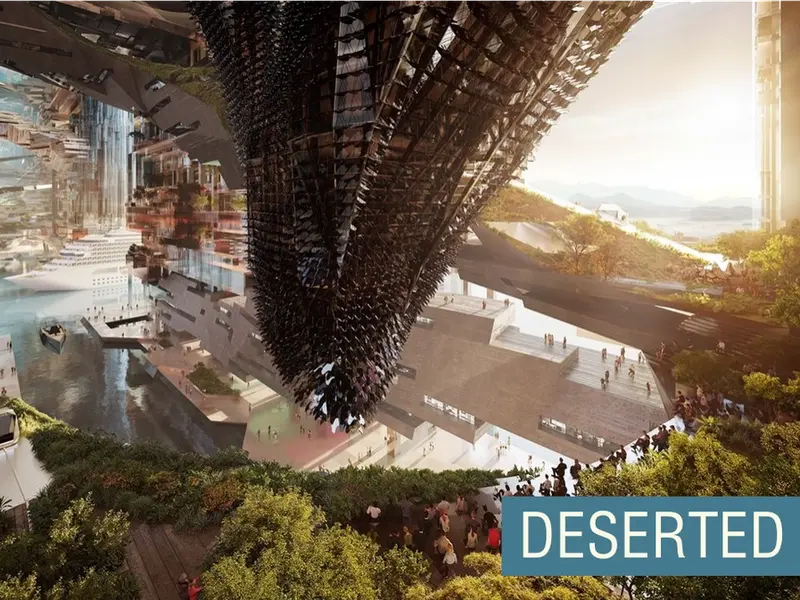
Credit: Semafor (render by NEOM).
Invisible Possibilities encapsulates this position with particular clarity. By cutting into the desert rather than building upon it, the installation foregrounds origin. Material, process, and site remain inseparable. The visitor’s movement through the work underscores the relational nature of space. The project does not offer a singular message. It establishes conditions for reflection.
Across projects, Syn Architects advances a practice grounded in attentiveness. Ecological awareness informs material decisions. Cultural memory informs spatial organisation. Community engagement informs representation. None of these elements operate independently. They form an integrated methodology responsive to context and change.
To encounter Invisible Possibilities is to encounter a recalibration of architectural ambition. The work does not seek dominance or iconography. It demonstrates that subtraction can be as potent as addition. It suggests that the future of architecture in rapidly transforming contexts may depend less on scale and more on alignment with land and memory. In this sense, the installation is not only a contribution to Desert X AlUla. It is a concise statement of method.
Photo Cover
Aerial perspective of the Invisible Possibilities installation integrated into the AlUla desert landscape. Credit: Wallpaper Magazine.