Now Reading: Inside Vienna’s Gasometers, Industrial Heritage Becomes Urban Life
- 01
Inside Vienna’s Gasometers, Industrial Heritage Becomes Urban Life

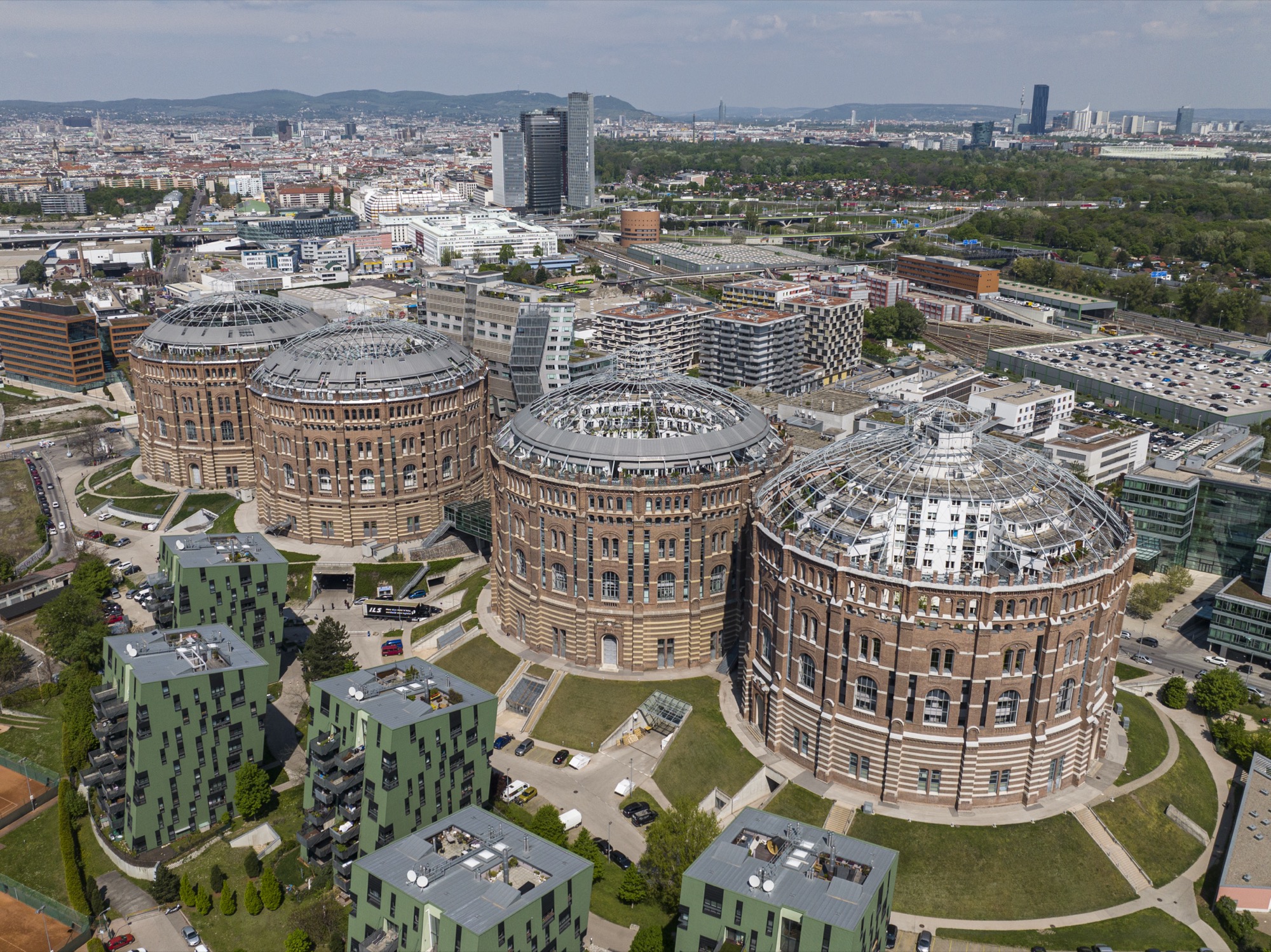

At the edge of Vienna’s Simmering district, four enormous brick cylinders still dominate the surrounding skyline despite the rapid urbanisation around them. Built between 1896 and 1899 to store town gas for the Austro Hungarian capital, the Gasometers were once among the city’s most important pieces of infrastructure. Each structure measured roughly seventy metres in height and sixty metres in diameter, with the capacity to hold ninety thousand cubic metres of gas used for street lighting, cooking, and domestic heating.

Today these former industrial containers accommodate apartments, offices, supermarkets, cafés, student housing, cinemas, and concert halls. Escalators move beneath nineteenth century brick vaults originally designed for heavy engineering infrastructure. Residents cross bridges suspended inside structures once conceived as sealed industrial drums. More than two decades after their transformation, the Gasometers remain one of Europe’s most ambitious examples of adaptive reuse, not simply because of their scale, but because of the complexity of their urban reinvention.

Completed between 1999 and 2001, the redevelopment of the Vienna Gasometers proposed a different future for industrial heritage. Rather than preserving the structures as static monuments or converting them into singular cultural destinations, Vienna transformed them into a functioning urban quarter. Residential programmes, offices, retail spaces, entertainment venues, and public infrastructure were inserted within the historic shells. Four architects, Jean Nouvel, Coop Himmelb(l)au, Manfred Wehdorn, and Wilhelm Holzbauer, were invited to reinterpret the four cylinders independently, producing four distinct architectural responses within a unified industrial framework.
The result sits somewhere between monument and contemporary infrastructure, where industrial memory continues to coexist with everyday urban life.

INDUSTRIAL INFRASTRUCTURE AND URBAN MEMORY
The story of the Gasometers begins in the final years of the nineteenth century, when Vienna was expanding rapidly as the capital of the Austro Hungarian Empire. Demand for gas lighting and domestic fuel was increasing across the city, requiring a new generation of storage infrastructure. Following an international competition launched in 1892, engineer Schimming and architect Theodor Herrmann developed the design for four monumental gas holders in Simmering, southeast of the city centre.
Although fundamentally industrial structures, the Gasometers were given unusually civic architectural treatment. Their steel frameworks were wrapped in elaborate brick façades articulated with arched openings, decorative cornices, and crenellated parapets. The intention was not merely technical efficiency. The buildings were designed to participate visually in the city rather than exist as isolated industrial objects. Even today, their silhouettes retain an ambiguous character somewhere between infrastructure, fortress, and public monument.
For nearly ninety years the Gasometers operated quietly as part of Vienna’s energy network. During the 1970s, however, the city gradually shifted from coal gas to natural gas, rendering the structures obsolete. By the mid 1980s they had been fully decommissioned. Protected as historic monuments since 1981, they could not be demolished, yet their future remained uncertain for more than a decade.
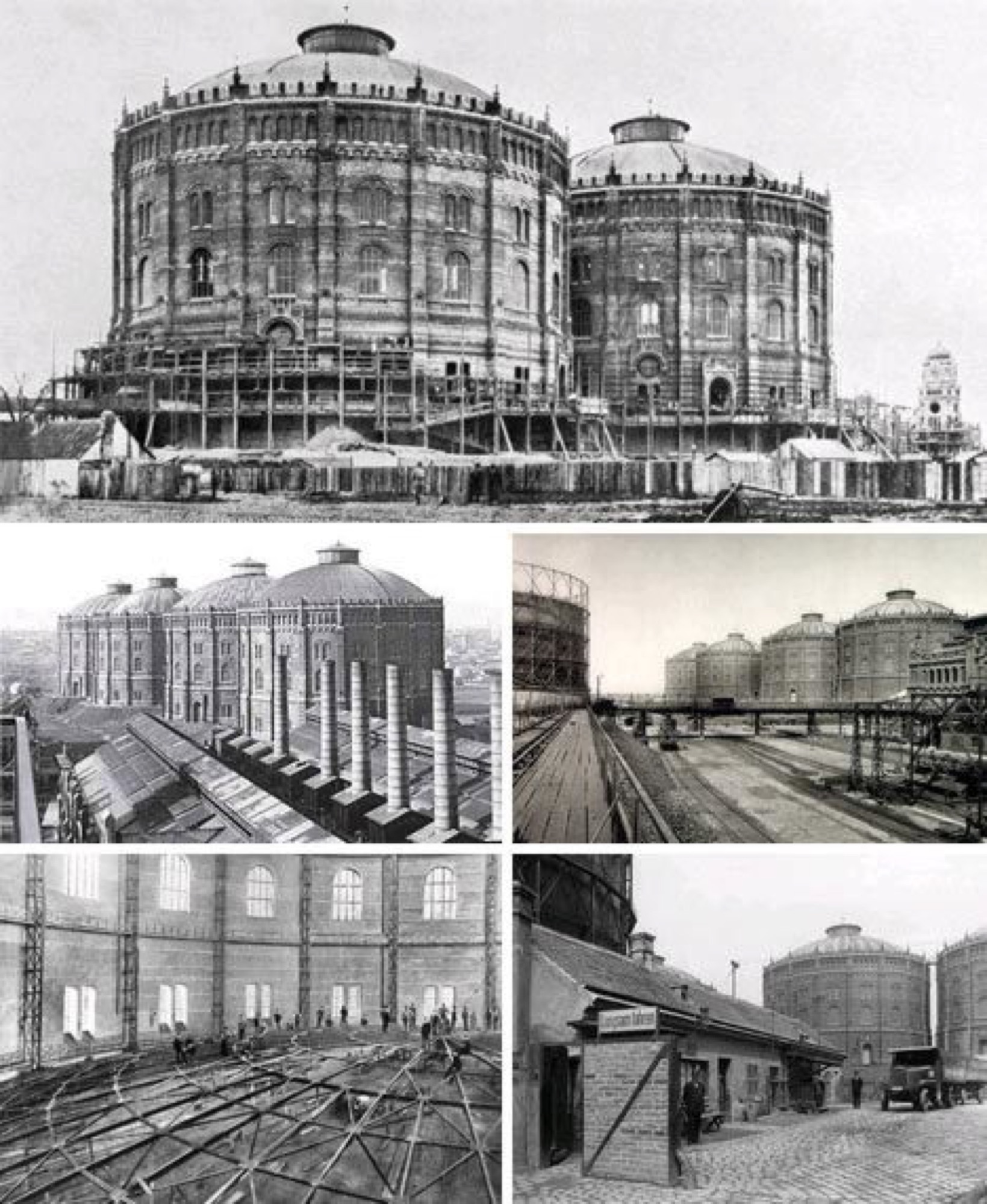
During this period the empty cylinders occasionally hosted temporary events, film productions, underground parties, and art installations. Their enormous internal volumes and unusual acoustics attracted experimental cultural uses, while their vacant presence became a visible reminder of Vienna’s industrial past. Like many European cities confronting deindustrialisation in the late twentieth century, Vienna faced a broader question: how could large industrial relics remain active within contemporary urban life without being reduced to nostalgia?
A feasibility study led by Manfred Wehdorn demonstrated that the structures could support extensive redevelopment. In 1995 the city launched an international competition calling for a mixed use transformation that would preserve the historic brick envelopes while completely rethinking the interiors. New housing, commercial programmes, public circulation systems, and transport connections were all integrated into the proposal. Construction began in 1999, and the redeveloped complex officially opened in 2001.
What made the Vienna project unusual was not only the preservation strategy, but the decision to invite four architects to work independently within nearly identical structures. The project therefore became not only a preservation effort, but also an architectural conversation about how contemporary design might inhabit industrial heritage.
FOUR ARCHITECTS, FOUR APPROACHES
Although the Gasometers share identical external shells, their interiors differ substantially. Each architect approached the problem of inhabiting the historic cylinders from a different position.
Manfred Wehdorn, whose earlier feasibility work helped secure the project’s future, adopted the most conservation oriented approach in Gasometer C. His intervention prioritised continuity between the old structure and the new residential insertions, creating what he described as a “house within a house.” Environmental performance and structural restraint became central concerns.
Wilhelm Holzbauer, responsible for Gasometer D, focused on spatial efficiency and flexibility. His intervention introduced star shaped floor plates that maximised usable residential area while preserving visual relationships with the existing shell.
The two most spatially assertive interventions, however, emerged from Jean Nouvel and Coop Himmelb(l)au. Their projects embody two radically different attitudes toward adaptive reuse. Nouvel worked through lightness, reflection, and perceptual ambiguity. Coop Himmelb(l)au approached the project through collision, structural autonomy, and deliberate contrast.

Together, these approaches transformed the Gasometers into a catalogue of architectural positions rather than a single unified statement.
JEAN NOUVEL: LIGHTNESS WITHIN THE HISTORIC SHELL
In Gasometer A, Jean Nouvel approached the industrial shell not as a surface to imitate, but as a spatial condition to intensify. The historic enclosure was preserved as a visible record of the building’s original life, while a new residential structure was inserted independently within the cylinder.
Nouvel organised the apartments into wedge shaped segments radiating inward from the perimeter wall. Crucially, these new volumes never touch the historic brick envelope directly. A continuous void separates old and new, allowing daylight to travel vertically through the building and revealing the full curvature of the original masonry surface.


Walking through the atrium, the scale of this gap becomes immediately perceptible. Light moves slowly across the brick walls during the day, while reflections from glass and polished metal surfaces fragment the perception of the interior volume. Despite the enormous mass of the structure, the space often feels unexpectedly light.
A glazed roof encloses the upper portion of the atrium, transforming the former industrial void into a luminous internal plaza. Commercial spaces and offices occupy the lower levels, while apartments rise above them. Rather than reproducing the industrial past literally, Nouvel stages a dialogue between material heaviness and visual dematerialisation.
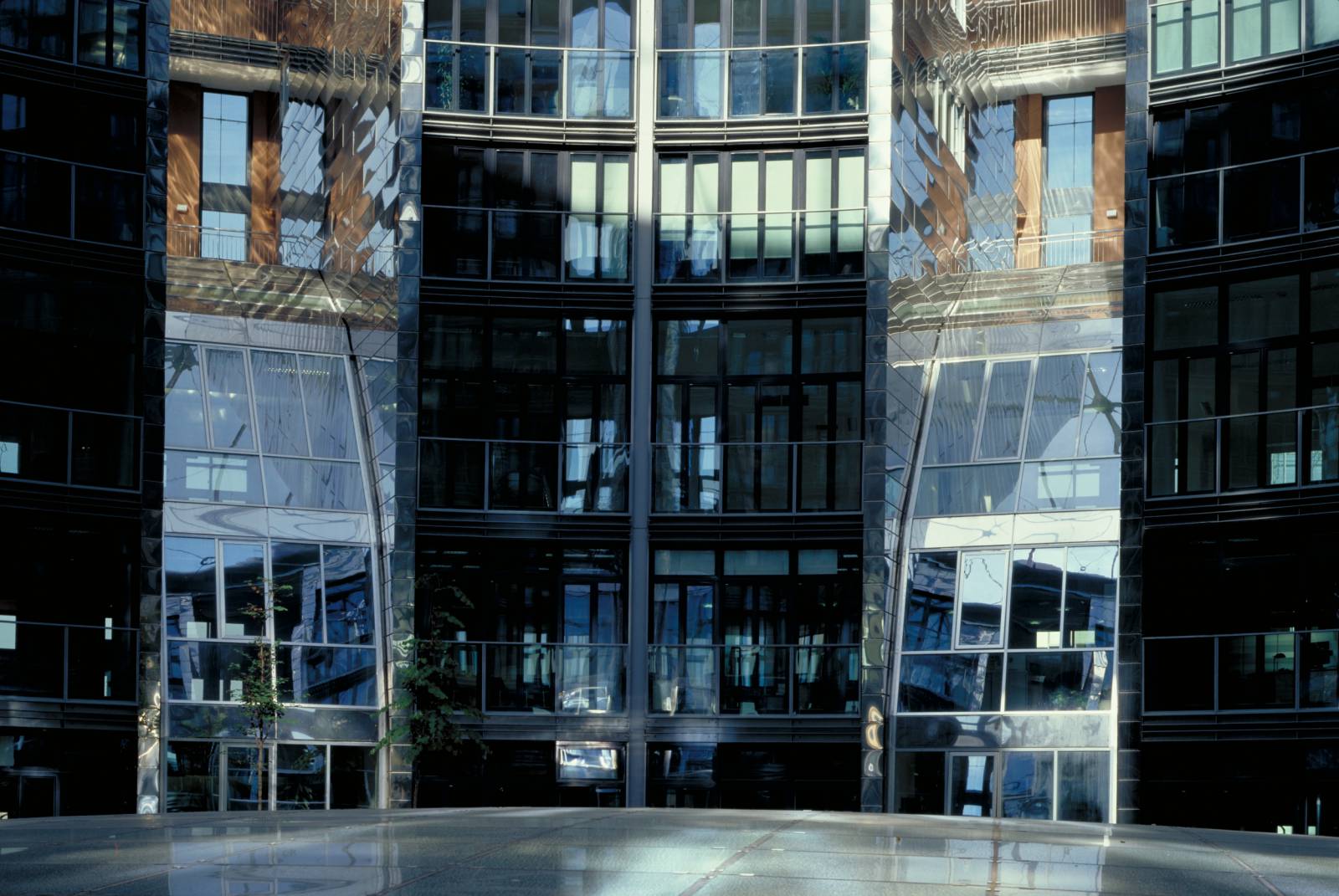
What makes the intervention particularly effective is its restraint. The historic shell remains fully legible throughout the experience of the building. The new architecture does not attempt to dominate the existing structure, nor does it disappear into it entirely. Instead, both remain visibly separate, maintaining a constant spatial tension between nineteenth century infrastructure and contemporary domestic life.
The retail complex remains one of the project’s strangest conditions. Escalators and storefronts occupy a space once designed for storing gas at an urban scale. Above them, residents live ordinary domestic routines inside one of Vienna’s most recognisable industrial monuments. At times the combination feels uneasy. Yet this friction is also what prevents the project from becoming a polished monument to industrial nostalgia.
COOP HIMMELB(L)AU: COLLISION AND AUTONOMY
If Jean Nouvel worked through lightness and separation, Coop Himmelb(l)au approached Gasometer B through confrontation. Their intervention introduces several distinct new volumes into and around the historic cylinder, producing one of the most visually aggressive transformations within the entire complex.
The project consists of three major components: an internal residential cylinder, a projecting shield like façade, and a large multifunctional event hall positioned at the base.
The residential structure rises independently within the existing shell, drawing daylight through a conical internal courtyard and the original arched openings. Unlike Nouvel’s emphasis on visual lightness, Coop Himmelb(l)au foregrounds structural presence. Steel, glass, and exposed geometries create an atmosphere of deliberate friction against the historic masonry.

The most visible intervention is the projecting glass and steel “shield” extending outward from the cylinder. Its curved form introduces a new urban silhouette that contrasts sharply with the static brick drum behind it. Large loggias and reflective surfaces intensify this visual tension, especially when viewed from surrounding highways and rail infrastructure.
At the base of the structure, the event hall operates as an entirely independent system. Structurally and acoustically separated from the residential programmes above, the hall accommodates concerts and large public events without interfering with the apartments. This autonomy was essential to the project’s mixed use ambitions.


Inside, the contrast between old and new is never softened. Historical brickwork, exposed structural systems, contemporary circulation elements, and large public interiors collide directly with one another. Yet the project avoids becoming purely theatrical. The apartments remain functional, inhabited spaces rather than architectural demonstrations detached from daily life.

More than twenty years later, some commercial interiors within the Gasometers inevitably reveal traces of late 1990s retail urbanism. Certain spaces feel less convincing than others. Still, the broader architectural strategy remains remarkably resilient. The project continues to accommodate shifting programmes without losing the identity of the original structures.
BEYOND PRESERVATION
The Vienna Gasometers emerged during a broader European reconsideration of industrial heritage. Projects such as Tate Modern, Zeche Zollverein, Westergasfabriek, and Landschaftspark Duisburg-Nord similarly explored how obsolete industrial infrastructure could remain active within contemporary cities.
Yet the Vienna project differs from many of these precedents in one important respect. Rather than transforming industrial structures primarily into cultural destinations, the Gasometers became part of everyday urban life. Housing, retail, entertainment, infrastructure, and public circulation were integrated into a dense mixed use environment. The project therefore operates less as a museum of industrial memory and more as a functioning urban fragment.
This distinction remains significant today. Adaptive reuse is often discussed in environmental terms, particularly within contemporary debates around demolition, embodied carbon, and sustainability. The Gasometers anticipated many of these discussions before they became widespread architectural concerns. Their redevelopment demonstrated that industrial preservation could support not only cultural memory but also long term urban occupation.
At the same time, the project avoids idealising the industrial past. The Gasometers were not frozen into static monuments. Their interiors were radically transformed, their programmes commercialised, and their identities fundamentally altered. What survives is not industrial authenticity in a pure sense, but rather the persistence of physical memory within changing urban conditions.
AN UNFINISHED URBAN CONDITION
At night, the illuminated brick cylinders still appear strangely detached from the surrounding city. Trains pass nearby, residents return home through retail corridors, concerts continue beneath former gas tanks. More than twenty years after their transformation, the Gasometers remain difficult to categorise.
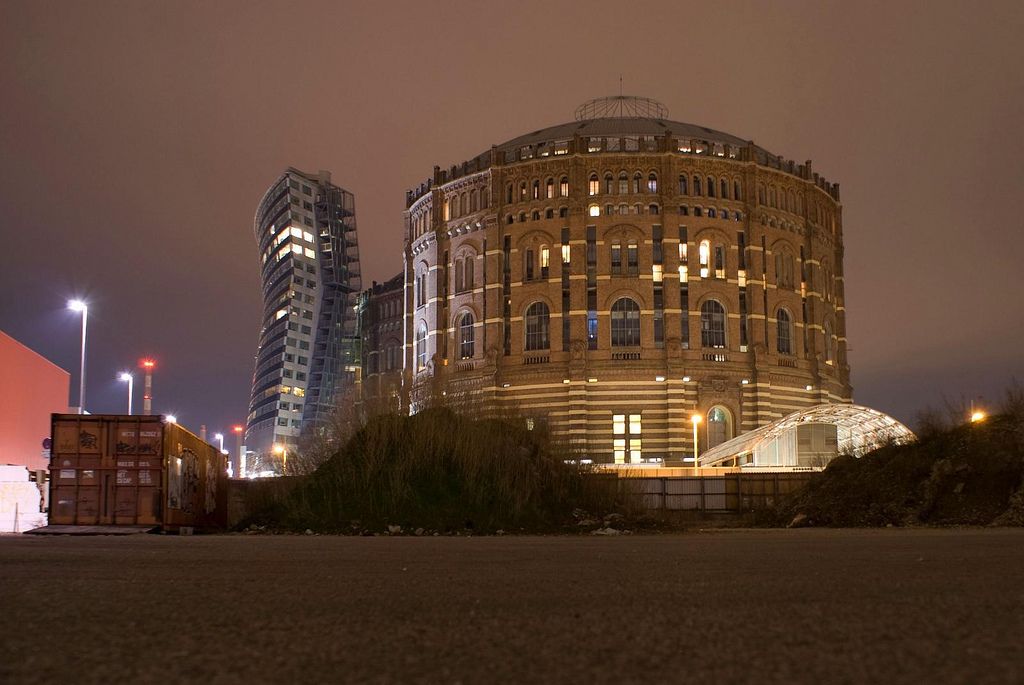
They are simultaneously monument, housing complex, entertainment venue, shopping centre, and infrastructural relic. Rather than preserving industrial heritage as nostalgia, Vienna allowed these structures to remain active, contradictory, and unfinished within the life of the city itself.
Perhaps this ambiguity is precisely what has allowed the Gasometers to survive beyond preservation alone.

Photo Cover
The four historic Gasometers in Vienna’s Simmering district, transformed into a vibrant mixed-use quarter. Aerial view showing the preserved brick shells and new glazed domes.
Credit: © Andreas Lechtape / Alamy Stock Photo