
Now Reading: Jean-Louis Chanéac: Parasitic Cells and the Architecture of a Living City
- 01
Jean-Louis Chanéac: Parasitic Cells and the Architecture of a Living City


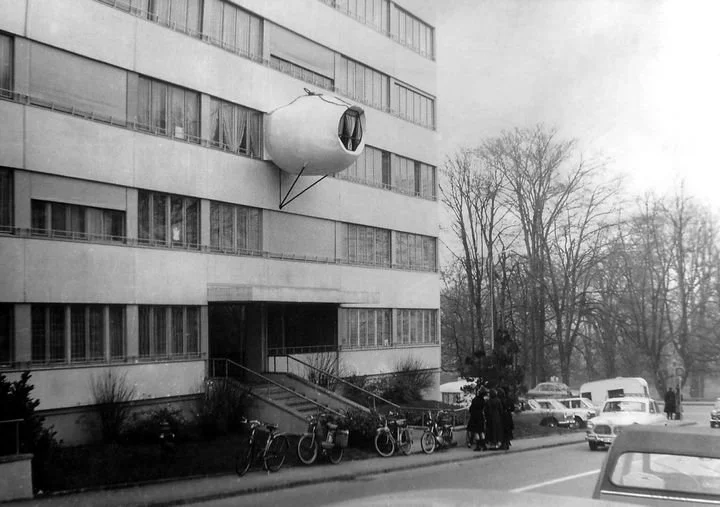
In the summer of 1971, a strange white bulb appeared on the facade of a nondescript modernist apartment block in Geneva. Shaped like a swollen seed pod, it clung to the concrete by suction cups and steel anchors. Inside lived a young family. The Bulle Pirate, or Pirate Bubble, was at once a bedroom, a protest, and a manifesto. Its creator, the French architect Jean-Louis Chanéac (1931–1993), designed it as the first realized example of what he called cellules parasites: habitable volumes that could attach themselves to existing buildings, multiply, adapt, and gradually transform rigid postwar cities into something organic and alive.
Chanéac never achieved the fame of Archigram’s Peter Cook or Kisho Kurokawa. Working quietly from the Alps of Savoie, far from Paris, he nevertheless produced one of the most radical and prescient responses to the crises of his time. While his contemporaries dreamed of megastructures and mass housing towers, Chanéac posed a simpler yet more subversive question: What if architecture could grow like a living organism, responding to people’s changing needs rather than imposing fixed forms upon them?
FROM PAINTER TO PROSPECTIVE ARCHITECT
Born Jean-Louis Rey in Avignon in 1931, he moved with his family to Chambéry as a teenager. He trained not at the École des Beaux-Arts but at Grenoble’s practical École du Bâtiment et des Arts Décoratifs, graduating in 1951. Early work as a commis d’architecte and the opening of his own office in Aix-les-Bains in 1958 allowed him to paint and sculpt alongside architecture. This artistic freedom shaped everything that followed.
By the early 1960s Chanéac had joined the architecture prospective circle around Michel Ragon and Yona Friedman. He rejected the rigid functionalism of the Athens Charter and the anonymous grands ensembles then spreading across Europe. Instead he sought an architecture capable of absorbing explosive population growth and rapid urbanization without destroying landscapes or communities. His first experiments, the cellules polyvalentes of 1960–61, were modest prefabricated units of wood and early plastics that could be assembled, rearranged, and expanded according to family needs. By 1963 these had evolved into the far more radical cellules parasites and cellules proliférantes.

The Insurrectional Vision
Chanéac’s 1968 manifesto L’Architecture Insurrectionnelle remains the clearest statement of his philosophy. Inhabitants of mass housing, he argued, should be given the tools to expand their apartments clandestinely. The city should not be a finished machine but an open framework. Parasitic cells, volumetric, industrially produced or spontaneously built, would attach to facades, roofs, and terraces with simple anchors. They could be added, removed, or reconfigured like biological extensions of the building.
Material choice was central. Reinforced polyester, fiberglass, resins, laminates, and structural foam allowed lightweight, curved, organic forms impossible in traditional concrete or steel. Chanéac patented systems for factory-produced cells that could be trucked to site and installed in hours. In an age of heavy concrete, his faith in plastics was both pragmatic and poetic, a material light and fast enough to match modern life.
FROM PROVOCATION TO BUILT REALITY
The Bulle Pirate in Geneva proved the concept worked. Commissioned by a resident frustrated with housing bureaucracy, the polyester pod hung dramatically from the building for several weeks. It instantly became a media sensation and symbol of architectural rebellion. Though short-lived as permanent housing, it demonstrated technical feasibility and captured the imagination of a generation questioning top-down urbanism.


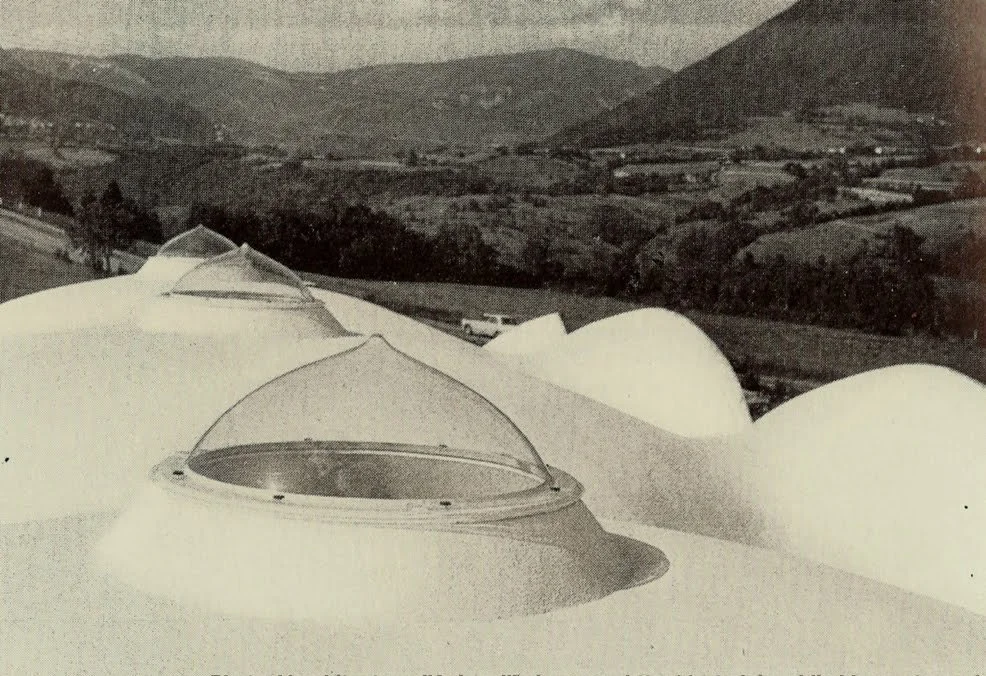
Chanéac’s speculative projects went further: crater cities, floating villages on Lake Bourget, proliferating domes, and urban systems in which housing units could cluster, separate, or migrate. These were not escapist utopias but practical answers to demographic pressure, architecture that could grow without paving over nature or condemning people to static boxes.

If the Bulle Pirate was the public provocation, Villa Chanéac (1974–1976) in Aix-les-Bains was the private laboratory. Sprayed-concrete domes and interconnected bulbous volumes created fluid interiors without traditional walls or right angles. Living in the villa meant inhabiting a system rather than a static object, an adaptable machine that blurred boundaries between rooms, inside and outside, structure and inhabitant.
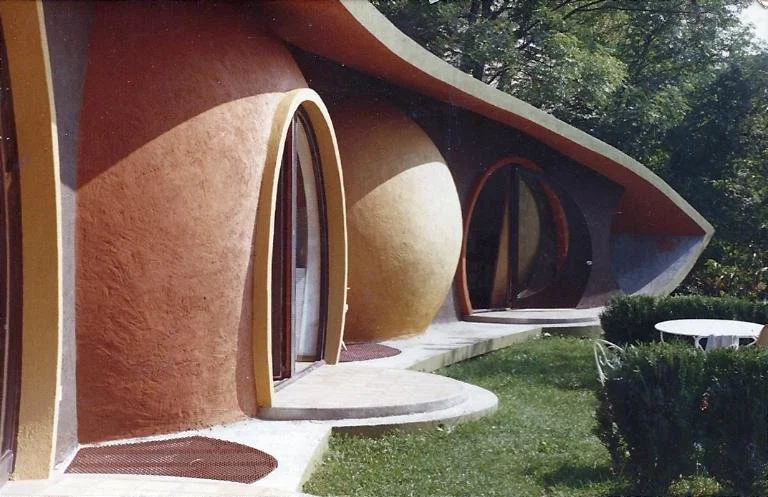
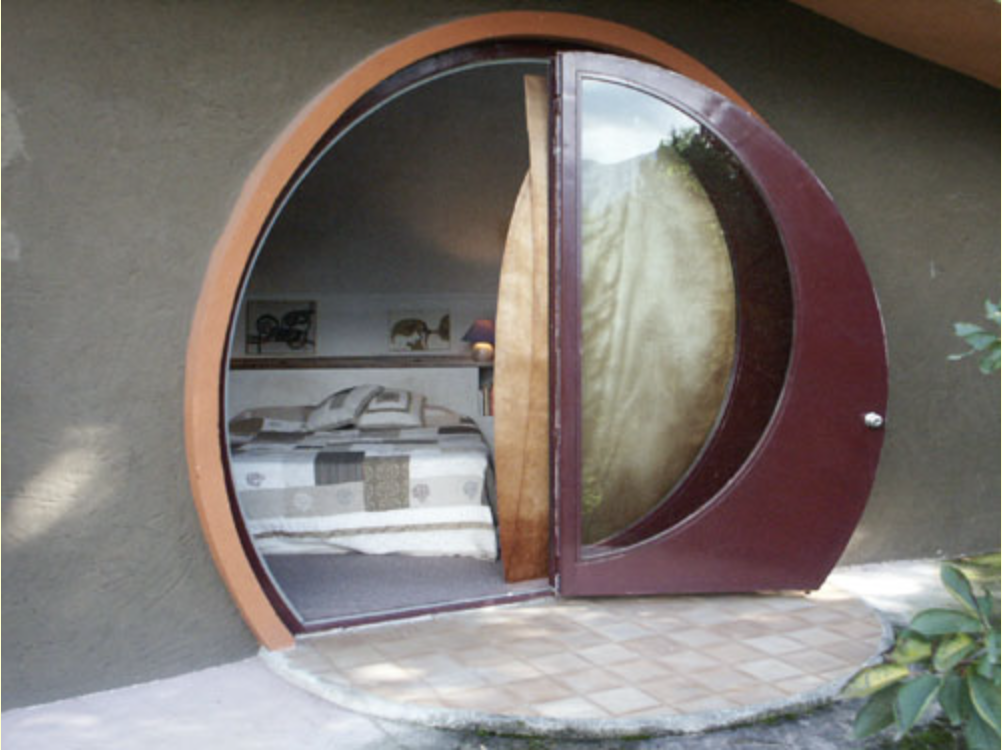
Classified as a historic monument in 2017, the house remains rare built proof of Chanéac’s ideas. Other realized works, often in collaboration with Pascal Häusermann and Claude Costy, included the dramatic wooden vortex staircase in the Châtillon-en-Michaille furniture store and housing experiments in Douvaine. These projects reveal a pragmatic architect willing to build within constraints while never abandoning his convictions.
FROM PROSPECTIVE TO ARCHORÉGION
The 1970s oil shocks and shifting cultural tides made large-scale industrial production of plastic cells difficult. Chanéac did not abandon experimentation; he evolved. In the 1980s, working chiefly in Savoie, he developed what he called archorégion, a regionalism that was not nostalgic pastiche but a living synthesis of modern technique and local spirit. Projects such as the Forum de Saint-Jean-de-Maurienne (1982), plans for Chambéry-Technolac, the Albertville Olympic site (1988), and developments in Val d’Isère integrated topography, local materials, and contemporary concrete to create buildings that respected mountain contexts yet remained unmistakably forward-looking. This was no retreat but a deepening: architecture as rooted yet visionary.

His book Architecture Interdite, written in the 1980s and published posthumously in 2005, is both memoir and indictment. In it Chanéac reflects on the bureaucratic, economic, and cultural forces that render bold ideas forbidden. It is a poignant testament from an architect who spent a lifetime pushing against limits.


A TIMELESS LEGACY
Jean-Louis Chanéac died in a car accident in 1993, leaving a body of work only partially realized. He remains less famous than his contemporaries, in part because he worked regionally and in part because his ideas resisted easy categorization or commercial success. Yet his relevance has only grown. In an era of housing shortages, climate emergency, and digital nomadism, parasitic architecture, modular plug-ins, adaptable micro-housing, and tactical urbanism feel prophetic. Today’s capsule hotels, co-living experiments, 3D-printed homes, and facade retrofits echo his vision. His insistence that architecture must be a living, participatory process rather than a finished product aligns with contemporary demands for circularity, resilience, and human scale.

The 2020 monograph Jean-Louis Chanéac: Formes rêvées, formes concrètes and exhibitions drawn from the FRAC Centre collection have brought his archive to new audiences. Villa Chanéac stands preserved. His drawings and models continue to inspire those seeking alternatives to both starchitecture and generic development.
Chanéac was never a revolutionary in the destructive sense. He was a builder of possibilities, someone who believed architecture could be insurrectional without violence, organic without sentimentality, and deeply personal without selfishness. In the Pirate Bubble, the Villa’s fluid domes, and the proliferating cells on paper, he offered a quiet but radical proposition: that the city of the future might not be designed from above but grown from within, one adaptable cell at a time.
As we confront our own crises of housing, ecology, and urban livability, Chanéac’s forbidden architecture feels less like a historical footnote and more like an open invitation. The cells are still waiting to be attached. The only question is whether we have the courage and the imagination to let the city live.
Photo Cover
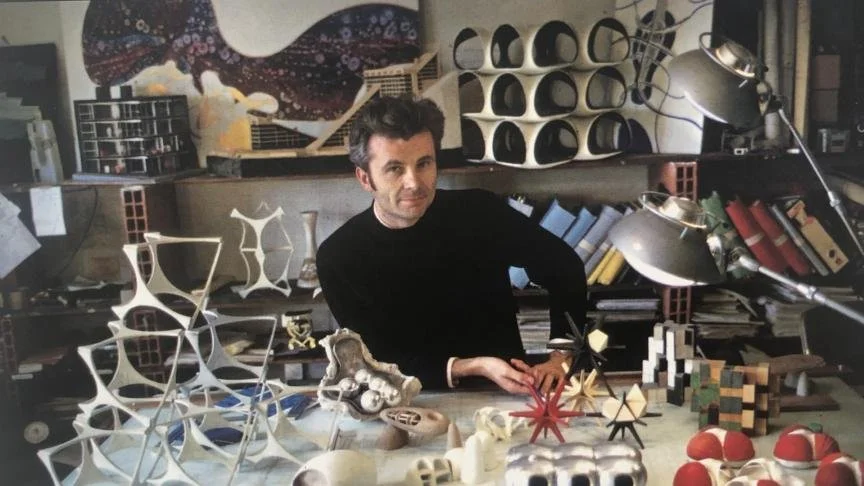
Jean-Louis Chanéac in his studio surrounded by architectural models, Aix-les-Bains, 1970s.
Photo: © Introverso / CAUE de Haute-Savoie