Now Reading: Sanjay Puri Architects unveils a terraced academic landscape for Prestige University in Indore
- 01
Sanjay Puri Architects unveils a terraced academic landscape for Prestige University in Indore

Sanjay Puri Architects unveils a terraced academic landscape for Prestige University in Indore

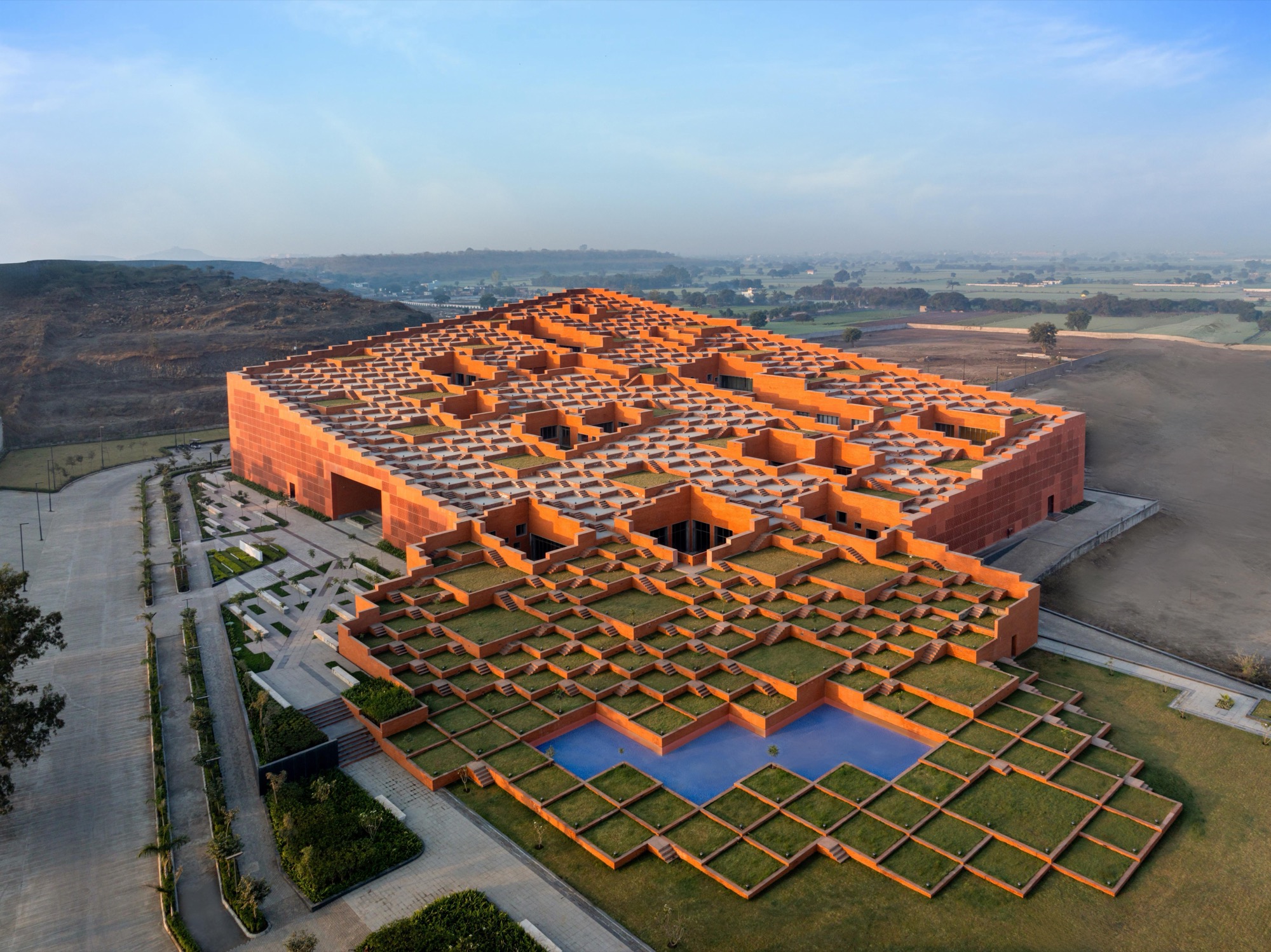
On a 32 acre campus in Indore, Prestige University consolidates its principal institutional functions into a single, topographically conceived structure. Designed by Sanjay Puri Architects, the 28 metre high building avoids monumentality. Instead, it rises gradually from the northern edge of the site, transforming what might have been an administrative block into an inhabitable landscape.

The programme is comprehensive. Administration offices, an auditorium, seminar halls, library, cafeteria, and classrooms are layered across five levels. Yet the architectural gesture is less about stacking functions than about shaping ground. The building steps diagonally upward, allowing the entire roofscape to become accessible. What emerges is not a conventional roof terrace but a vast open air auditorium carved into the campus fabric.

The terraced form recalls the geometry of historic Indian stepwells, civic structures that for over a millennium have combined water storage with social congregation. Here, that precedent is abstracted into 463 stepped platforms forming a 9,000 square metre rooftop garden. The terraces accommodate simultaneous activities at different scales, from informal gatherings to large events seating up to 9,000 students.

This reinterpretation transforms the academic building into a collective stage. Circulation becomes performance, and the roof becomes a democratic forum. Several of the platforms are wheelchair accessible, reinforcing the building’s ambition as an inclusive public realm rather than a closed institutional object.


Indore’s climate, with temperatures between 30 and 40 degrees Celsius for much of the year, shapes the architectural response. Landscaped courtyards punctuate the interior, introducing indirect north light and drawing air through the sectional volumes. A continuous diagonal indoor street cuts across the building, linking programmes while enabling cross ventilation.
The east, west, and southern facades are wrapped in ventilated GFRC screens that temper solar gain. This porous envelope, combined with shaded courts and stepped terraces, reduces dependence on artificial lighting and mechanical cooling. The result is an energy efficient structure that draws from principles embedded in traditional Indian architecture while employing contemporary materials and construction techniques.

Internally, the building unfolds as a sequence of varied sectional experiences. The ground floor houses the most public amenities, including the auditorium, food court, and administration, ensuring accessibility from the campus approach. Above, the library occupies the first floor, connected by a bridge spanning the indoor street. Classrooms and tiered lecture halls populate the upper levels, each deriving light and ventilation from adjacent courts that double as recreational spillover spaces.

Rather than isolating programmes in sealed volumes, the design interweaves built and open spaces. Courtyards, terraces, and internal streets dissolve boundaries between circulation and occupation. The architecture operates as a layered social condenser, fostering engagement across faculties and disciplines.


Prestige University’s new academic building positions itself not as an icon but as infrastructure for interaction. Its stepped massing blurs the distinction between roof and ground, between building and landscape. By synthesising climatic intelligence with cultural memory, the project reframes institutional architecture as civic terrain.


In doing so, it proposes an alternative model for contemporary campuses in India: one where energy efficiency, accessibility, and social vitality are embedded directly in form.
Project Credit
Project name: Prestige University
No. of Floors: G+4
Location: Indore, Madhya Pradesh, India
Completion Date: January 2026
Design firm: Sanjay Puri Architects / @sanjay_puri_architects
Photo: Vinay Panjwani / @panjwani.vinay
More Photos