Now Reading: Szczecin Philharmonic: Barozzi Veiga’s Prism of Light and Gold
- 01
Szczecin Philharmonic: Barozzi Veiga’s Prism of Light and Gold


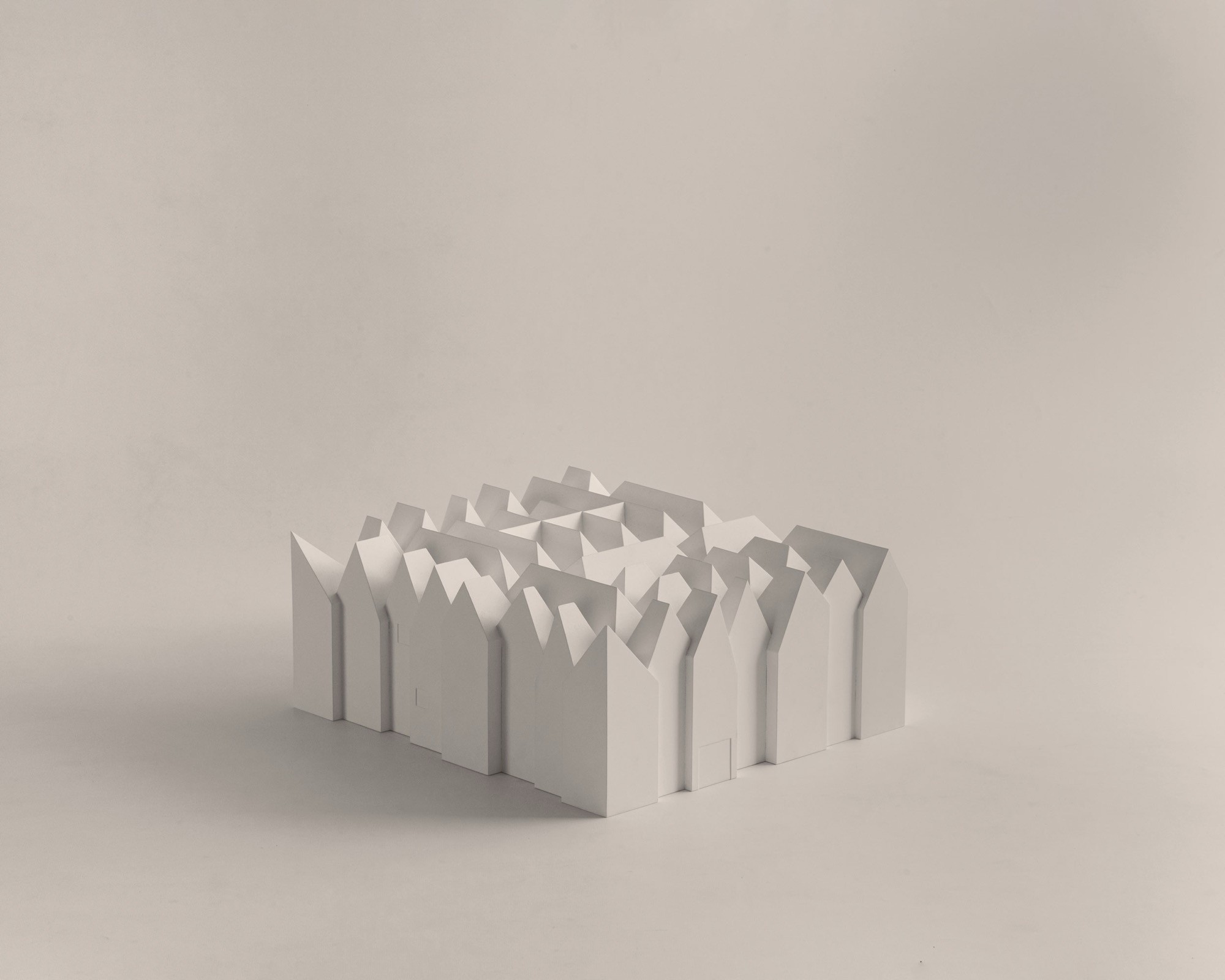
Barozzi Veiga’s Philharmonic Hall in Szczecin is both replacement and reinvention. Conceived as a single complex that accommodates a symphony hall and a chamber music hall, the building steps into the civic role once held by its predecessor, while borrowing cues from the city around it. The result is not a nostalgic reconstruction, but an architectural reset: a new silhouette that acknowledges context without surrendering to it.
From a distance, the Philharmonic reads as an abstracted mass shaped by insistently vertical lines and an unmistakable roofscape. Those jagged, pitched forms gather the building’s expressive power into a single graphic gesture, turning the roof into both identity and urban marker. Its presence is commanding, yet strangely poised, as if the volume is simultaneously carved and assembled.

The perimeter and roof patterning recall the intensity of Central European expressionist architecture, not through direct quotation but through atmosphere. It’s a building that performs emotion through geometry: sharp, repetitive, and deliberately strange.

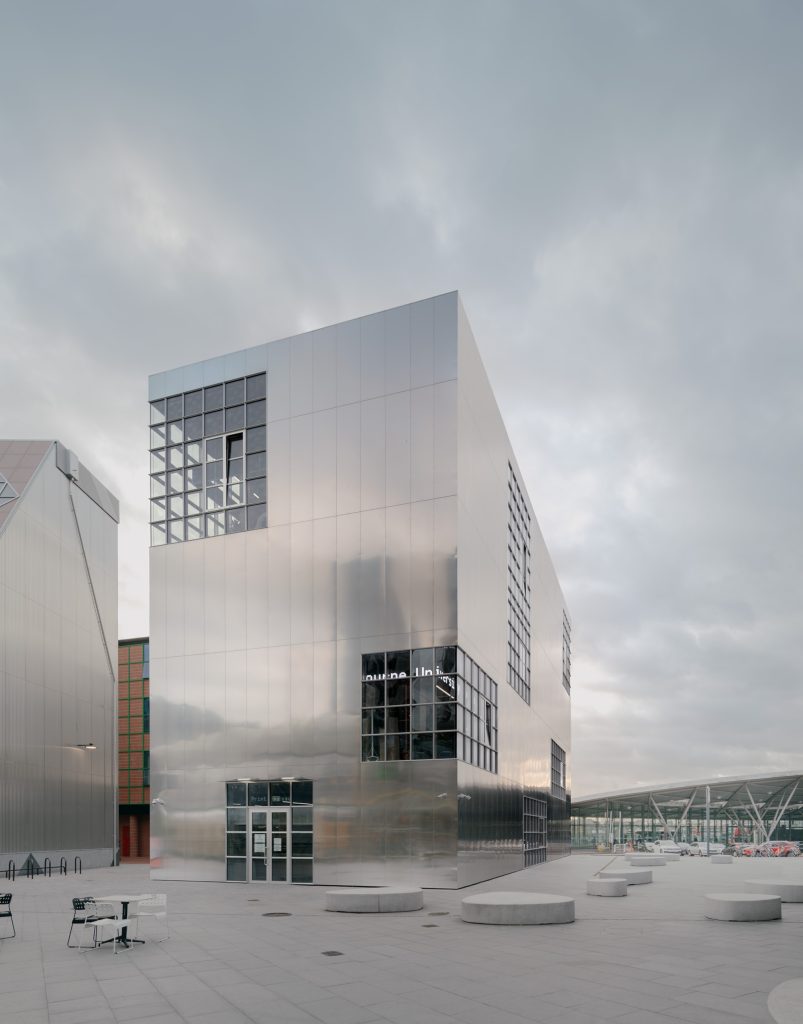
Externally, the hall presents itself as a light object rather than a heavy monument. An aluminum and glass envelope filters perception, oscillating between translucency and opacity depending on angle, time of day, and internal activity. This shifting skin feels calibrated to the building’s program, allowing the façade to register use without turning the interior into a display.


In Szczecin’s often muted light, that ambiguity becomes a strength. The building doesn’t simply reflect the city. It edits it, compressing the surrounding context into a hazy outline while maintaining an aura of precision.
If the exterior leans toward restraint, the main hall pivots into intensity. Here, gold becomes more than decoration. It is craft, atmosphere, and cultural memory, evoking the lineage of classical Central European concert halls while remaining unmistakably contemporary. The gilded interior draws on local traditions of craftsmanship, using gold leaf in a way that is at once ornamental and functional, a surface treatment that shapes both perception and performance. The contrast is deliberate: a cool, almost immaterial shell protecting a warm core. In that shift, the building stages a narrative familiar to music itself, moving from controlled silence to resonant fullness.


Acoustics are not treated as an invisible technical layer but as a spatial driver. The hall’s surfaces follow a sequence of geometrical fragmentation that intensifies as distance from the stage increases, turning the room into a calibrated field of reflections. What looks like ornament is, in fact, an instrument: a system that shapes sound through form, amplifying clarity while deepening immersion.

Like Barozzi Veiga’s other works, the Szczecin Philharmonic pursues formal autonomy. Yet autonomy here doesn’t mean indifference. The building aligns with its context in scale and civic intent, integrating into the city’s fabric while keeping a distinct identity. It belongs, but it refuses to blend in.
In a single gesture, the Philharmonic holds together multiple contradictions: mass and lightness, severity and opulence, contextual sensitivity and architectural independence. It is not simply a container for music, but an urban presence that performs, even before the first note is played.
Project Credit
Project name: Philharmonic Hall
Location: Poland, Szczecin
Design Firm: Barozzi Veiga / @barozziveiga
Completed: 2014
Photo: Simon Menges
More Photos