Now Reading: Arina Krisanova reinterprets Kikutake’s 1958 Sky House in modular Moskva apartment
- 01
Arina Krisanova reinterprets Kikutake’s 1958 Sky House in modular Moskva apartment

Arina Krisanova reinterprets Kikutake’s 1958 Sky House in modular Moskva apartment

In Moskva, interior designer Arina Krisanova revisits the radical spatial logic of the 1958 Sky House by Japanese architect Kiyonori Kikutake, translating its metabolist ethos into a contemporary domestic interior. Conceived as a modular dwelling defined by a single expansive room and movable partitions extended through portals, Kikutake’s original project embodied the principle of transformation. Architecture was not fixed form but an adaptable framework, capable of evolving alongside its inhabitants.
Krisanova’s project adopts this logic as both conceptual and spatial foundation. The so called Kikutake Room, anchored by a library, becomes the central connective element around which the entire apartment is organized. Geometry, color, and placement of every interior component are governed by the idea of modularity, understood not as stylistic reference but as a structural principle of living. The result is an interior that treats transformation as an everyday condition rather than a dramatic event.

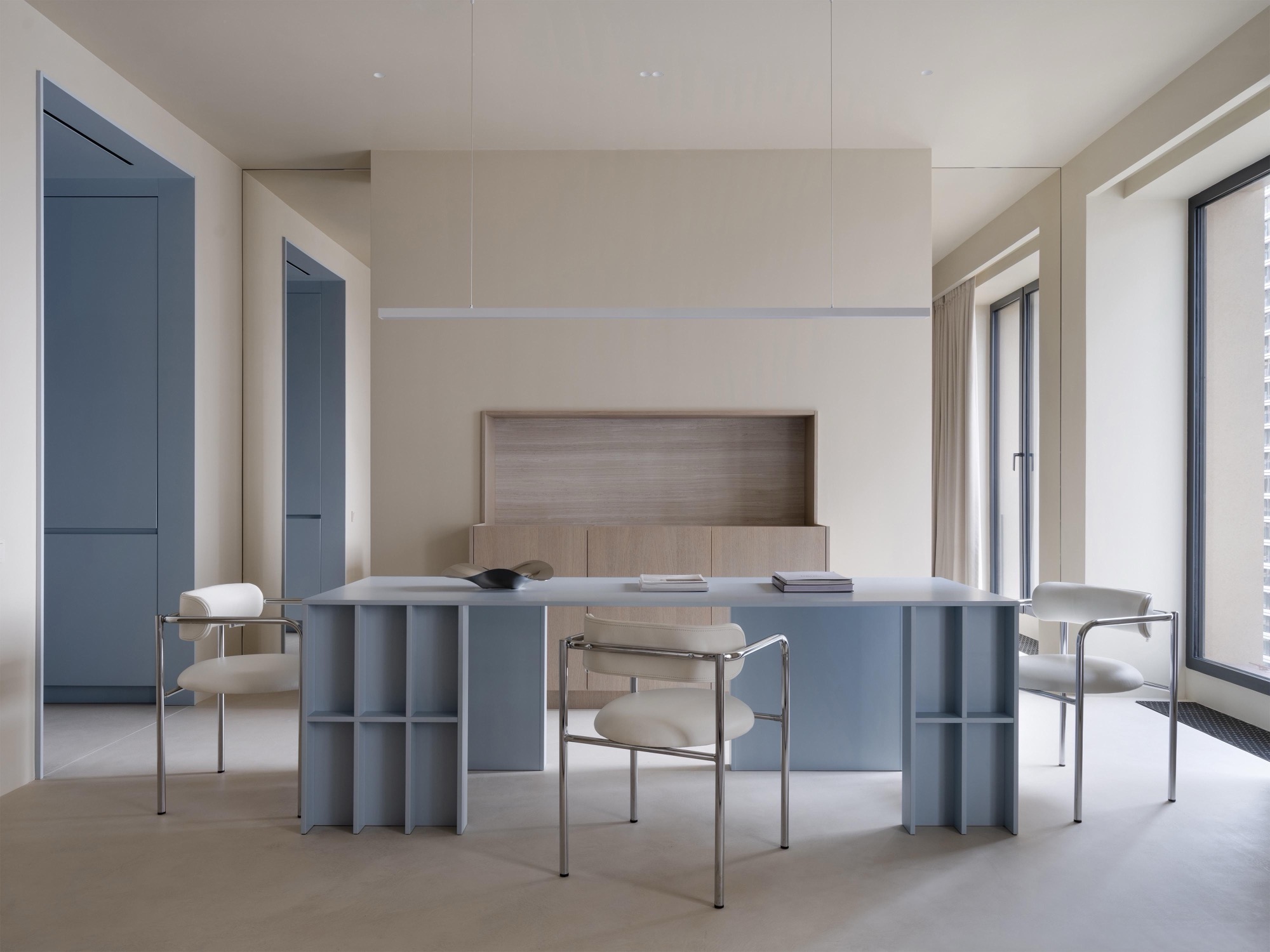
At the heart of the common area lies a sky blue volume that mediates between kitchen and workspace. When its facades are opened, it functions as a compact preparation zone for light cooking. Once closed, it becomes a private office. This mutable enclosure extends the metabolist logic into the realm of daily routine, allowing function to shift without altering the spatial order.


Mirrors play a crucial architectural role. Positioned on either side of the built in box, they reflect the surrounding library and create the illusion of additional windows and passages. The effect recalls the circular gallery of the original Sky House, enveloping the interior and dissolving its boundaries. Rather than enlarging the apartment physically, reflection expands it perceptually, transforming the kitchen living area into a layered and partially concealed domestic landscape.


The project carries particular intensity as it was designed for the architect’s own residence. In assuming the roles of author, supervisor, client, and curator, Krisanova confronts the paradox of self commission. The freedom of complete creative control is accompanied by the weight of unfiltered decision making. The process reveals the tension between rational design logic and personal desire, yet it also allows for an uncompromised expression of spatial ideology.
This dual position reinforces the project’s conceptual clarity. Without external mediation, the metabolist framework is pursued consistently, from spatial organization to material detail.


With the exception of upholstered pieces, all furniture was designed from Krisanova’s sketches. The dining table and library reinterpret the structural language of Kikutake’s Sky House. The table legs, inspired by the original project’s portal supports, appear to shift depending on the observer’s position, introducing a dynamic reading of an otherwise stable object.


In the main bathroom, the sink operates as a sculptural volume that transitions into a cuboid form through its seamless reflection in a mirror placed behind it. The boundary between object and image collapses, reinforcing the project’s ongoing dialogue between material presence and spatial illusion.


The guest bathroom incorporates a limited edition ASKO x Maxim Kashin Architects home laundry unit, featuring Maxim Kashin’s Suprematist pattern. Produced in a series of ten to commemorate Kazimir Malevich’s first Suprematist exhibition, 0.10, the appliance situates the domestic interior within a broader lineage of avant garde experimentation.


Perhaps the most demanding aspect of the project was the selection of wall color. Approximately twenty variations of beige were tested, each responding differently to changing daylight conditions. In an interior conceived as almost entirely monochrome, with the exception of the sky toned accent volume, tonal precision became critical.
The chosen shade establishes continuity between vertical and horizontal planes, allowing surfaces to flow seamlessly into one another. Rather than functioning as neutral background, color here operates as a calibrating device, ensuring that light, reflection, and geometry remain in equilibrium. The sky accent emerges not as decorative gesture but as spatial counterpoint within a carefully controlled chromatic field.
Through its disciplined reinterpretation of Kikutake’s metabolist principles, Rethinking the Sky House demonstrates how modularity, reflection, and spatial adaptability can be reactivated within a contemporary residential interior. The project does not replicate the 1958 icon. Instead, it translates its manifesto into a lived, intimate environment, where transformation becomes both architectural strategy and domestic ritual.


Project Credit
Project name: Rethinking the Sky House
Area: 72 m²
Location: Moscow, Russia, Residential Complex Prime Park
Designers: Arina Krisanova / @krisanova.design
Completion date: November 2025
Photo: Inna Kablukova / @in_kablukova
Interior stylist for the photo shoot: Irina Temnova
More Photos