Now Reading: Mix Architecture wraps Nanjing’s Red Mountain in iron-oxide concrete with Red Box
- 01
Mix Architecture wraps Nanjing’s Red Mountain in iron-oxide concrete with Red Box

Mix Architecture wraps Nanjing’s Red Mountain in iron-oxide concrete with Red Box

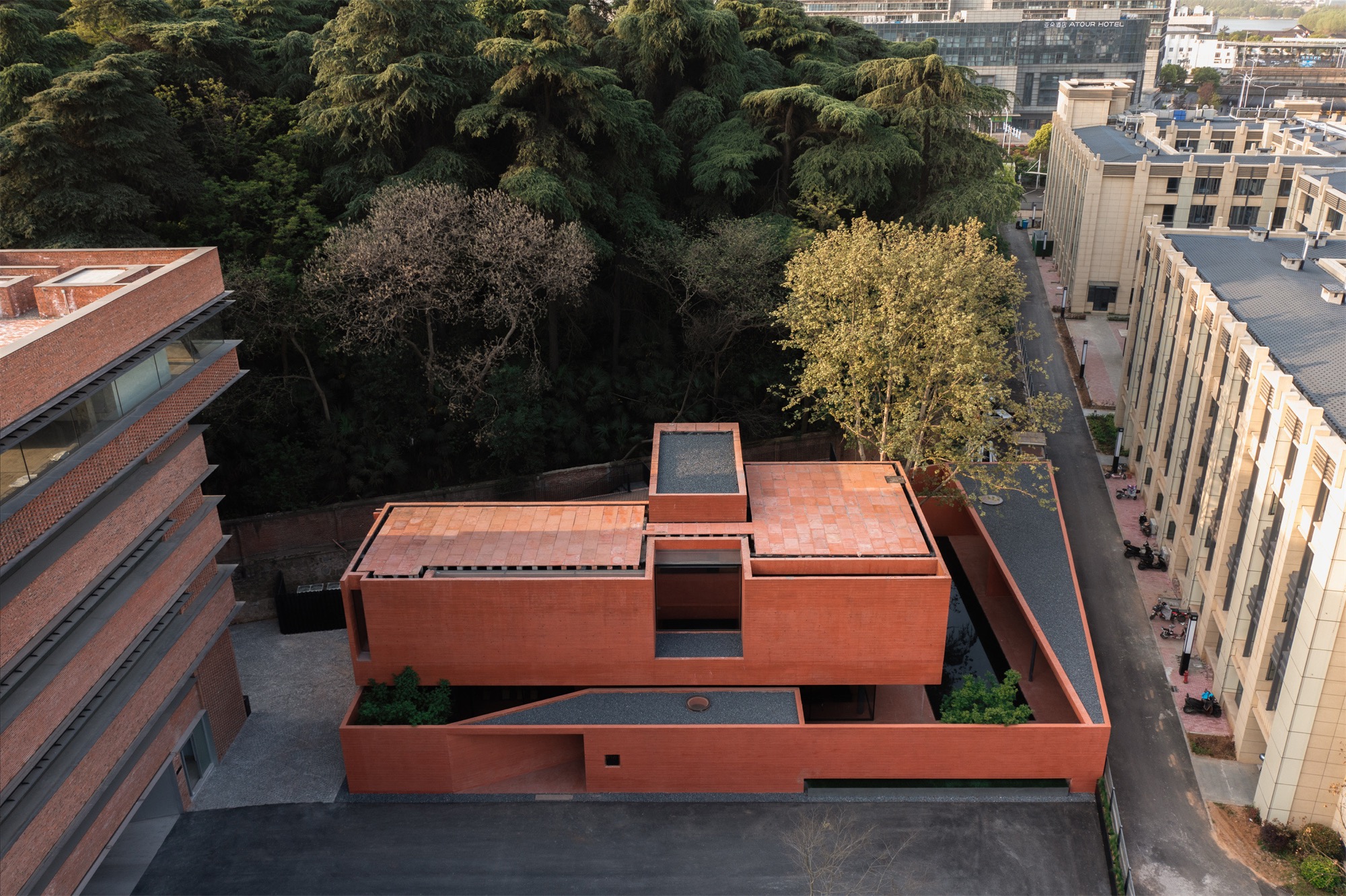
At the foot of Red Mountain in Nanjing, the Red Box by Mix Architecture emerges as a compact yet resonant intervention within the former industrial grounds of the Nanjing Combat Machinery Factory. Cast entirely in red concrete, the 500 square metre commercial building positions itself as both artifact and atmosphere, responding to layers of memory embedded in the site while asserting a precise, contemporary identity.

The project takes its name and chromatic intensity from three intertwined references. The first is historical. Red Mountain Park, once the Nanjing Combat Machinery Factory founded in the 1950s, witnessed the industrial optimism of early New China. The color red, long associated with that period, carries generational memory. Rather than reproducing symbols, the architects translate this collective recollection into matter.


The second reference lies in the red brick fabric of the original factory buildings. The Red Box does not mimic them; instead, it echoes their cadence. Red concrete is poured using timber formwork whose grain approximates the dimensions and rhythm of existing bricks. The result is a monolithic volume that subtly registers the industrial logic of its surroundings, its surface marked by wood texture that bridges past and present.
The third reference is geological. Red Mountain acquired its name during the Republic of China period, when the iron rich soil and the presence of hematite were identified. Hematite, composed primarily of iron oxide, lends the mountain its hue. In the Red Box, iron oxide becomes the key additive in the concrete mix. Through multiple casting tests, the architects refined both texture and tone. During construction, digital control of raw material ratios ensured chromatic consistency, turning color into a calibrated architectural instrument.
Facing north toward the park, the building presents a largely solid wall, reading as a rectilinear mass poised above a horizontal courtyard wall. To the south, terraces step back in succession, establishing a topographical dialogue with the slopes of Red Mountain. The geometry allows landscape to infiltrate the architecture, blurring the boundary between constructed and natural terrain.


A triangular incision in the courtyard wall conceals the entrance. Visitors approach along a gently winding path that compresses before releasing into a tall entry space defined by a six fold staircase. This choreography of concealment and reveal sets the experiential tone of the project, where movement unfolds as a sequence of spatial intensities.

On the west side, a generous public courtyard anchors the composition. A mature tree has been preserved at its center, encircled by corridors and a reflecting pool. Water and foliage mirror the forested slopes beyond, folding the mountain’s presence into the heart of the building. The eastern side accommodates more private functions, maintaining a calibrated balance between openness and retreat.

The plan is structured around multiple courtyards that mediate light and privacy. A narrow courtyard lines the north, while a pine courtyard to the south introduces evergreen texture and seasonal continuity. Ascending to the second level, a corridor bridges two principal volumes, functioning both as circulation and as an elevated belvedere. From this vantage point, the greenery of Red Mountain fills the southern view, turning landscape into a living backdrop.


Within these upper spaces, two main walls incorporate acrylic semi permeable elements embedded within the red concrete. One surface is punctuated with dot like openings, filtering light in a constellation effect that evokes a starry sky. The other adopts a brick like openwork pattern, recalling the red brick architecture of the surrounding factory buildings. These devices allow light to seep through the mass while maintaining the monolithic presence of the structure.


From the interior, the large terrace frames the mountain in a direct, almost cinematic composition. Architecture becomes a device of framing, where Red Mountain appears to dissolve into the red concrete envelope, and the building itself reads as an extension of the terrain.
Although the Red Box appears elemental, its realization is grounded in high levels of industrial coordination. Architecture, interior, and landscape were conceived synchronously, ensuring spatial and material continuity. The building is treated almost as a mechanical product, in which structure, façade, environmental systems, lighting, and detailing are interlocked with precision.

Close collaboration with manufacturers of fair faced concrete, windows, doors, lighting, and mechanical systems enabled the project to meet stringent tolerances. The pursuit of durability guided both design and construction. Material tests, digital calibration of concrete mixes, and refined management processes ensured that form, light, and equipment align seamlessly, resulting in a building intended to endure physically and culturally.


Project Credit
Project name: Red Box
Location: Huangjiayu Drive, block 41-1, Hongshan high-tech factory, 16th block, Gulou district, Nanjing, China
Design firm: Mix Architecture / @mix_architecture
Construction Area: 500 square meters
Photo: Arch-Exist / @archexist