
Now Reading: Peer Collective and Kateřina Šedá Transform a Christmas Market in Brno
- 01
Peer Collective and Kateřina Šedá Transform a Christmas Market in Brno


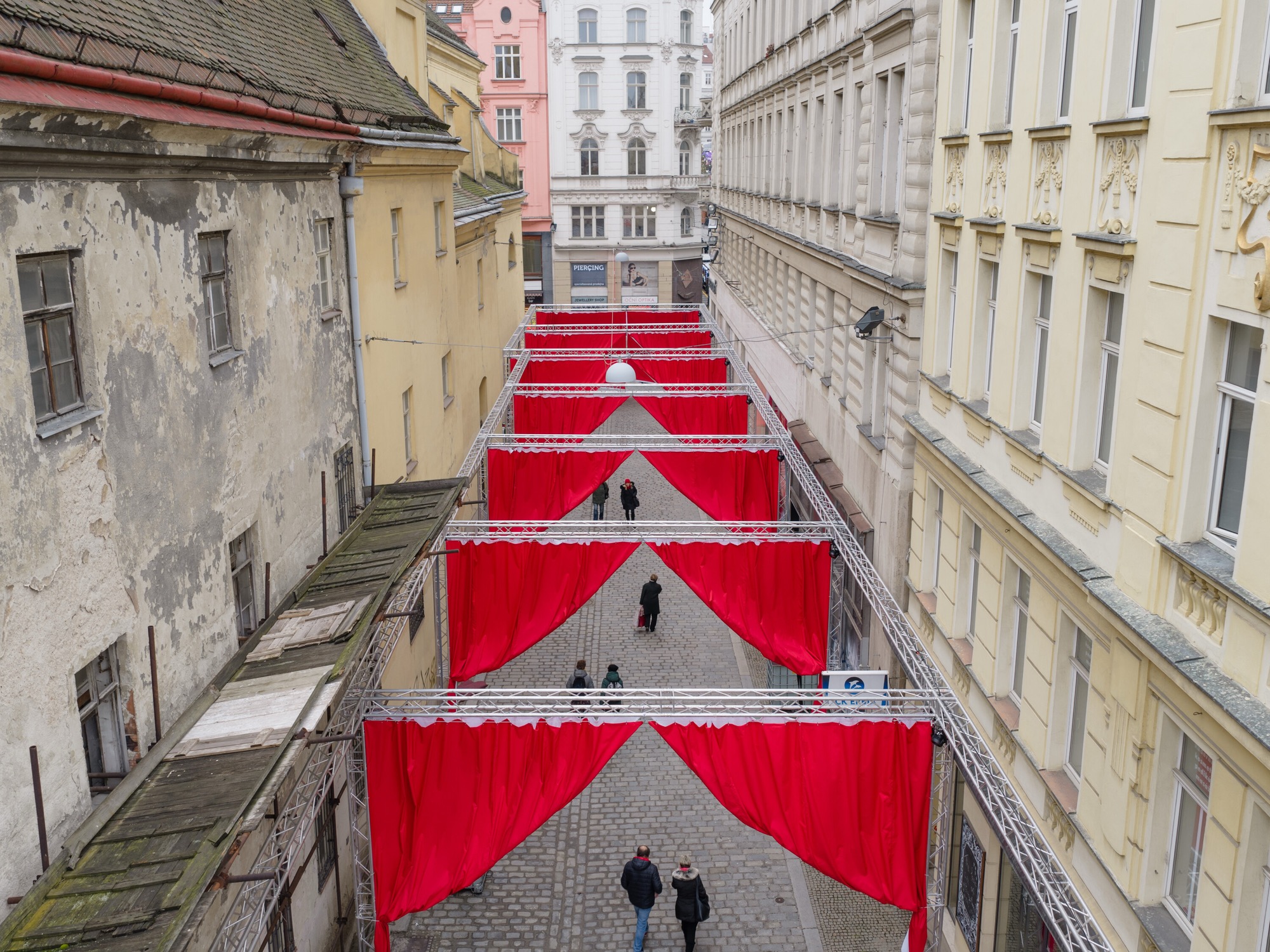
In the centre of Brno, just steps away from the commercial intensity of Masarykova Street, a forgotten fragment of the city has been temporarily transformed into an unexpected place of calm. Římské náměstí, an overlooked extension of Františkánská Street, becomes the setting for the Christmas Festival of Bad Habits, a project that deliberately turns away from the spectacle and consumption typically associated with seasonal markets. Conceived by artist Kateřina Šedá in collaboration with architectural studio Peer Collective, alongside Renadi and the Brno střed Municipal District, the project reframes Christmas as a moment for reflection rather than excess.

The initiative emerged from Renadi’s long term effort to create safe, pressure free environments during the holiday season, particularly for people who often feel excluded from festive public life. Invited to expand this ambition, Kateřina Šedá connected it with her ongoing research project The National Collection of Bad Habits, which examines everyday weaknesses and social patterns in Czech society. The result is a spatial narrative structured as a personal journey. Instead of stalls and transactions, visitors encounter situations that prompt them to confront their own habits, compare experiences with others, and consider the possibility of change.
At the conceptual centre of the square stands a confessional, not as a religious symbol but as a shared point of pause. Here, self reflection becomes both individual and collective, reinforcing the idea that the city can host moments of vulnerability alongside everyday movement.

SOFT ARCHITECTURE AND TEMPORARY URBAN ROOMS
Peer Collective responded to this brief with an architecture that is deliberately light and adaptable. Using modular truss structures typically associated with stage design, the architects suspended large curtains of white and red fabric to subdivide the square into a sequence of temporary rooms. These eighteen spatial pockets create a rhythm of passages and clearings, allowing visitors to move through the site as if navigating an interior, despite remaining under open sky.


Covering an area of nearly two and a half thousand square metres, the installation acts as a temporary urban interior, redefining how public space can operate during the winter season. The curtains function as soft thresholds, encouraging people to cross boundaries, slow their pace, and momentarily withdraw without disconnecting from the city around them.


PUBLIC SPACE BETWEEN THE PERSONAL AND THE COLLECTIVE
As night falls, the square shifts again. Testimonies drawn from The National Collection of Bad Habits are projected onto the white fabric surfaces, turning the installation into an open air gallery. Accompanied by restrained sound and gentle lighting, the projections blur the boundary between public display and private thought. The space becomes intimate without becoming isolated, offering a rare atmosphere of shared quiet in the urban centre.
Architecture here does not act as scenery but as an active framework. The experience depends on human presence, participation, and movement. Visitors are not consumers but contributors, shaping the meaning of the space through their engagement.


THE CONFESSIONAL AS CIVIC DEVICE
Replacing the traditional market stall, six confession booths form the emotional core of the festival. These are not places of exchange but of listening and speaking. An interactive audiovisual system responds to individual inputs, weaving personal statements into a collective narrative. What is usually hidden or unspoken becomes part of a shared urban experience, suggesting that vulnerability can also be a form of civic connection.


After passing through the confessional, visitors exit behind the red curtains, returning to the city with a sense of transition, as if stepping back from a momentary suspension of everyday noise.
AN INCLUSIVE CITY EXPERIMENT
The ambition to remove barriers extends beyond symbolism. The square itself was physically adapted using simple interventions, with fine gravel leveling the surface to ensure accessibility for wheelchair users, parents with strollers, and elderly visitors. Local residents participated in shaping the site during an earlier community event, embedding social involvement into the project before it even opened. Alcohol was deliberately excluded, addressing not only physical but also social and psychological barriers.


The Christmas Festival of Bad Habits demonstrates how temporary architecture and artistic practice can reframe familiar rituals. By replacing consumption with contemplation, it proposes a different model for seasonal urban life, one where public space becomes a tool for care, reflection, and shared humanity rather than spectacle alone.

Project Credit
Architecture: Peer Collective / @peer.archi
National Collection of Bad Habits author and art concept: Kateřina Šedá
Location: Římské náměstí, Františkánská ulice, Brno, Czech Republic
Year: 2025
Photo: Matej Hakár, Jan Urbášek
More Photos


Peer is an architectural collective based in Brno, Czech Republic, formed as a loose association of architects and creative practitioners whose collaboration began during their student years. The studio approaches architecture as an open and evolving discipline, grounded in experimentation, dialogue, and collective authorship. Each project begins with conceptual discussion and is developed through shared exploration, ranging from sketches and physical models to digital simulations and virtual reality. International collaboration is central to Peer’s practice, reflected in award-winning projects developed in partnership with Paris-based studio Muoto, as well as competition-recognized works in Brno. The collective operates without hierarchy, emphasizing equality and shared responsibility, with all members contributing jointly to each project.
Kateřina Šedá is a Czech contemporary artist whose practice is closely aligned with social architecture and participatory art. Educated at the Academy of Fine Arts in Prague, she is known for initiating socially conceived projects that take place in everyday settings such as villages, streets, and public squares, often involving large groups of people outside the art world. Her work explores interpersonal relationships, social habits, and collective behavior, using provoked action and shared participation to encourage lasting change. Šedá’s projects have been presented internationally at institutions including Tate Modern, SFMoMA, Documenta Kassel, and the Venice Biennale, and she is the recipient of numerous awards. Alongside her artistic practice, she is a prolific author and an active lecturer, committed to making art accessible and socially transformative.