Now Reading: Nonspace: A rural context seeking new forms of exchange
- 01
Nonspace: A rural context seeking new forms of exchange


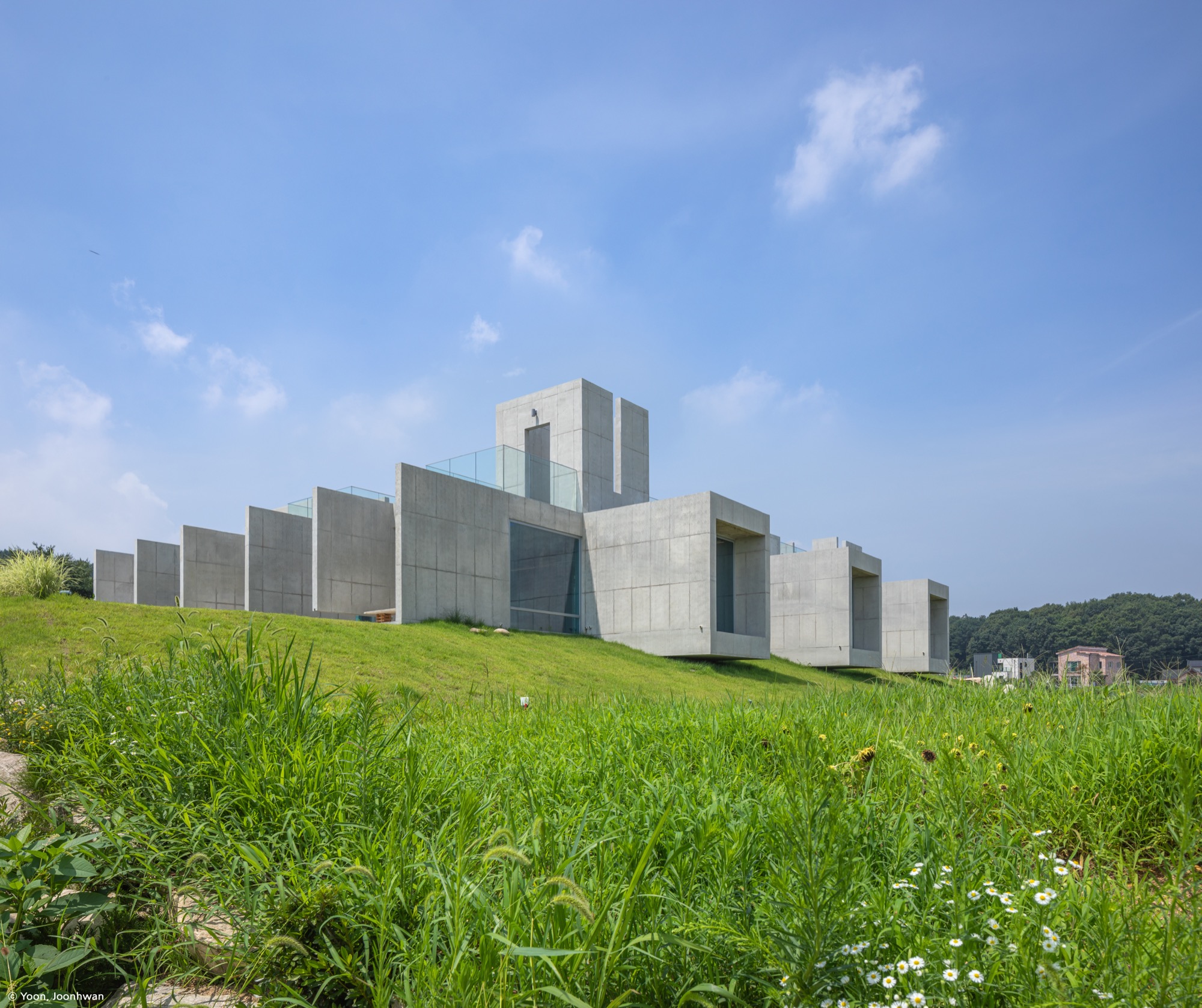
Located in Icheon, a region long associated with rice cultivation and flower farming, NONSPACE emerges from a village context facing gradual demographic decline and an ageing population. Rather than introducing a singular commercial destination, the project is conceived as a spatial framework capable of supporting new forms of social and cultural interaction. The ambition is not to replace local life, but to extend it, offering a place where different rhythms, activities, and cultural presences can overlap.
Developed as a small scale cultural and commercial facility, NONSPACE positions itself between local routines and external influences. It operates as a connective device, inviting visitors while remaining grounded in the material and agricultural identity of its surroundings.

CROSS SPACE AS SPATIAL STRATEGY
The architectural structure of NONSPACE is organised through a grid that establishes both widthwise and depthwise orders. At their intersections, a series of cross spaces emerge, forming the core of the project’s spatial logic. These are not fixed rooms defined by a single function, but flexible zones capable of accommodating multiple programs and interpretations over time.

The term NONSPACE reflects this condition of indeterminacy. Each cross space acts as a platform rather than a destination, allowing uses to expand, contract, or overlap. In this way, the building avoids the rigidity of conventional commercial interiors and instead supports a gradual accumulation of activities, encounters, and cultural exchanges. The architecture does not prescribe behaviour but provides a spatial structure that encourages it to unfold.


MATERIAL EXPERIMENT AND SENSORY EXPERIENCE
Material experimentation plays a central role in shaping the atmosphere of NONSPACE. Exposed concrete surfaces are cast using rice straw, a material drawn directly from the agricultural context of Icheon. Prior to pouring the concrete, bundles of straw are laid onto the formwork and soaked with water. Once the formwork is removed, fragments of straw remain embedded in the concrete surface, producing a texture that recalls woven straw structures rather than conventional industrial finishes.


This material choice is not merely visual. Over time, the straw continues to change, subtly altering the appearance and ambience of the interior. The building thus registers time and use, reinforcing a connection between architecture and seasonal cycles.


Spatially, the project is conceived as an environment that engages the senses. Movement through the building reveals shifts in light, enclosure, and openness. Water is introduced as an acoustic element, its sound emerging from narrow openings in the floor before becoming visually legible deeper inside the space. Trees planted to represent different seasons frame internal voids, while stone and pebble surfaces underfoot produce soft sounds that accompany walking across the rooftop.

Smell, sound, touch, and light operate together, creating a sequence of spaces that expands and contracts, brightens and darkens. Rather than relying on visual spectacle, NONSPACE builds its identity through subtle sensory transitions, allowing visitors to experience architecture as a gradual and bodily encounter.


Project Credit
Project Name: NONSPACE
Office Name: On Architects Inc / @onarchitects_inc
Location: Hobeop-myeon, Icheon-si, Gyeonggi-do
Completion Year: 2022
Gross Built Area: 428.48 m2
Photo: Yoon Joonhwan