
Now Reading: Maximising Space Without Extending: THISS Studio Reimagines a Victorian Home in Waltham Forest
- 01
Maximising Space Without Extending: THISS Studio Reimagines a Victorian Home in Waltham Forest

Maximising Space Without Extending: THISS Studio Reimagines a Victorian Home in Waltham Forest

In North East London, THISS Studio has renewed a typical Victorian terraced house, transforming a dim and constricted ground floor into a bright, expressive, and flexible family interior. Rather than adding square metres, the architects unlocked the potential already embedded in the existing shell, demonstrating that meaningful space can be created through intelligence and imagination rather than carbon-heavy extensions.
When first approached, the client requested a standard side-return extension. Instead of fulfilling the familiar formula, THISS Studio reframed the brief entirely. They focused on what the family truly needed: a generous kitchen, a stronger connection to the garden, a workspace for quiet hours while the children are at school, and an environment with sculptural character and emotional warmth.
This shift in perspective opened a pathway to design value. By working within the home’s existing footprint, the architects freed up the budget for crafted materials, bespoke furniture, and expressive finishes that celebrate the clients’ identity. The project stands as a compelling counter-argument to the assumption that bigger is automatically better.

A KITCHEN THAT BECOMES THE HEART OF THE HOUSE
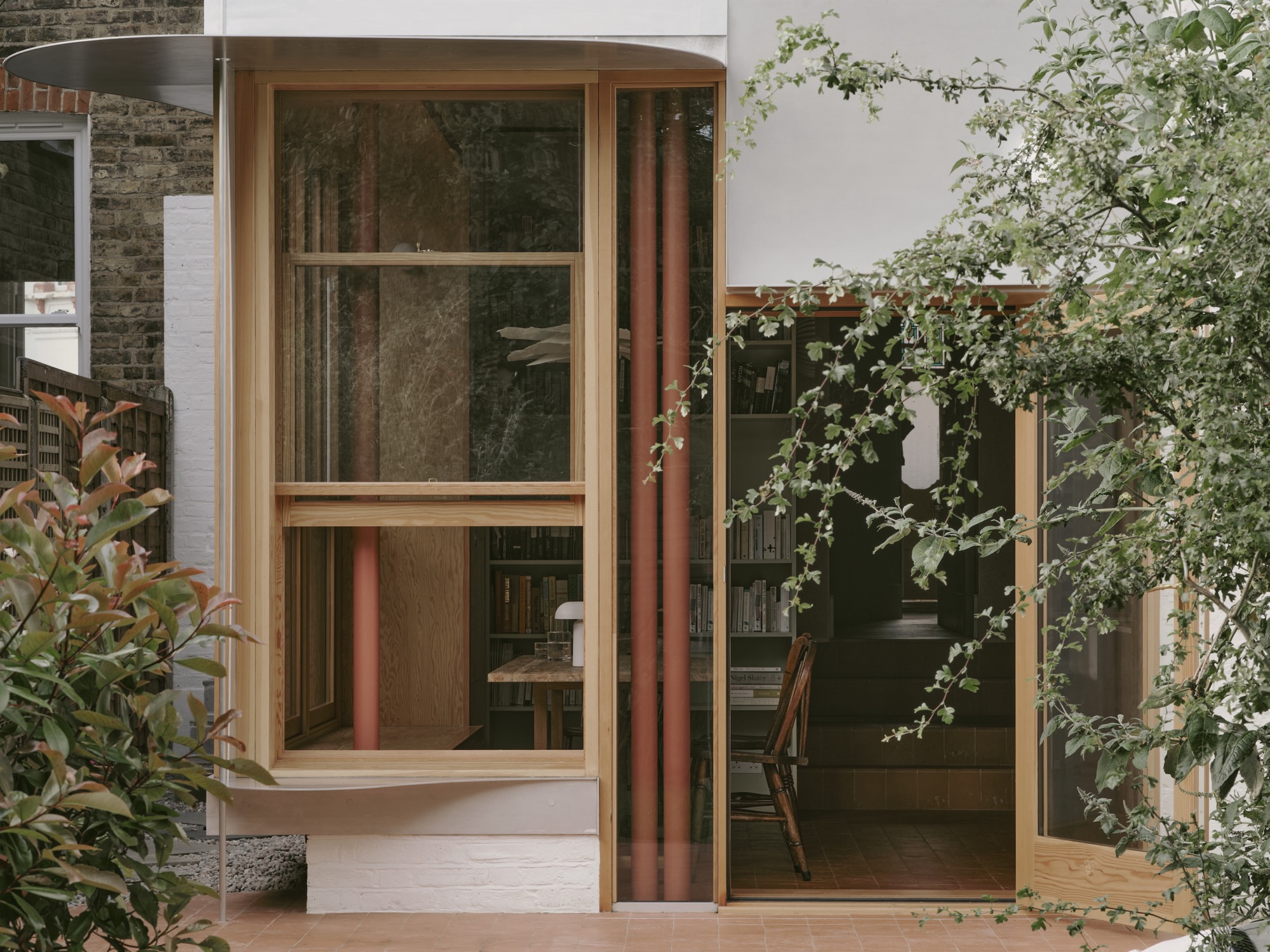
THISS Studio’s strategy centred on reconfiguring the rear of the dwelling. The architects introduced a cantilevered dining bench framed by three oversized timber sash windows, creating a bay of light that visually enlarges the room and dissolves the boundary between kitchen and garden.
The kitchen itself is handmade locally using FSC-certified pine, contributing both tactility and sustainability. During early investigations, the architects discovered a generous void beneath the existing floor. Rather than filling it, they embraced it. Removing the floor enabled the creation of a level garden threshold and revealed an unexpected extra metre of ceiling height. The result is a voluminous room with a sense of clarity and openness rare in Victorian plans.

A palette of natural wood, terracotta, and pale cream acoustic panels made from recycled paper gives the interior a calm groundedness. A mint-green, floor-to-ceiling shelving unit introduces vertical rhythm, while playful floral light fixtures echo the family’s lively personality.


A GARDEN CONNECTION CRAFTED WITH CARE
The relationship between inside and outside is choreographed with subtlety. Terracotta tiling extends from the kitchen into the garden, forming a circular patio affectionately nicknamed the “disco ball patio,” where a tonal shift in the tilework marks a gentle transition between the two realms.
Custom Douglas fir glazing floods the kitchen with daylight and frames views of the garden as a living backdrop. A built-in sunlit bench below the windows becomes a natural gathering place for family and friends. To create an expansive opening without the cost of bespoke doors, THISS Studio employed large sash windows, a simple but effective way to achieve generous glazing within a modest budget.


Outside, a sculptural curved canopy made from recycled aluminium projects from the building’s corner. Laser-cut and fixed above the south-facing elevation, it provides shade and weather protection for the timber windows while adding a moment of architectural whimsy. A smaller aluminium ledge below mirrors this gesture, offering an informal seat or outdoor table.

The renovation also addressed the rest of the ground floor. A former kitchen at the front of the house was restored to its intended use as a peaceful living and study room painted in soft butter yellow. A compact WC and utility space were slotted efficiently into the centre of the plan, contributing to the home’s new sense of clarity and flow.
Throughout, colour, natural textures, and crafted details bring personality to every room, giving the home a feeling of authenticity and comfort.


A core achievement of the project lies in its environmental intelligence. By avoiding an extension entirely, the architects eliminated the need for new concrete foundations and significantly reduced embodied carbon. All interventions worked with the existing structural footprint, turning the house into an exemplar of low-carbon retrofit.
Material choices reinforce this ethos. FSC-certified pine and Douglas fir were sourced from within Europe, reducing transportation emissions. Recycled aluminium was selected for the external canopy for its durability and infinite recyclability. Together, these choices articulate a holistic approach to sustainable design on a real-world budget.
Project Credit
Location: Waltham Forest, London
Size: 64m2
Completion: 2024
Architect: THISS Studio / @thiss.studio
Photographer: Henry Woide / @henrywoide