Now Reading: MaJiaLong Village Activity Building transforms rural store into social space
- 01
MaJiaLong Village Activity Building transforms rural store into social space

MaJiaLong Village Activity Building transforms rural store into social space

Located in Jiangshan Fishing Village in Gaochun, Nanjing, the MaJiaLong Village Activity Building by Mix Architecture transforms an ordinary rural structure into a new communal landmark. Positioned at the entrance of the settlement, the project explores how small scale architectural interventions can reactivate public life within the contemporary Chinese countryside.
Jiangshan Fishing Village is composed of seven smaller settlements distributed across a wider rural territory. Rather than focusing on large scale redevelopment, the architects approached the village through a process of gradual “acupuncture” renewal, introducing targeted interventions capable of improving everyday social and spatial conditions over time.


The project occupies a former convenience store located at the western entrance of MaJiaLong Village. While architecturally modest, the building held strategic importance as a threshold between cultivated farmland and the village itself. In rural settlements across southern China, these transitional spaces often carry both symbolic and communal value, functioning simultaneously as gateways, gathering points, and markers of collective identity.


Instead of replacing the existing structure, Mix Architecture reimagined it as a multifunctional activity building designed to host informal gatherings, rest areas, and shared public events. The intervention preserves the familiarity of the original rural typology while introducing a more open and fluid spatial character.


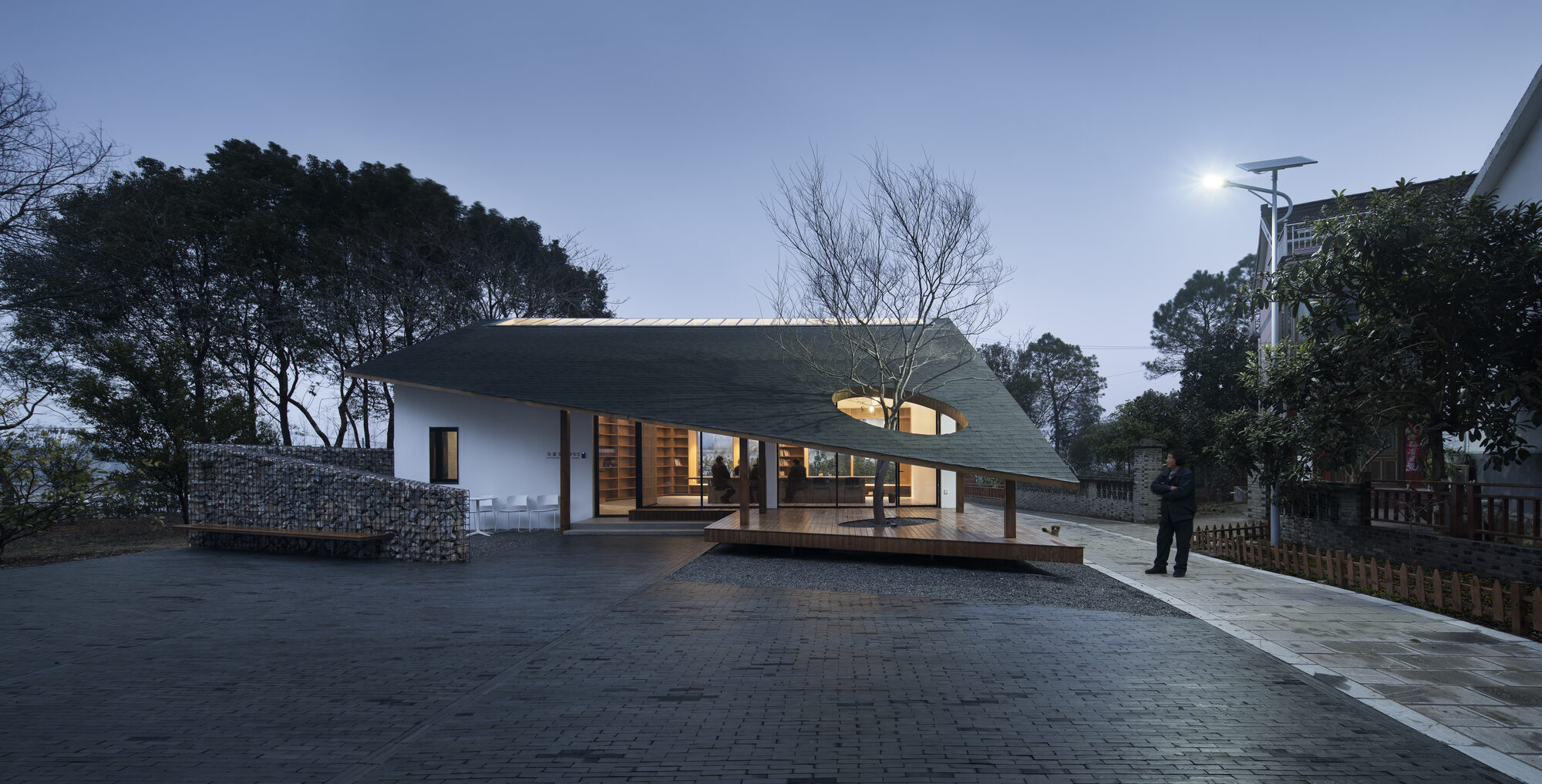
The project is defined by its expressive roof composition, where overlapping pitched forms and deep overhanging eaves generate a sequence of semi open spaces around the building. The roof becomes both architectural language and social infrastructure, extending beyond enclosure to create shaded areas that encourage gathering and everyday interaction.


Irregular roof geometries carve out voids between interior and exterior, dissolving the boundary between building and site. These transitional spaces allow the activity building to operate less as an isolated object and more as an extension of village life itself.


Openings inserted into the roof introduce natural light deep into the interior, transforming the building into a softly illuminated communal space during the day. At night, light escaping through the roof lanterns turns the structure into a glowing beacon visible from surrounding pathways and agricultural fields.


At the center of the project, an old zelkova tree is carefully integrated into the architecture. More than a landscape gesture, the tree operates as a cultural and emotional anchor within the village. In many traditional Chinese rural settlements, mature trees historically marked the social center of communal life, functioning as places for gathering, conversation, and collective memory.
By embedding the tree within the new structure, the architects reconnect the project to this deeper rural symbolism. The canopy extends across the eaves and gathering spaces, activating the entire site while reinforcing the relationship between architecture, memory, and landscape.

Rather than acting as a monumental civic building, the MaJiaLong Village Activity Building introduces a quieter architectural strategy rooted in familiarity, openness, and participation. Through modest spatial gestures and carefully framed communal spaces, the project transforms a forgotten village edge into a new social nucleus for contemporary rural life.
Project Credit
Project Name: MaJiaLong village activity building
Location: Jiangshan Village, Gaochun Zone, Nanjing City, Jiangsu Province, China
Studio: Mix Architecture
Completion Year: 2019
Build-up Area: 102m2
Photo: Bowen Hou